
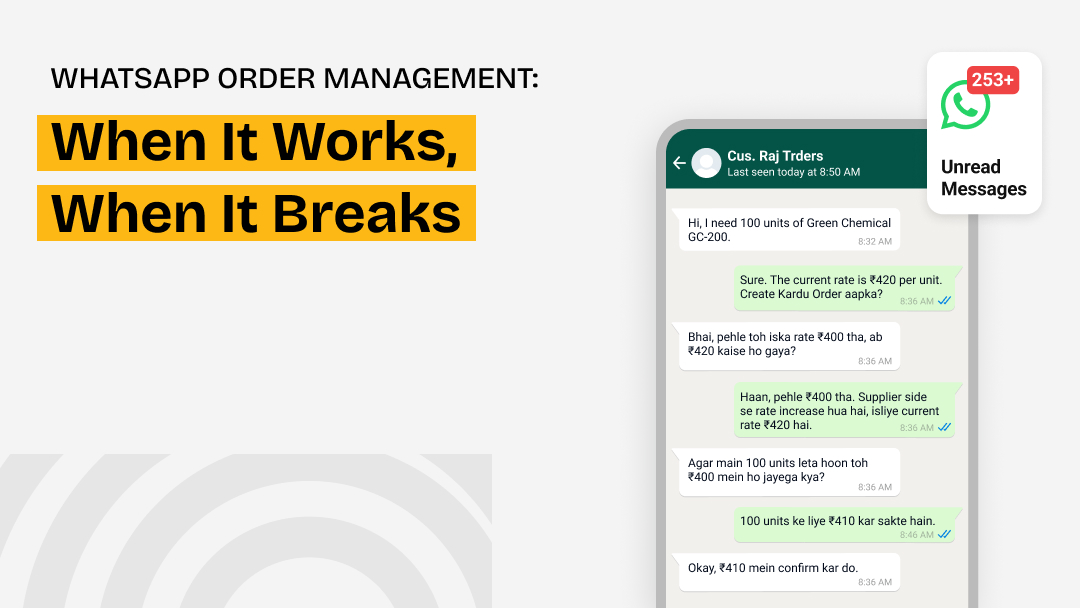
WhatsApp Order Management: When It Works, When It Breaks
An honest assessment for the Indian MSME that runs its entire order workflow through chat There is no order management software in India with more active users than WhatsApp. That is not a joke. It is the literal truth. Somewhere between 70 and 80 percent of Indian MSMEs take at least some of their orders through WhatsApp. For many, it is the only system. The dealer sends a message. The owner reads it. Someone writes it down. The order gets processed. Business happens.
And for a while, it works. That is the part nobody says out loud when they are trying to sell you software. WhatsApp genuinely works as an order channel when the business is small enough, the order volume is low enough, and the owner has enough mental capacity to hold every detail. The problems start later. Not because WhatsApp changes. Because the business does.
This piece is an honest look at both sides. Where WhatsApp order management works and why. Where it breaks and what it costs when it does. And what the realistic transition looks like for an MSME that has outgrown the chat window but is not ready for a six month ERP implementation. If you are running your business through WhatsApp right now, this is written for you, not to tell you that you are wrong, but to help you figure out whether you have hit the point where it is costing more than it is saving.
Where WhatsApp order management actually works
It is important to start here because most software companies skip this part entirely. They go straight to the problems. But WhatsApp is not stupid. Millions of Indian businesses use it for orders because it solves real problems that formal software does not always solve.
It is already on every phone
No installation. No training. No onboarding. Every dealer, every retailer, every salesperson already has WhatsApp on their phone. The friction to place an order is zero. Compare that to asking a kirana shop owner to download an app, create a login, and learn an interface he has never seen. WhatsApp wins on adoption every single time, and adoption is the thing that kills most software implementations.
It handles relationship communication alongside orders
A dealer does not just send orders. He sends complaints, asks about stock, negotiates rates, forwards payment screenshots, and occasionally sends a festival greeting. All of this happens in the same chat thread. For a business where the relationship IS the business, having everything in one place, including the informal human stuff, has genuine value. Formal OMS software separates the order from the relationship. WhatsApp keeps them together. For a lot of Indian MSMEs, that is the right trade off at small scale.
It works without internet stability
WhatsApp messages queue when connectivity drops and send when it returns. A field salesperson in a tier 3 town with patchy data can send an order from the market, and it will arrive at the office whenever the signal comes back. This reliability in low connectivity environments is something most cloud based OMS platforms struggle to match.
It costs nothing
Zero subscription. Zero per user fee. Zero implementation cost. For a business doing fifty lakh a year with fifteen dealers, the ROI calculation on paying for order management software does not always make sense. WhatsApp is free, the team already knows how to use it, and the order volume is manageable. At that scale, it is the right tool.
Where it breaks, and why
The problems do not start on a specific day. They accumulate. A missed order here. A pricing dispute there. A voice note transcribed wrong. Each one is small. The business absorbs it. Then the business grows. More dealers, more SKUs, more orders per day, more schemes to track. And the small problems that were absorbable at fifteen dealers become structural at fifty. By a hundred, the WhatsApp workflow is actively costing money. Here is where and how.
Orders get lost in the scroll
A busy WhatsApp group or individual chat can have a hundred messages by noon. Orders sit between stock queries, payment confirmations, rate negotiations, and forwards. The person consolidating orders has to scroll through everything to find the actual order messages, copy them into a register or Excel sheet, and hope they did not miss one. On a normal day, one or two get missed. On a busy day, five. Over a month, that is revenue that was demanded and never fulfilled. If you are managing orders across multiple channels without a system, this is where the first crack appears.
There is no pricing logic
WhatsApp is a messaging app. It does not know that Dealer A has a negotiated rate of Rs 92 while Dealer B pays Rs 96. It does not know that a bulk order above 500 kg qualifies for a different price tier. It does not know that the scheme expired last Tuesday. All of that logic sits in the owner’s head. When the owner processes the order, the right price goes out. When someone else does it, the wrong price goes out. And the dealer notices, even if the owner does not.
Voice notes create disputes that nobody can resolve
A dealer sends a voice note specifying quantities. Whoever transcribes it hears one number. The dealer meant another. There is no clean record of what was actually ordered. The dispute that follows is unwinnable for both sides because the evidence is a voice note that both parties interpret differently. These disputes happen weekly in WhatsApp based operations, and they cost more in relationship damage than in the rupee amount involved. This pattern is one of the most common signs that a business has outgrown manual order management.
No dispatch tracking exists
An order is placed on WhatsApp. It gets processed. Did it get dispatched? When? Was it the full order or a partial? If partial, what is still pending? WhatsApp has no concept of order status. The answers live in someone’s memory or on a notepad. When the dealer follows up asking about the pending items, the team has to reconstruct the situation from chat history and dispatch records. That reconstruction takes time, and the answer is not always accurate.
Scheme and discount application is manual every time
Every order placed through WhatsApp needs manual pricing. The team has to check which customer this is, what their rate is, whether a scheme applies, whether the scheme is still active, and whether the quantity qualifies. This process happens for every single order. At twenty orders a day, it is tedious. At fifty, it is where errors start compounding. At a hundred, it is the operational bottleneck.
There is no audit trail
When a pricing dispute happens, when a dealer says they ordered X and the invoice says Y, there is no clean record to settle it. Chat messages can be deleted. Voice notes are ambiguous. Forwarded orders lose context. The absence of an audit trail means every dispute is resolved through argument rather than evidence, and the person with less power in the relationship usually absorbs the cost. This is the hidden tax of WhatsApp order management, and it grows with every dealer added to the book. Read more about how manual systems create these hidden costs.
What the breaking point actually costs
- Most MSMEs running on WhatsApp do not track these costs because each individual incident looks small. Here is what the numbers look like when you add them up across a year.
- Missed orders from chat scroll: 1 to 3 percent of monthly order value, depending on volume
- Pricing errors from manual application: 1 to 3 percent of revenue on customer specific pricing mistakes
- Voice note disputes and corrections: 2 to 4 hours per week of the owner’s time, plus relationship cost
- Partial dispatch tracking failures: 2 to 4 percent of order value sitting in untracked pending status
- Scheme errors from manual checking: 1 to 2 percent margin leakage, higher in FMCG where schemes are complex
- Audit trail gaps: unquantifiable in rupees, but the single biggest source of dealer trust erosion over time
For an MSME doing two to five crore in annual revenue with fifty or more dealers, the combined WhatsApp tax sits between 5 and 10 percent of margin. For a five crore business, that is twenty five to fifty lakh rupees a year. Most of it invisible. Most of it preventable. For a deeper breakdown of these costs by industry, see the order management problems faced by Indian MSMEs.
What does not work as a WhatsApp replacement
Before talking about what does work, it is worth clearing out the options that sound reasonable but fail in practice for most Indian MSMEs.
WhatsApp Business API with chatbots
Some companies pitch automated order taking through WhatsApp Business API. A chatbot asks the dealer what they want, captures the order, and routes it to the system. In theory, this keeps the familiar WhatsApp interface while adding structure. In practice, Indian B2B dealers do not want to talk to a bot. They want to talk to a person. The adoption rate on WhatsApp chatbot ordering in traditional B2B is extremely low. The dealers who are comfortable with technology are comfortable with an app. The ones who are not will not use a chatbot either.
Moving everything to email or web portal
This solves the audit trail problem but kills the adoption advantage. A dealer who sends WhatsApp messages twenty times a day will not open a web portal to place an order. The friction increase is too high. Email is slightly better but creates a different consolidation problem, and most field salespeople do not use email for order communication.
Full ERP
ERP solves everything in theory and nothing in practice for most MSMEs. The implementation takes months, costs lakhs, requires IT support, and the team that was comfortable on WhatsApp is now staring at a screen with twenty modules they will never use. Most MSME ERP implementations stall or get abandoned within the first year. The jump from WhatsApp to ERP is too large.
What actually works as the next step after WhatsApp
The transition that actually sticks for Indian MSMEs is not WhatsApp to ERP. It is WhatsApp to a purpose built order management system that is as easy to use as WhatsApp but adds the structure that WhatsApp cannot provide.
That means a few specific things.
- The team should be able to learn it in a week. Not a month. Not with a consultant. In a week, using their own phones.
- Orders from all channels, including WhatsApp messages that the team enters manually, flow into one place with one status for each order.
- Customer specific pricing applies automatically. The billing team does not need to remember rates.
- Partial dispatch tracking is built in. Pending items do not get lost on a notepad.
- The owner can see the full picture, orders, dispatches, credit positions, without being the person who processes every transaction.
Biizline is built for exactly this transition. It is designed for the Indian MSME that has outgrown WhatsApp and Excel but does not need or want a full ERP. The interface works on mobile. The team can learn it in days. Hindi and Gujarati are supported. Customer specific pricing, trade schemes, partial dispatch tracking, and dealer credit visibility are core features, not add-on modules. And Tally integration means the accounting workflow does not change.
The key features are designed around the specific problems that WhatsApp creates: scattered order intake, manual pricing, no dispatch tracking, no audit trail. Each one is addressed at the system level so the fix holds even when the owner is not personally watching every order.
The transition from WhatsApp to a structured OMS takes weeks, not months. Most businesses report that the team adapts within the first week because the interface is designed around the workflow they already know. The difference is that the workflow now has structure, and the structure holds the discipline in place even as the business grows.
MSMEs across plastics, FMCG, hardware, electrical, auto parts, and food wholesale have made this exact transition. See what they say about the switch.
How to know when it is time to switch from WhatsApp to a proper Order Management System
Not every MSME needs to switch right now. WhatsApp works at small scale and there is no shame in using it until it stops working. Here are the signals that it has stopped working.
- You are missing one or more orders per week because they got buried in chat messages.
- A new team member cannot process orders without calling the owner for rates.
- Pricing disputes with dealers happen more than twice a month.
- You cannot tell the full dispatch status of any order placed three days ago without checking with multiple people.
- Your credit exposure across dealers is a number you only see at month end.
If three or more of these are true, the WhatsApp workflow is now costing more than a proper system would. The transition is simpler than most MSMEs expect, and the margin recovery starts in the first quarter.
Frequently asked questions
Can WhatsApp work as an order management system?
At a small scale, yes. For an MSME with under twenty dealers and simple pricing, WhatsApp handles order communication adequately. Beyond fifty dealers, or when pricing becomes customer specific and schemes get complex, WhatsApp creates more problems than it solves. It is a communication tool, not an order management system.
What are the biggest problems with WhatsApp order management?
Lost orders from chat scroll, no pricing logic, voice note disputes, no dispatch tracking, manual scheme application, and no audit trail for dispute resolution. Each one is small individually. Together they cost 5 to 10 percent of margin for an MSME doing two to five crore in revenue.
Is WhatsApp Business API a solution for B2B ordering?
In theory, chatbot based ordering through WhatsApp Business API adds structure while keeping the familiar interface. In practice, Indian B2B dealers do not engage with chatbots for order placement. The adoption rate is very low. Dealers who are comfortable with technology will use an app. Those who are not will not use a chatbot.
What is better than WhatsApp for B2B orders?
A purpose built B2B order management app that is as easy to use as WhatsApp but adds pricing logic, dispatch tracking, audit trails, and customer specific rates. The jump should be WhatsApp to OMS, not WhatsApp to ERP. The latter is too large a transition for most MSMEs and most implementations stall.
How long does it take to switch from WhatsApp to an OMS?
For a well designed MSME focused OMS like Biizline, the transition takes one to two weeks. The team learns the interface in the first week. Orders start flowing through the system alongside WhatsApp initially, then WhatsApp becomes the communication channel and the OMS becomes the order channel. Most businesses report full adoption within the first month.
Will my dealers accept a new ordering system?
Most dealers do not need to change anything. The dealer can continue sending orders through WhatsApp or phone. The change happens at the desk, where the team enters the order into the system instead of into an Excel sheet. The dealer’s experience does not have to change for the wholesaler’s backend to improve.