
Updated on
From Polymer Rate Lag to SKU Errors: Where Plastic Orders Go Wrong
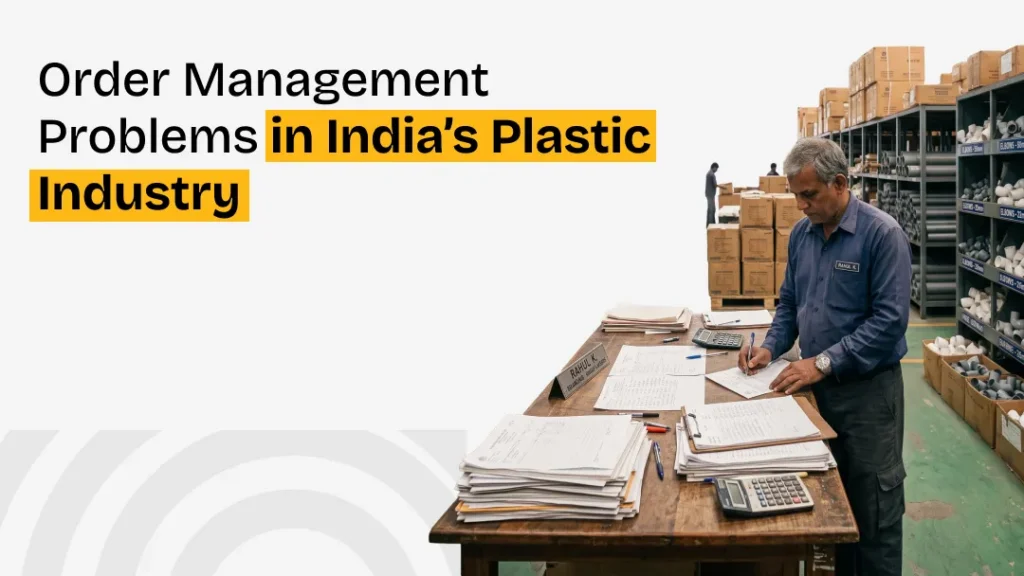
What MSME manufacturers and polymer traders need to understand about the operational layer eating their margin and recommended tool for order management
In one of the recent conversations, our founder Mohit came across this story from a fittings manufacturer in Ahmedabad. He added 40 new dealers last year. Revenue went up by roughly 30% but the profit went up by only 8%. Surprisingly, the owner could not figure out where the gap was coming from. Raw material costs were stable and pricing was also competitive. The team was working harder than ever. So where did the other 22 percent of growth go?
We figured that it went into the space between how the business takes orders and how it should take orders. Into a billing desk quoting polymer rates from three days ago because the price list had not been updated. Into a dispatch error on a pipe variant that looked right on the order form but was wrong in the godown. Into a partial shipment that was supposed to go out next week but sat in a pending list nobody checked. Into a dealer dispute about a negotiated rate that was never documented anywhere.
None of these problems showed up on a profit and loss statement. Each one was too small to flag individually. But added together, across twelve months and forty dealers, they were the entire margin gap. And this particular manufacturer is not unusual. It is the norm. The Indian plastic processing sector has roughly thirty thousand operating units, 85 to 90 percent of them MSMEs, and the operational friction they absorb every year sits between 8 and 15 percent of theoretical margin. This piece is about where that friction comes from, why it persists, and what it takes to fix it.
Why plastic order management is a category of its own
Not all B2B order management is the same. A hardware wholesaler’s problems are different from an FMCG distributor’s, and both are different from what a plastic processor faces. Three things make plastics uniquely difficult, and understanding them matters because they explain why tools that work in other industries break here.
SKU variants run in five or six dimensions
A single product in a plastic processor’s catalogue can vary by polymer grade, colour, size, wall thickness, pack count, and custom specification. Five base products become forty variants once you account for all the combinations. A fittings manufacturer with a hundred base products is actually managing six or seven hundred line items. When the order form says 25mm schedule 40 white and the billing desk enters 25mm schedule 80 white, both items exist in the godown, both look similar on the shelf, and the error travels all the way to the dealer’s counter before anyone catches it.
Pricing moves faster than the price list
Polypropylene, PVC, HDPE all move on international benchmarks. A processor buys resin at one rate on Monday, and by Wednesday the market has shifted. That shift needs to reach every dealer’s quoted price immediately. For most processors, the update happens through a revised Excel file that is perpetually a day or two behind reality. The problems with running orders through Excel are well documented, but in plastics the issue is sharper because the frequency of rate changes is higher than in almost any other B2B category.
The customer base has conflicting needs
A single plastic manufacturer may sell to bulk project dealers at one rate, retail traders at another, government procurement at a third, and FMCG packaging buyers at a fourth. Each customer type has a different pricing logic, different documentation expectations, and different credit terms. Running all four through one informal system, which for most processors means the owner’s memory and a shared WhatsApp group, is where the cracks start.
Five problem areas and what they actually cost
1. Pricing inconsistency: the largest and least visible leak
This is where the biggest margin loss sits. And it is the hardest one to see because it does not look like a loss. It looks like normal business.
The first layer is rate lag. Polymer prices shift on Tuesday. The processor’s Excel price list gets updated on Thursday. During those two days, every quote going out is at stale rates. On a monthly volume of ten crore, a fifty paisa per kg lag is not rounding error. It is lakhs of rupees in margin that simply vanished between the rate change and the price list update.
The second layer is negotiated pricing. Most processors have ten to forty dealers with individually agreed rates. These agreements were made through conversations over the last year, sometimes documented in a notebook, sometimes just remembered. When the owner is at the billing desk, the right rate goes out. When a new team member handles the invoice, the standard rate goes out instead. The dealer notices. Sometimes immediately, sometimes a month later when they reconcile invoices. Either way, the relationship takes a hit that is disproportionate to the rupee amount involved.
Then there are the bulk tier errors. A dealer ordering 800 kg qualifies for tier 2 pricing but gets billed at tier 1 because nobody checked the slab. An advance payment discount gets forgotten. A seasonal adjustment does not get removed after the season ends. Each error is a few hundred or a few thousand rupees. Industry estimates place the total pricing leak at 1 to 3 percent of revenue for a manual operation.
2. Order intake: five channels, zero structure
WhatsApp from one dealer. A phone call from another. An Excel attachment from a third. A broker’s handwritten chit from a fourth. Every morning, somebody at the desk rebuilds the day’s order book from these fragments. On a normal day, one order gets missed or entered wrong. On a busy day, three. For processors still managing multiple orders without a system, this reconstruction is the first operational task of the day, and it starts the day with a deficit.
The more expensive problem is not the missed order. It is the misentered one. A wrong colour variant. A schedule 40 logged as schedule 80. The correct product in the wrong size. These errors do not get caught at the billing desk because both items exist in inventory and the order looks plausible. They get caught at the dealer’s end, after the truck has left, after the dealer has opened the package, after the installation has failed or the wrong product has been counted into stock. The return, the second dispatch, the phone call, all of it costs more than the original margin on the order.
Timing is the third dimension. A field salesperson takes an order at 11 AM. Without a way to log it from the field, the order reaches the desk at 6 PM when the salesperson returns. Dispatch planning is already done. The order either misses the next morning’s cycle or requires a last minute change that disrupts the loading plan. The dealer does not know why their order was late. They just know it was.
3. Inventory blind spots: promising what you do not have
A salesperson commits to dispatching 1,500 kg by Thursday. They assume stock is there. The assumption is wrong. By Wednesday, the team discovers that 600 kg was already committed to a different order placed the same morning by someone else. Now there are two dealers expecting full delivery and only enough stock for one.
This happens because sales and the godown do not share a real time view. The godown knows physical stock. Sales knows committed orders. Neither knows what the other has done in the last two hours. The result is regular overcommitment, followed by difficult phone calls, followed by a slow erosion of the kind of reliability that keeps dealers loyal.
Partial dispatch adds a second layer. Seven out of ten items ship. The remaining three get a verbal promise for next week. The promise lives in someone’s head or on a notepad that gets buried under new paperwork by Friday. Two weeks later, the dealer calls asking about the balance. The team scrambles. The trust erosion is small but cumulative, and over a year of these incidents, it changes which dealer gives you their first call and which one calls you second, after trying someone else.
Industry estimates put lost volume from commitment blind spots at 2 to 4 percent of monthly throughput. That is the volume you already had and gave away through poor visibility.
4. EPR and compliance: records exist, access does not
Two years ago, EPR was annual paperwork. Today, documentation has shifted to monthly tracking. State pollution control boards are running verification audits. And the gap between what a processor’s EPR registration says and what they actually produced is beginning to attract real attention, with real penalties.
Most processors are not non compliant in the deliberate sense. They have batch numbers, supplier certificates, and dispatch logs. The problem is that these records sit in five different places. A notebook for batch numbers. An email folder for supplier certificates. Excel for dispatch logs. A third system for EPR returns. When a state board auditor asks for traceability from raw material to dispatched product for a specific category, the reconstruction takes two to three days. An unannounced audit does not wait two days.
For processors supplying packaging to FMCG brands, the pressure is still higher. Brands like HUL, Dabur, and Marico now require batch level documentation from their packaging vendors. Not as a best practice suggestion. As a contract requirement. The processor who cannot produce this paperwork cleanly does not lose a negotiation. They lose the conversation entirely.
5. Dealer trust: the slowest loss and the most permanent one
A pricing error does not end a dealer relationship. A wrong dispatch does not end it. A forgotten partial delivery does not end it. But a year of all three, happening intermittently, happening unpredictably, changes the shape of the relationship in ways that are invisible until they become permanent. The dealer does not leave dramatically. They just start placing their better orders with someone else, and the smaller, less profitable orders are what remains. By the time the processor notices, the shift is already six months old. If this pattern is familiar, these are the signs a business has outgrown its current order management approach.
Underneath the trust problem is a structural one. The owner who holds every dealer’s pricing, every pending dispatch, every credit position, every scheme detail in their head is operating the business as a single point of dependency. When the owner travels, decisions wait. When the owner is unwell, the business slows. Growth hits a ceiling not because demand is lacking but because the system, which is the owner’s attention, cannot scale. This ceiling typically shows up somewhere between fifty and a hundred dealers, and most processors who have crossed that line will recognise it immediately.
Adding it up: the real cost of running manually
- Pricing lag and inconsistency: 1 to 3 percent of revenue
- Variant errors and rework: Rs 50,000 to 2 lakh per month for a mid sized processor
- Commitment blind spots: 2 to 4 percent of monthly volume at risk
- Compliance exposure: variable, but state level penalties have increased sharply since 2024
- Dealer trust erosion: impossible to put a clean number on, but over three to five years, the most expensive line on this list
For a five crore processor, the combined operational friction sits between forty and seventy five lakh rupees annually. The number does not show up on a single line item. It is distributed across five different leaks, each one small enough to absorb on any given day. The cumulative cost is what most processors never calculate.
Why Excel, Tally, and full ERP do not fix the order management problems
Most processors who recognise these problems have already considered, and usually rejected, three common solutions. Worth understanding why each one falls short.
Excel is a data tool, not an order tool. It can track orders if someone maintains it carefully. It cannot apply dealer specific pricing at the point of entry. It cannot catch a variant error before the truck leaves. It cannot push rate changes across fifty dealer accounts simultaneously. And it cannot produce batch traceability on demand during an audit.
Tally is an accounting platform. It handles GST, invoicing, and financial reporting well. It does not manage order intake from multiple channels, enforce pricing logic across customer types, track partial dispatches, or catalogue SKU variants in a searchable way. Processors who try to force Tally into an order management role end up with workarounds that break every time a new requirement appears.
Full ERP covers everything from production planning to HR to CRM. Most of it is irrelevant for a mid sized processor whose core problem is the order layer. The implementation costs lakhs, takes months, requires dedicated IT support, and the processor’s actual bottleneck, which is order intake, pricing, and dispatch, is one module inside a twenty module suite. This is why most processors who evaluate ERP end up staying on WhatsApp. The gap between the problem and the proposed solution is too wide.
What a structural order management system actually does
The fix is not about digitisation for its own sake. It is about removing the five friction points described above at the workflow level, so the fixes hold even when the owner is not personally watching every transaction.
A system built for this does the following. Polymer rate updates push through to every dealer account at once, so the billing desk is always quoting the current rate. Customer specific pricing, bulk tiers, and advance payment discounts apply automatically the moment an order is entered. SKU variants are structured as defined fields (grade, colour, size, wall thickness) rather than free text, so the team selects from a list rather than typing something that could be wrong. Partial dispatch tracking lives inside the order record, not on a notepad. And batch data attaches to every order and dispatch automatically, so traceability is one search away instead of a three day reconstruction. Biizline is built around exactly these workflows for Indian plastic manufacturers and traders.
The feature set is designed for the five problem areas described in this piece. Not as modules bolted onto a generic platform, but as the core architecture of how the system works. Rate lock at order confirmation. Dealer wise pricing that applies without anyone having to remember it. Variant aware catalogues that prevent the schedule 40 versus schedule 80 mistake before it enters the system.
The cost of this transition has dropped sharply in the last two years. A processor doing three to ten crore in annual revenue can implement a proper order management system in weeks, and the margin recovery starts showing up in the first quarter. For most processors, the system pays for itself within a few months through recovered margin alone.
Processors across Gujarat and Maharashtra who have already made this switch have seen the impact firsthand. See what changed for them.
Where to start with Biizline
Fix the most expensive leak first
For most processors, that is pricing inconsistency or variant errors. Pick one. Audit it for a month. Count every correction, every rate dispute, every stale quote. Put a rupee figure on it. That number becomes the business case for everything that follows.
A simple test: ask a new team member at the billing desk to pull every dealer’s negotiated rate without calling the owner. If that is not possible, the rates are not documented anywhere that matters. They are memories. And memories do not survive a staffing change, a sick day, or a growth phase. More on how manual workflows create hidden costs for MSMEs.
India’s plastic industry is valued at over USD 47 billion and growing at 6 percent annually. Roughly thirty thousand processing units serve the market, the vast majority of them MSMEs. The growth is real. The margin opportunity is real. The question for each processor is whether their operation captures that growth as profit or absorbs it as more volume with the same thin margin. The answer lives in the order management layer. It always has.
Frequently asked questions
1. What are the biggest order management problems in the plastic industry?
Five problem areas dominate: pricing inconsistency from polymer rate lag and negotiated rate errors, order intake errors from managing multiple channels manually, stock overcommitment from lack of real time visibility, compliance documentation gaps from scattered records, and dealer trust erosion from accumulated small operational errors. Together these cost a typical plastic MSME 8 to 15 percent of margin annually.
2. Why is order management harder in plastics than other B2B categories?
Three things make it uniquely difficult. SKU variants run in five or six dimensions (grade, colour, size, thickness, pack count). Pricing moves with global polymer benchmarks, sometimes daily. And the customer mix requires different pricing logic for bulk dealers, retail traders, project buyers, and packaging customers simultaneously.
3. Can Excel handle order management for a plastic business?
Excel tracks data. It does not manage orders. It cannot apply dealer pricing automatically, validate SKU variants before dispatch, push rate changes across all accounts at once, or provide batch traceability during an audit. Beyond fifty dealers, an Excel workflow leaks margin consistently because the tool was never designed for real time order processing.
4. How much does operational friction cost a plastic MSME?
Between 8 and 15 percent of theoretical margin for a manually run operation. For a five crore processor, that translates to roughly forty to seventy five lakh rupees annually. The cost is distributed across pricing errors, variant mistakes, dispatch gaps, compliance exposure, and dealer trust erosion.
5. What is the difference between ERP and order management for plastics?
ERP covers the full business: production, HR, accounting, CRM, and more. Order management focuses on orders, pricing, dispatch, and dealer management. Most plastic MSMEs need the order layer fixed, not a full business suite. Order management software is faster to implement, costs significantly less, and addresses the specific friction points that eat margin in plastics.
6. How quickly do results show after switching to a proper order management system?
Most processors report measurable improvement in the first quarter. Pricing accuracy improves immediately because dealer rates apply automatically. Variant errors drop because selection is structured rather than free text. Partial dispatch tracking becomes reliable. The margin recovery typically pays for the system cost within the first few months.
Share this Blog