

Updated on
What Manual Order Handling Is Really Costing Your MSME

There is a version of business growth that feels less like progress and more like controlled chaos. Orders are coming in, and customers are calling. The team is busy, but at some point in the day, you, as a founder, realise that half your energy has gone into figuring out what was ordered, by whom, at what price, and where it currently stands. The energy is wasted because it didn’t go into actually running the business.
This is what order management problems look like in practice for most growing MSMEs: a slow, steady drain on time and attention that gets harder to ignore as you add more customers.
If you want a fuller picture of how B2B order management should work as your business scales, the complete B2B order management guide for MSMEs covers the foundation well. What follows here is more specific: the individual failure points that catch most businesses off guard.
What Manual Order Management Actually Looks Like Day to Day
Ask most MSME founders how orders are managed, and you will hear the same story. A customer calls, sends a WhatsApp message, or leaves a voice note. Someone on the team listens, writes it down somewhere, and the order enters a loose chain of coordination that depends almost entirely on people remembering things correctly and passing information along without losing anything.
At a small scale, this works. People know the customers, remember the prices, and can hold most of it in their heads. The informal system is fast and flexible, which are real advantages.
The problem is that this system has a ceiling. And for most businesses, that ceiling arrives long before they expect it.
Two major problems with manual order management
1. The Channel Problem
Orders arrive wherever the customer feels comfortable. A phone call from one buyer, a WhatsApp voice note from another, an email from a third. Some customers send images of handwritten lists. Each channel requires someone to manually consolidate the details, and each consolidation is an opportunity for something to get lost or recorded incorrectly. There is no single place where all of it sits together.
2. The Memory Problem
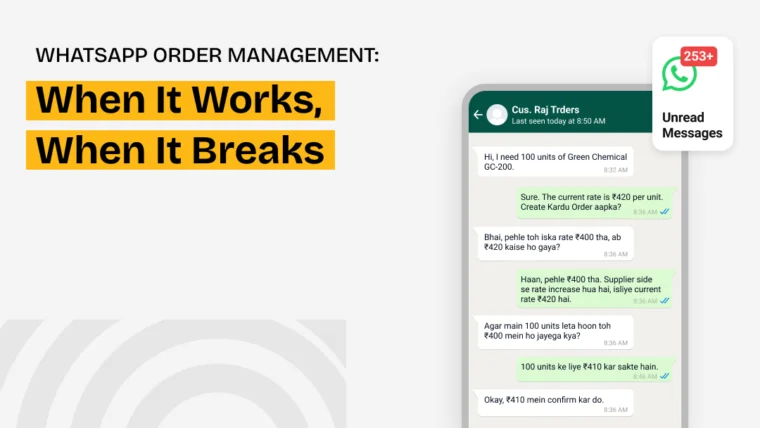
Pricing in the Indian B2B trade is rarely uniform. Different customers get different rates, based on order volume, payment terms, and the history of the relationship. A lot of that pricing logic lives in someone’s memory or is buried in an old chat thread. It works until the person who holds that knowledge is unavailable. Or until they remember it slightly wrong. Either way, the result shows up as a problem later.
The Five Order Management Problems That Cost MSMEs the Most
These are not edge cases. They are the everyday failures that come with managing orders manually across a growing customer base. Each one is predictable. Most of them are preventable.
1. Orders That Get Recorded Wrong From the Start
A customer leaves a voice note. Someone listens and writes it down, but gets one quantity wrong, or misses an item, or the note gets buried under forty other messages before anyone gets back to it. By the time the error surfaces, the customer is already waiting on a delivery that was never properly recorded.
This is not about carelessness. It is what happens when order placement has no structured format, and every channel introduces its own room for error. Order tracking issues start at the very beginning, before the order reaches the team.
2. Pricing Errors That Nobody Catches Until It Is Too Late
Customer A gets a special rate because they pay in advance. Customer B gets a bulk discount above 200 units. Customer C is an older client with a negotiated price from six months ago, agreed over a phone call and never formally written down anywhere. All of this pricing logic lives in someone’s head or scattered across old chat threads.
When a new team member handles an order, or when the usual person is unavailable, the wrong price goes out. Sometimes the customer catches it. More often it does not surface until month end, when the margin numbers look off and no one can quite trace where the leak came from.
This is a pattern that comes up often in conversations among MSME owners on forums and trade communities. The informal pricing system that works fine with ten customers becomes a recurring source of billing mistakes in business once that number reaches fifty or more.
3. Inventory Commitments Made Without Knowing Stock Levels
A customer asks if you can deliver 500 units by Thursday. Sales says yes, based on a rough sense of what is probably in stock. Operations finds out about the order two days before the deadline. The inventory mismatch problem is already in motion before anyone realizes it.
The scramble to fulfill it either costs margin, sourcing from an alternate supplier at a higher cost, or costs trust, telling the customer it will be late. Neither outcome is good. And both were preventable if the stock position had been visible when the commitment was made.
4. Delayed Deliveries That Could Have Been Avoided
When dispatch planning runs on urgency rather than a visible order queue, the loudest customer gets attention first. Orders placed earlier by quieter customers wait. Delayed order delivery, in many cases, has nothing to do with logistics. It is simply the result of a team that cannot see what is coming and plans accordingly.
Nobody intends for this to happen. It is just what occurs when there is no structured view of what orders are in progress, where they stand, and what needs to go out when
5. Billing Mistakes That Create Disputes and Erode Trust
By the time invoicing comes around, the agreed price is somewhere in a WhatsApp thread from three days ago. The delivered quantity might differ slightly from what was originally ordered.
Accounts has to reconstruct the transaction from messages, notes, and memory. Billing mistakes in business of this kind are not dramatic. They are quiet and frequent. And each one puts a small strain on the relationship.
B2B relationships run on trust. When a customer repeatedly has to question an invoice, that trust gets thin. And by the time it breaks, the business has usually already lost the relationship without realising when it started going wrong.
What These Problems Actually Cost Beyond the Obvious
The direct costs are visible enough. Wrong pricing, missed orders, delayed deliveries. Those show up in the numbers eventually, even if it takes a while to trace them back to their source.
The indirect costs are harder to see and probably more significant.
In most growing MSMEs, there is one person, usually the founder or a senior operations person, who holds everything together. They know which customer has a special rate, where the current dispatch plan stands, and which supplier is reliable for urgent orders. They are, in practice, the system. When they are unavailable, decisions wait. Orders sit. Things slow down or stop entirely.
This is not sustainable past a certain scale. And most founders are aware of it. They just rarely know what to replace it with.
There is also the growth cost. Many business owners hold back from taking on new customers, entering new markets, or adding new SKUs because the backend already feels stretched. The manual system is not just costing a margin today. It is limiting what the business can become.
This is the pattern that shows up consistently in growing Indian MSMEs, and it is worth reading about in more detail. The breakdown of why growing MSMEs struggle with orders even when sales are strong covers this in depth.
Why Adding More People or Tools Does Not Fix the Problem
The first response most businesses have when coordination starts breaking down is to add something. Hire an extra person to manage orders. Add a CRM for the sales team. Create a new WhatsApp group for dispatch updates. Build a better spreadsheet.
All these efforts are genuine but they only tend to the symptom rather than the cause. The underlying issue is that the information lives in different places, which is why adding more people isn’t gonna solve it.
The system is fragmented, so adding more communication on top of it increases the coordination load without reducing ambiguity. The WhatsApp group fills up with messages. The shared spreadsheet has version conflicts. The new hire spends most of their time chasing updates rather than resolving them. And the founder, or whoever is at the centre of the coordination effort, gets increasingly stretched.
Research on small business operations consistently shows that manual data re-entry between disconnected tools is one of the largest sources of operational waste in growing businesses. The problem is not the individual tools. It is the gaps between them.
What is actually missing is a connected flow. An order placed at one end automatically reaches everyone who needs to act on it, without anyone having to manually pass the information along. That is what an order management system for a small business is supposed to do. Do not add features, but remove the gaps between the parts that already exist.
What a Proper Order Management System for Small Business Should Actually Do
The solution is quite simple, and it requires a fundamental shift in how orders are captured and shared across the business
- Orders enter once. The customer places an order and it is immediately visible to sales, operations, dispatch, and accounts. No relay, no duplicate entry, no version conflicts
- Pricing applies automatically. Customer-specific rates, bulk tiers, and advance payment discounts are set once in the system and applied whenever a matching order comes in. The agreed price is always tied to the order record.
- Stock is visible before committing. Before a delivery date is confirmed, the system reflects current inventory levels. Overselling stops before it starts.
- Order status is visible without anyone asking. As the order moves from confirmed to processing to dispatched, the customer can see that progression. Follow-up calls decrease without anyone managing that reduction.
- Every change is logged. Modifications, price adjustments, delivery date changes, all recorded with a clear reference. When disputes come up, and they always do eventually, they get resolved quickly
This is where Biizline fits into the picture. It’s an order management software for Indian businesses (please note that it’s not an ERP, not a marketplace, not a generic SaaS tool). It is built specifically for how Indian MSMEs actually operate: relationship-driven, with negotiated pricing, informal communication, and variable order volumes. The system formalises what arises from those relationships without disrupting them.
When a customer places an order through Biizline, both parties see the same record. Pricing is locked in at that moment. Inventory levels are reflected. Status is visible as the order moves forward. And when it is time to invoice, the operational data is already clean.
Signs Your Order Management Has Outgrown Your Business
If most of the following sound familiar, the problem is structural rather than operational. Hiring more people or working longer hours will not solve it.
- You personally verify orders before dispatch because you do not fully trust the handoff
- The same questions come up every week: where is this order, what price was agreed, and did the customer confirm
- New team members take weeks to get up to speed because nothing is properly documented
- When one key person is unavailable, decisions wait and things slow down noticeably
- You are hesitant to take on more customers because the backend already feels stretched
- Reporting means someone manually pulling data from multiple places
Most MSME founders hit this wall somewhere between 30 and 80 customers. It is not a sign that the business is failing. It is a sign that the system has not kept pace with the growth that has already happened.
Final Thoughts: The Quiet Cost Compounds Over Time
Manual order management is not a catastrophic failure mode. It is a slow one. Orders get slightly wrong, prices get occasionally misapplied, and deliveries get delayed by a day or two. None of it feels urgent enough to fix right away. And so the informal system stays long past the point where it actually works.
The cost accumulates quietly. In margin leakage that never gets traced back to its source. In customer relationships that get a little thinner each time an invoice needs to be questioned. In growth that does not happen because the backend feels too unstable to build on.
The shift to a structured order management system is not about adopting technology. It is about building something the business can actually grow on. The relationships, the negotiations, the trust built over the years, those stay. What changes is the operational layer underneath them. Orders get captured properly, pricing gets applied consistently and order status gets communicated without someone having to chase it.
See how other MSME owners are using Biizline to manage this transition.
Share this Blog






3 comments