
Updated on
Pricing Chaos to Credit Blind Spots: Order Issues in Hardware Wholesale
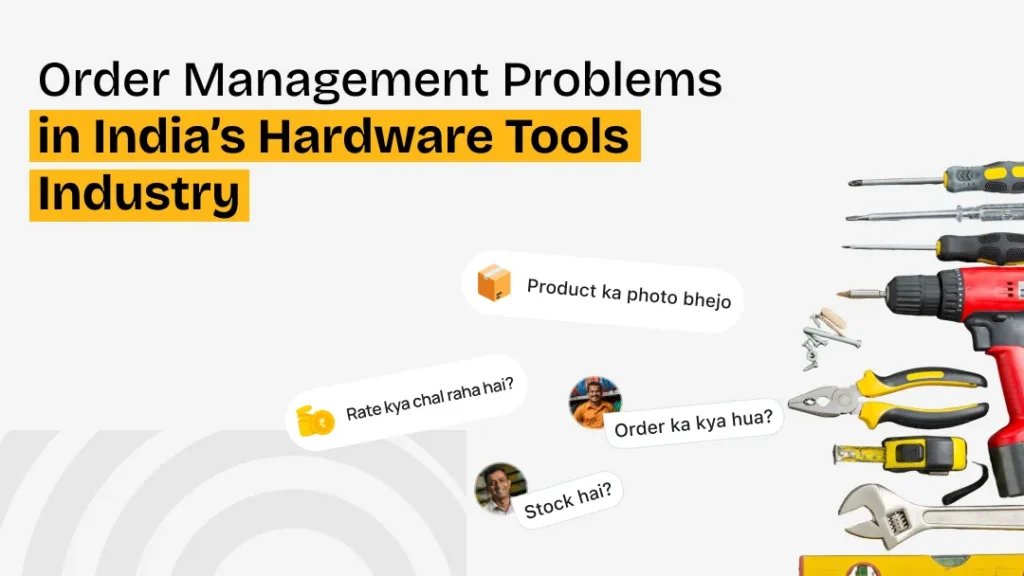
What every wholesaler should know about the operational friction sitting underneath a growing business
More than half of all sales in the Indian hardware business happen on credit. That is not a rough estimate. Ask any wholesaler in Chawri Bazaar or on Ahmedabad Ring Road and they will tell you the same thing. Plumbers buy on credit. Electricians buy on credit. Contractors buy on credit and then pay when the project payment comes through, which could be thirty days from now or ninety. The entire business runs on a credit cycle that has been stretching longer every year.
Now layer the rest of the operation on top of that credit reality. Eight to fifteen brands, each with its own price list. Pricing that changes when the brand sends a WhatsApp message that nobody opens for a week. SKU variants across hand tools, power tools, fasteners, and furniture hardware that run into thousands of line items. And the whole thing is managed by a team of three or four people through phone calls, memory, and a set of Excel files that are always a few days behind.
A hardware wholesaler whose revenue is growing at 15 percent and whose profit is growing at 4 percent is probably not losing the gap to competition. The gap is sitting inside the operation itself. In the rate that went out wrong because the latest price list was still unopened. In the partial dispatch that was promised for next week but forgotten by Friday. In the dealer credit that stretched to ninety days because nobody was tracking it until the month end report. The combined cost of this operational friction, based on what wholesalers across India’s major hardware clusters report, sits between 6 and 10 percent of margin annually. This piece breaks down where it comes from.
What makes hardware order management uniquely messy
Multi brand complexity is the default condition
A typical hardware wholesaler carries 8 to 15 brands. Bosch, Makita, Stanley, Hettich, Hafele, Godrej Locks, Hilti, DeWalt, Ebco. Each one has its own pricing structure, its own dealer programme, its own scheme logic, its own minimum order quantities. In FMCG or food distribution, the pricing logic across brands is broadly similar. In hardware, every brand operates on different rules. Managing that variability is the core operational challenge, and it starts the moment you add a sixth brand to the portfolio.
SKU sprawl across sub segments
Could be anything from Hand tools, Power tools, Fasteners, Furniture hardware, Locks or Architectural fittings. Each sub segment has its own variant logic. A furniture hinge comes in six sizes, three finishes, and two load ratings. A fastener comes in a hundred specifications. A wholesaler carrying products across three sub segments may be managing four to five thousand line items, and the order tracking tools most of them use were designed for a fraction of that catalogue.
Credit as a way of life
Hardware credit cycles have stretched from 30 to 45 days a few years ago to 60 to 90 days now in many relationships. The wholesaler is financing the dealer’s business for three months while paying suppliers on much shorter terms. That working capital squeeze is the single biggest pain in hardware wholesale, and it is made worse when the wholesaler cannot see their credit position clearly in real time.
Five problem areas draining hardware wholesale margins
1. Brand price lists go stale before they reach the billing desk
Bosch revises in March. Hettich in April. Stanley sends a new scheme by email on a Tuesday that the team opens on the following Monday. Between the revision and the update, every quote going out is wrong. Some are too low, eating margin. Some are too high, losing the order to the shop next door that updated faster.
For a wholesaler carrying ten brands, price list maintenance is a continuous background task that never actually gets finished. By the time all ten are current, the first one has changed again. The team at the billing desk is unknowingly quoting from a patchwork of dates. Brand A’s prices are from this week. Brand B’s are from three weeks ago. Brand C’s scheme expired last Friday but is still being applied. The margin leakage from this patchwork is invisible on any single transaction but adds up to 1 to 3 percent of revenue over a year.
2. Customer rates exist only in the owner’s memory
A long standing dealer has a special rate negotiated over the phone eight months ago. A contractor who buys in bulk every quarter has a different arrangement. A new account that the owner wanted to give a discount to as a relationship builder has a third rate that was never written down. All of these live in the owner’s head.
When the owner is at the desk, the right rate goes out. When the owner is travelling, or when a new team member handles the billing, the standard rate goes out. The dealer notices, sometimes immediately, sometimes during monthly reconciliation. The conversation that follows is never about the two percent difference on one invoice. It is about whether the wholesaler’s operation can be trusted to get it right consistently. That trust, once questioned, is expensive to rebuild. This is exactly the kind of problem that manual order management creates.
3. SKU lookup eats hours every day
A dealer calls and asks for a specific furniture hinge. Hafele, 35mm cup, soft close, nickel finish. The wholesaler has it. Somewhere. Finding it in the godown, confirming the exact specification, and quoting the right rate takes eight to ten minutes. The dealer is already on the phone with the next supplier.
Now multiply that across twenty such enquiries in a day. That is nearly three hours of the team’s time spent on lookup alone. Not selling. Not dispatching. Not managing credit. Just finding things and quoting prices. For a wholesaler carrying furniture hardware alongside general tools, this SKU lookup tax is one of the largest hidden costs in the operation. And it gets worse as the catalogue grows, because every new brand adds another layer of variants to search through.
4. Partial dispatch tracking lives on a notepad
The dealer orders fifteen items. The wholesaler has twelve in stock. Twelve get dispatched with a verbal promise to send the remaining three by next week. The promise gets written on a notepad, or not written at all. Two weeks later, the dealer calls asking about the balance. The team scrambles. The notepad has been buried under new paperwork. Nobody can say with confidence whether the remaining items were dispatched, are still pending, or were cancelled.
In hardware, where multi item orders across multiple brands are the norm rather than the exception, partial dispatch is not an edge case. It is the majority of orders. And tracking partials through verbal commitments and notepads is the most common cause of the quiet trust erosion that eventually costs dealer accounts.
5. Dealer credit positions are visible only at month end
The wholesaler does not have a clear, current view of which dealer is at 30 days outstanding versus 75 versus 120 until the accountant runs the report at month end. By then, the credit decisions for the next month have already been made on instinct. Some dealers get more credit than they should. Others get refused and feel slighted. The wholesaler sitting on crores in outstanding receivables is making daily credit decisions based on rough memory rather than actual data.
In a business where more than half the revenue moves on credit, this blind spot is arguably the most expensive one on the list. Not because of any single bad credit decision, but because every credit decision made on instinct rather than data carries a risk premium that the wholesaler cannot see and cannot manage.
What it costs, in numbers
- Price list staleness and scheme errors: 1 to 3 percent of revenue
- Customer pricing mistakes: 0.5 to 1 percent of revenue in absorbed corrections and trust cost
- SKU lookup time: 2 to 3 hours daily across the team, equivalent to one full team member’s output
- Partial dispatch tracking failures: 2 to 4 percent of monthly order value in pending limbo
- Credit blind spots: working capital tied up 15 to 30 additional days versus a visible credit system
For a three crore wholesaler, the combined operational friction sits between eighteen and thirty lakh rupees annually. The number hides across five different places and never appears on a single line item.
Why the usual tools do not solve this
Excel tracks brands and prices, but it cannot apply the right price automatically when a dealer places an order. It also cannot track which price list version the team is working from today versus which one should have been updated last Tuesday.
Tally handles accounting and GST. It does not manage order intake from five channels, enforce brand specific scheme logic, track partial dispatches, or give a real time credit position per dealer.
Full ERP is designed for manufacturers, not wholesale operations. Most of the modules are irrelevant, the implementation takes months, and the cost is out of proportion to a wholesaler’s actual problem, which is the order layer, not the production floor.
What a structural fix looks like
The fix is a system built around how Indian hardware wholesale actually works. Multi brand price lists that update when the brand updates, not when someone remembers to open the email. Customer specific rates that apply automatically at the billing desk regardless of who is processing the order. SKU search that takes seconds, not minutes. Partial dispatch tracking inside the order record rather than on a notepad. And dealer credit positions visible at any moment, not just at month end. Biizline is built for exactly this kind of MSME wholesale operation.
The feature set handles the multi brand pricing complexity and scheme logic that generic software treats as edge cases. For a hardware wholesaler, these are not edge cases. They are the core of daily operations. Rate lock at order confirmation. Brand wise scheme application. Dealer credit dashboard. SKU search across variants. All of it designed for the Indian wholesale workflow rather than adapted from a generic B2B template.
The implementation takes weeks, not months. Most wholesalers see measurable improvement in the first quarter. The pricing accuracy alone typically recovers enough margin to cover the cost of the system within the first few months.
Hardware wholesalers across Ahmedabad, Delhi, and Rajkot have already made this transition. See what changed for them.
Where to start
Pick the most expensive leak. For most hardware wholesalers, that is either the price list staleness across brands or the dealer credit blind spot. Audit one for a month. Count every quote that went out at the wrong rate. Count every credit decision made without checking the actual outstanding. Put a number on it. That number is the case for everything that follows.
A simple test: can a new team member at the billing desk pull the current price for a Hettich soft close hinge and the negotiated rate for Dealer X without asking the owner? If the answer involves a phone call or a guess, the operation has a single point of dependency that limits how far the business can grow. Read more about how manual systems create hidden operational costs.
India’s hardware market is valued at over USD 20 billion and growing at 5 percent annually. The furniture hardware segment alone is growing at 12 percent. The market is expanding. The question for every wholesaler is whether their operation captures that growth as profit or absorbs it as more chaos with the same thin margin. The answer is in the order management layer. It always is.
Frequently asked questions
What are the biggest order management problems for hardware wholesalers?
Multi brand pricing staleness, customer specific rates living in the owner’s memory, SKU lookup time across sub segments, partial dispatch tracking through verbal commitments, and dealer credit blind spots. Together these cost a typical hardware wholesaler 6 to 10 percent of margin annually.
Why is hardware wholesale harder to manage than other B2B categories?
Three things make it uniquely complex. Multi brand pricing where every brand has different rules and different update cycles. SKU sprawls across sub segments like hand tools, power tools, fasteners, and furniture hardware. And a credit heavy business model where more than half of sales happen on credit with stretching payment cycles.
Can Excel manage a hardware wholesale operation?
Excel can track data. It cannot apply the right brand price to the right dealer automatically, enforce scheme logic across brands, track partial dispatches reliably, or give a real time view of dealer credit positions. Beyond eight brands and 200 dealers, the Excel workflow leaks margin consistently.
How much does operational friction cost a hardware wholesaler?
Between 6 and 10 percent of margin for a manually run operation. For a three crore wholesaler, that is eighteen to thirty lakh rupees annually across pricing errors, lookup time, dispatch tracking failures, and credit blind spots.
What is the difference between Tally and order management software for hardware?
Tally handles accounting and GST. Order management software handles orders, multi brand pricing, scheme application, dispatch tracking, and dealer credit visibility. They serve different functions. Most hardware wholesalers who adopt an OMS continue using Tally for billing.
Share this Blog