

Updated on
Cost vs Payoff: When Order Management Software Makes Sense for MSMEs
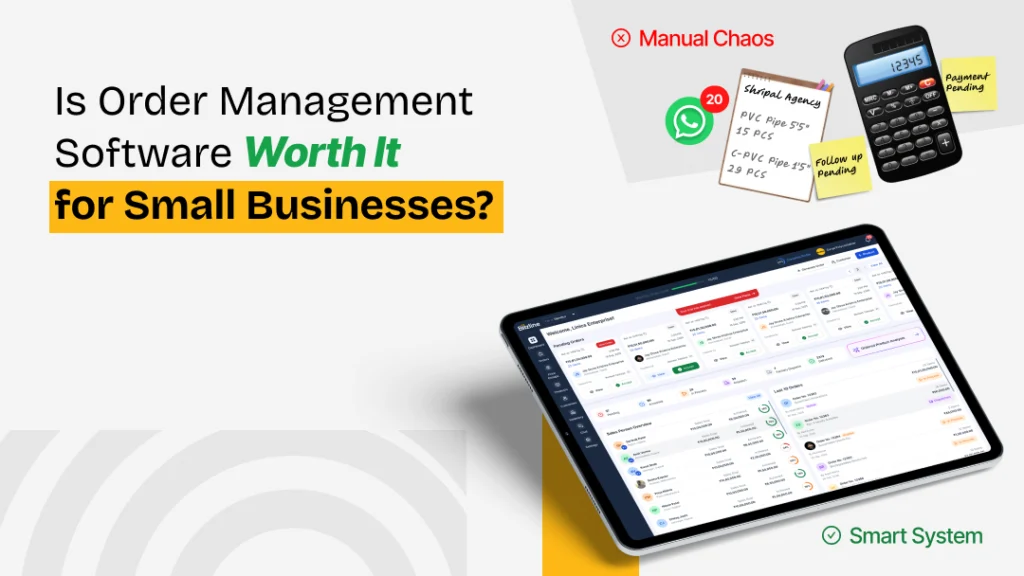
The answer depends on where your business actually is right now. When a small business owner asks whether order management software is worth the investment, they are not usually expressing doubt about technology in general. The question is more specific and more practical: is this the right moment for a business of this particular size and operational condition to make a change that will cost time and money to implement? The hesitation is reasonable. Software requires commitment, and commitment during a period of growth, when attention is already stretched, carries real risk if the timing is wrong.
The honest answer is that order management software is not universally worth it at every stage of a business. Any piece of writing that argues otherwise, without qualification, is not being straight with the reader. A business with 10 reliable customers, consistent order patterns, and one person managing the full cycle may have no genuine need for a dedicated system right now. The informal approach is still working within its range, and the investment may not generate a return that justifies the disruption.
The answer changes at a specific operational point, and understanding where that point is, and whether a particular business has already crossed it, is more useful than a blanket recommendation.
This guide walks through what small-business order management looks like in practice across the Indian MSME sector, what the informal approach costs when it operates beyond its limits, and how to assess whether those costs already outweigh the cost of a dedicated system. If you want a fuller picture of what B2B order management should look like structurally, that is worth reading alongside this guide.
The Operational Reality of Small Business Order Management in India
Before the question of software can be evaluated sensibly, it is worth being clear about what the alternative actually looks like in daily practice, because informal order management tends to feel normal to the people inside it, which makes it genuinely difficult to assess from the outside. What follows is not a description of a failing business. It is a description of how most growing Indian MSMEs, across sectors including plastics, FMCG, hardware, agriculture, chemicals, and apparel, manage their orders today, and it is a pattern that works well right up until it no longer does.
How Orders Actually Move Through a Typical Small Business Without a System
The standard flow, traced from start to finish, looks roughly like this across most MSME sectors:
- A lead arrives through IndiaMART, a referral, or a direct call
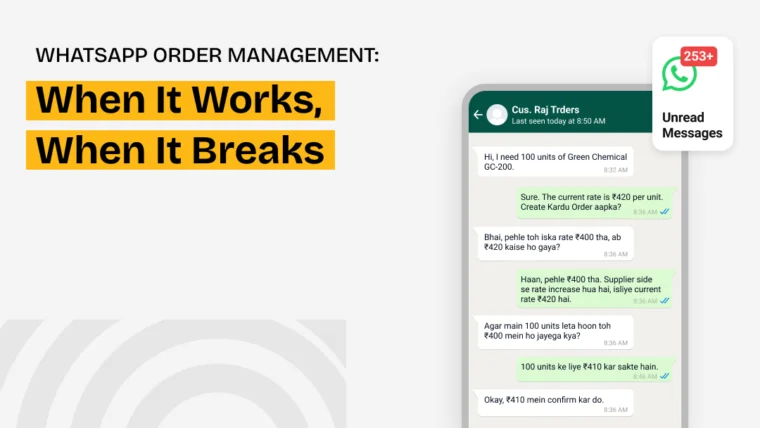
- The customer places an order over WhatsApp, sometimes as a voice note, sometimes as a photograph of a handwritten list
- Someone on the supplier side consolidates the details manually, calculates the applicable pricing, and sends a quotation
- . The customer approves, and the order is confirmed
- Stock is checked separately, usually by calling the warehouse or opening a spreadsheet that may or may not reflect current levels
- Dispatch is informed through another message or call
- The order is delivered, and the accounting entry is made later, often by a different person in a different system
This process works for a hardware distributor managing 15 familiar customers, or a plastics trader whose buyers order on a predictable cycle, because the informal approach is entirely manageable. The person at the center carries most of the relevant context in their head, and the volume is low enough for memory to serve as a reliable system. The point worth examining is not that this approach is wrong, but that it has a cost structure that becomes more visible and more expensive as order volume grows.
Where the Cost of Manual Order Management Begins to Accumulate
The friction does not arrive all at once. It builds across several specific points in the process:
Orders received through voice notes or WhatsApp messages introduce ambiguity at the point of entry. A quantity gets heard incorrectly. An item is missing. The note gets buried before anyone can act on it. By the time the error surfaces, the customer is already waiting on a delivery that was never properly recorded.
Customer-specific pricing, which is standard in Indian B2B trade rather than exceptional, creates a different category of risk. When rates for each customer live in the salesperson’s memory or are scattered across old chat threads, the wrong price goes out whenever the person holding that knowledge is unavailable or misremembers an agreement reached verbally several months ago.
Stock commitments made without real-time visibility into current levels lead to over-selling. The pressure of a customer on the line pushes toward a confident yes based on a rough sense of what is probably in stock. When that estimate is wrong, fulfillment becomes reactive, sourcing from alternative suppliers at higher cost or managing a customer conversation about an avoidable delay.
Follow-up calls from customers who have not received a status update consume a portion of every working day in most MSME operations that have grown past a certain size. Each call is individually small. Collectively, they represent time spent on communication rather than on decisions.
The Hidden Cost of Not Having an Order Management System
The question of whether order management software is worth it is usually framed as a straightforward cost comparison: what does the software cost, and what does the business receive in return? That framing is reasonable as far as it goes, but it only accounts for one side of the calculation.
The other side is what the current approach costs, and that figure is rarely estimated because it shows up in ways that are easy to absorb individually, yet add up to something significant over time.
The Time Cost: Running Without Inventory and Order Management Software
A realistic estimate of how much time is consumed each day by coordination that a connected system would handle automatically tends to surprise most founders when they think about it directly. Consider what falls into this category:
- Relaying order details from one channel to another
- Checking stock separately before confirming a delivery date
- Fielding customer calls about order status that nobody can answer without making another call first
- Correcting pricing errors discovered after dispatch
- Reconstructing what was agreed when a customer raises a dispute weeks later
Even at a conservative estimate of 90 minutes per day across the working week, this represents a substantial portion of productive time spent on coordination rather than on decision-making.
For businesses managing 40 or more customers with varied pricing and frequent orders, the actual figure is often considerably higher and tends to grow disproportionately with the customer count rather than in a straight line.
The Margin Cost: When Pricing Errors Become a Pattern
Pricing errors in B2B trade are both common and quantifiable. When customer-specific rates are not documented and applied automatically at the point of booking, errors occur at a predictable frequency:
- A bulk discount was missed because the order fell just short of the threshold, and nobody caught it in time
- An advance payment rate is applied to an account that no longer qualifies because the terms changed three months ago
- An older negotiated price is used because the person handling the order was not the one who negotiated the current rate
Each error is small in isolation. Across a business managing fifty customers with varied pricing structures and regular rate changes, these errors occur often enough that the cumulative margin impact over a quarter is typically larger than the founders’ estimate when they think about it directly.
And because errors surface at month’s end rather than at the point of the transaction, they are difficult to trace and harder still to correct after the invoice has already been raised.
The Growth Cost: When Your Process Becomes Your Ceiling
The least visible cost of informal order management, and in many cases the most consequential, is the growth that does not happen because the operational foundation cannot support it. When a founder hesitates to enter a new territory, add a product line, or respond to an opportunity that would increase order volume, and the hesitation is driven not by market conditions but by the sense that the backend is already stretched, the process has begun to determine the business’s ceiling.
This pattern is worth examining closely if it sounds familiar, and the signs that a business has outgrown manual order management are worth reading alongside this guide.
The cost of informal order management is not zero. It is just paid differently — in time, in margin errors, and in growth that does not happen.
When Order Management Software Is Not Worth It and When That Changes
Treating this question honestly requires acknowledging that there are businesses for which order management software is not the right investment at this time. Being clear about what that looks like is what makes the rest of this argument credible.
The informal approach is likely still within its range when:
- The business has fewer than fifteen to twenty customers with consistent, predictable order patterns
- A single person manages the full cycle from booking to dispatch without meaningful coordination overhead
- Pricing is straightforward enough that errors are rare and easily caught
- There are no immediate plans for significant growth in customer count or product range
The answer changes when the conditions above no longer hold. Specifically when,
- Order volume increases past the point where one person can hold the full picture without strain
- Customer-specific pricing has become complex enough to generate regular errors
- A meaningful portion of each working day is consumed by coordination rather than decisions
- Customers are raising questions about order status that nobody can answer without making a call.
- The hesitation to take on new business is no longer about whether the opportunity is right, but about whether the operation can absorb it.
At that point, the software is not an additional cost. It is a replacement for a cost the business is already paying through a less visible mechanism.
What Good Order Management Software Actually Replaces in Your Business
The most practical way to think about order management software for a small business is as a replacement for a specific layer within the existing operation, not as an addition to it. That layer is the coordination layer: the set of activities currently running through people, messages, calls, and memory.
When a connected system handles that layer, several things change at once:
- Orders enter once and are immediately visible to everyone who needs to act on them, without relay or re-entry. Sales, operations, and dispatch all see the same record with complete details from the moment the order is placed.
- Pricing logic is applied automatically at the point of booking, so the correct rate goes to the correct customer without anyone having to recall the agreement from a previous conversation.
- Stock levels are visible before a commitment is made, so overselling is addressed before it starts rather than managed after the fact.
- Order status updates as the order moves through the process, which means the customer does not need to call, and the team does not need to manage the update manually.
These are not advanced capabilities. They are the structural baseline of what a business managing orders at scale requires, and they are precisely what informal coordination cannot reliably provide once customer volume crosses a certain threshold. The benefits of this connected approach are most visible not in any individual feature but in what disappears from the daily operation: the follow-up calls, the pricing reconciliations, the morning spent reconstructing where things stand.
The customer relationships stay as they are. The negotiations stay as they are. What changes are there in the operational layer underneath them, and with it, the time and margin that the informal approach was absorbing?
How Biizline Works as a B2B Order Management Software for Indian MSMEs
Biizline is built for the stage this guide has been describing: a growing Indian MSME that has moved past the point where informal coordination is reliable but has not yet reached the scale that justifies the complexity of an ERP.
As a private B2B order management platform designed around Indian trade realities, it handles the coordination layer across a wide range of industries, including plastics, FMCG, hardware, agriculture, chemicals, and apparel.
What it handles specifically:
- Customer-specific pricing is built into the booking process and applied automatically at the point of order confirmation
- Real-time stock visibility before commitments are made to the customer
- Order status accessible to both supplier and buyer throughout the fulfillment process, without manual updates from either side
- A private workspace shared only between the supplier and their customers, not a public marketplace where pricing or relationships are exposed
- Accounting system integration so that confirmed operational data flows into financial records without duplicate entry
The pricing structure starts at Rs 999/- per month, billed quarterly. For a business managing forty or more customers with varied pricing and regular orders, that figure is considerably less than the time cost of manual coordination alone, before accounting for the margin impact of pricing errors. The comparison is not between the cost of software and the cost of nothing. It is between the cost of the software and the cost of the current approach, calculated honestly.
The key features page covers the specific operational functions in detail. And for businesses that want a sense of what the transition actually looks like in practice, reading what other MSME owners have said tends to be more useful than any feature description.
Final Verdict: Is Automated Order Processing Right for You?
The question of whether order management software is worth it does not resolve to a single answer, and any piece of writing that offers one without qualification is not useful to the reader. What it resolves to is a conditional answer, and the condition is operational.
At a certain stage of growth and complexity, the cost of managing orders manually is already higher than the cost of managing them through a dedicated system. The software does not introduce a new expense. It replaces an existing one that was always there, just never visible on a single line of the accounts.
For businesses still within the range where informal coordination works, the answer may genuinely be not yet. For businesses recognizing themselves in the operational picture this guide has described, the more honest question is how much longer the current approach is worth sustaining, and what that continuation is actually costing, month by month, across time, margin, and the growth that is not being pursued.
That calculation is worth doing with real numbers from the actual operation. The answer, when done honestly, tends to clarify the decision fairly quickly.
Share this Blog






1 comment