
Updated on
9 Order Headaches Food and Spice Wholesalers Can Finally Solve
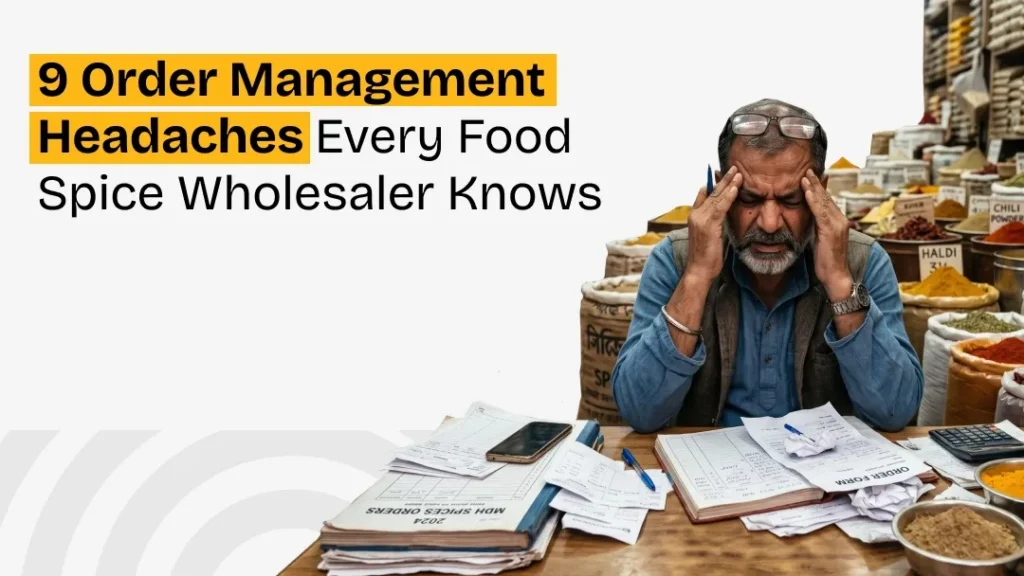
From FSSAI batch traceability to mandi rate volatility, the operational problems shaping the food trade in 2026
FSSAI conducted close to four lakh inspections in FY25 to FY26 with penalties crossing Rs 154 crore. For most food wholesalers, that is not a statistic they read in a report. It is a real risk that hangs over the daily operation. A surprise inspection asks for batch records, supplier certificates, dispatch traceability. Pulling all of it together from a few notebooks and an Excel sheet takes two days. The inspector does not have two days.
Food and spice wholesalers in 2026 are facing compliance pressures, perishable inventory, weight based pricing, and mandi rate volatility, often all at once. The nine problems below are everyday reality. Each one carries a cost. Most wholesalers have stopped tracking how those costs add up.
Why Food Spice Order Management Is Uniquely Demanding
Compliance pressure is real and tightening. FSSAI enforcement has shifted from paperwork warnings to active inspections with real penalties. The 2024 ethylene oxide bans in Singapore and Hong Kong added export quality scrutiny on top of domestic enforcement. Pricing is weight based and volatile. Mandi rates for spices, dals, and agri commodities change daily. A static price list is wrong within 24 hours.
Inventory is perishable and lot tracked. Batch numbers, expiry dates, and FIFO discipline matter operationally, not just on paper. The customer mix is messy too. Retail kirana, HoReCa, institutional buyers, and quick commerce sourcing each have different pricing logic and different documentation needs. This is the operational reality that makes food trade different from other B2B categories, and it is also why general purpose order management breaks in this trade.
Compliance and Traceability Gaps
Problem 1: Batch traceability from supplier to retailer is incomplete
FSSAI walks in and they ask for batch records of a specific spice that left the warehouse three months ago. Questions arise like
- Where did it come from?
- Which supplier?
- Which batch?
- Which retailers did it ship to?
The wholesaler has the answers, technically, spread across five different places. Putting them together takes days. A surprise inspection does not give days. This single problem is the largest compliance risk in food wholesale in 2026.
Problem 2: FSSAI documentation per dispatch is patchy
Every dispatch in a regulated category should include batch numbers, expiry dates, and supplier certificates, either attached or referenced. In practice, this happens about half the time. Even when it does, the records often have gaps that only show up when someone comes looking. The wholesaler ends up scrambling to reconstruct what should have been captured automatically at the time of dispatch.
Problem 3: Larger buyers now demand batch certificates
Quick commerce platforms, organised retail, and HoReCa institutional buyers have started insisting on batch test certificates and pesticide residue documentation before they accept dispatch. Most wholesalers were never set up to provide this. Either the supply relationship gets renegotiated or it ends. The wholesalers who built batch documentation discipline early are picking up the contracts the others lose.
Pricing and Rate Volatility
Problem 4: Mandi rate changes do not flow to dealer pricing fast enough
To understand this problem, let’s take an example: the Unjha mandi closes for the day at one cumin rate. The Khari Baoli wholesaler is still quoting yesterday’s rate at 11 AM the next day. By the time the price list updates, the dealer has either taken the order at the older lower rate, and the wholesaler eats the loss, or moved to a competitor who quoted fresh. This is daily for spice wholesalers and weekly for dal and oil traders.
Problem 5: Weight based pricing errors during order entry
The dealer ordered 47 kg of haldi. The team logged 47 kg. The actual weight at dispatch is 48.3 kg because the bag is what it is. Billing for the exact dispatched weight versus the ordered weight is a routine point of friction. Without weight tolerant pricing logic at order level, the team is either short billing, which is margin loss, or arguing with the dealer, which is trust loss.
Inventory and Expiry Handling
Problem 6: FIFO discipline breaks down with mixed inventory
FIFO means First In, First Out (the stock that comes in first, goes out first). There could be the same SKU, but two different batches in the warehouse – one is fresh (new) and the other is older stock (from last month). The dispatch team grabs whichever bag is closer to the loading dock. The older batch sits, gets older, and eventually has to be written off near expiry. Without FIFO logic at dispatch, expiry write offs are a routine 1 to 3 percent of perishable inventory value. That is money walking out the godown door every month.
Problem 7: Near expiry SKUs go to the wrong customer
Near expiry stock should go to a high velocity retailer who will move it in days. Not to a small kirana who will keep it on the shelf for weeks. Without an expiry aware dispatch view, the allocation is whatever the dispatch team picks first. Stock expires on the wrong shelf. The wholesaler eats the loss. The retailer eventually notices and complains. Both sides lose.
Customer Mix Complexity
Problem 8: HoReCa, retail, and institutional pricing get mixed up
A hotel client buys at one rate – Better margin, larger volume, predictable schedule. While a kirana retailer buys at another – Lower margin, smaller volume, more frequent orders. An institutional buyer like a school or office canteen has a third rate, negotiated separately, often with documentation requirements attached. The team routinely applies the wrong rate to the wrong customer. Each error is a quiet margin loss or a trust hit.
Problem 9: Salesperson route coordination is informal
Spice and food distribution often has field salespeople running fixed routes through specific markets. Their orders come in via phone or WhatsApp throughout the day. The team at the desk consolidates these orders manually.
Missed orders, double counted orders, and route versus stock mismatches are a routine. The salesperson’s productivity is whatever the manual workflow allows, which is usually less than half what a structured system would give them. If your salespeople are running on this kind of informal setup, speeding up order processing is probably the highest return investment you can make this year.
What These Problems Cost a Food Spice Wholesaler
- FSSAI compliance gap exposure: variable, but penalties have risen sharply (Rs 154 crore total in FY25 to FY26)
- Mandi rate lag margin loss: 1 to 3 percent of revenue on volatile rate SKUs
- Expiry write offs: 1 to 3 percent of perishable inventory value annually, mostly preventable
- Pricing errors across customer mix: 0.5 to 1.5 percent margin leakage monthly
- Salesperson productivity loss from manual coordination: roughly 30 to 40 percent of theoretical capacity
- Lost large buyer contracts due to batch documentation gaps: hard to quantify but real
How to Fix Food Spice Order Management Problems
Add it up and a food spice wholesaler running manually loses around 6 to 12 percent of theoretical margin to operational friction. For a 4 crore wholesaler, that is between 24-48 lakh rupees leaking out of the business each year. The compliance exposure on top of that is harder to put a number on, but it is a genuine business risk in 2026.
The fix has two parts:
- Operational discipline, and
- A system that makes the discipline hold at scale.
But the caveat here is, you can have all the discipline in the world, but if batch records are in notebooks and pricing is in the owner’s head, the discipline does not survive the owner being away for a day.
Biizline is built for the food spice wholesale operation described in this piece. Batch tracking sits inside every order and dispatch record, so traceability from supplier to retailer is one search away rather than a two day reconstruction. Mandi rate updates push through to dealer price lists at once. Weight based pricing handles tolerances at the order level so the 47 kg versus 48.3 kg argument stops happening. FIFO discipline is built into the dispatch logic. Customer mix pricing, HoReCa versus retail versus institutional, applies automatically based on the customer category.
For food spice wholesalers in particular, the platform addresses the compliance and perishability constraints that general purpose software treats as awkward exceptions. The key features page walks through how each of the nine problems above maps to specific functionality, including batch tracking, weight based pricing, and expiry aware dispatch.
Action Takeaways for Food Spice Wholesalers
- Audit your batch traceability first
If you cannot pull six months of dispatch records by batch number in thirty minutes, that is the most pressing gap to fix - Build quality documentation
Ensure you build a good documentation process for any supplier whose product reaches export or organised retail channels. The pressure will reach you indirectly even if you do not sell to them directly. - Clean up pricing accuracy
Pick one customer category, HoReCa, retail, or institutional, and clean up its pricing accuracy first. Measure the impact for a quarter before tackling the next. - Create operational discipline
If you serve quick commerce platforms or plan to, batch and dispatch discipline is now a contract requirement.
Food spice wholesalers across Unjha, Khari Baoli, and other clusters have already made this switch. See how other wholesalers are using Biizline and what changed in their compliance workflow and customer relationships once the operational layer was in place.
Final Thoughts
Food spice trade is a thin margin, high frequency business where operational discipline is genuinely the difference between profit and loss. The compliance pressure is not going to ease. FSSAI enforcement is tightening. Large buyers are demanding more documentation. Quick commerce is becoming a real channel with its own operational requirements.
The wholesalers who treat order management and batch tracking as core operations, not paperwork someone handles between other things, will absorb the growth that 2026 is bringing. The ones who treat them as overhead will face escalating penalties and lost contracts. There is not really a middle path anymore. There used to be. There is not.
Frequently asked questions
What is the top order management issue for food spice wholesalers in 2026?
Batch traceability from supplier to retailer is the most pressing issue. FSSAI inspections now actively check batch records and dispatch documentation. Most wholesalers have the records but they are scattered across notebooks and Excel sheets. Pulling them together during a surprise inspection takes too long.
How does mandi rate volatility affect pricing accuracy?
Mandi rates for spices, dals, and agri commodities change daily. A wholesaler still quoting yesterday’s rate at 11 AM is either losing margin on orders or losing dealers to competitors who quote fresh. Without daily rate sync to the price list, the gap costs 1 to 3 percent of revenue on volatile SKUs.
Why is expiry tracking such a problem in food wholesale?
Perishable inventory needs FIFO dispatch, meaning older stock goes out first. In practice, dispatch teams grab whatever is closest to the loading dock. Without system level FIFO logic, older stock sits in the godown, ages past expiry, and gets written off. This costs 1 to 3 percent of perishable inventory value annually.
What FSSAI compliance is required for food wholesalers?
Valid FSSAI licenses at the appropriate scale, batch tracking from supplier through to dispatch, retrievable records for at least the previous 12 months, and supplier level documentation including quality certificates for regulated categories. The enforcement regime intensified after 2024 with active sampling and meaningful penalties for non compliance.
Can software actually help with batch traceability and expiry management?
Yes, if the software is built for food trade rather than general B2B. Batch tracking needs to sit inside every order and dispatch record automatically, not as a separate step someone does later. Expiry logic needs to be embedded in dispatch so FIFO happens by default. Weight based pricing and customer category pricing need to be structural, not manual overrides. General purpose software usually does not handle these.
Share this Blog