
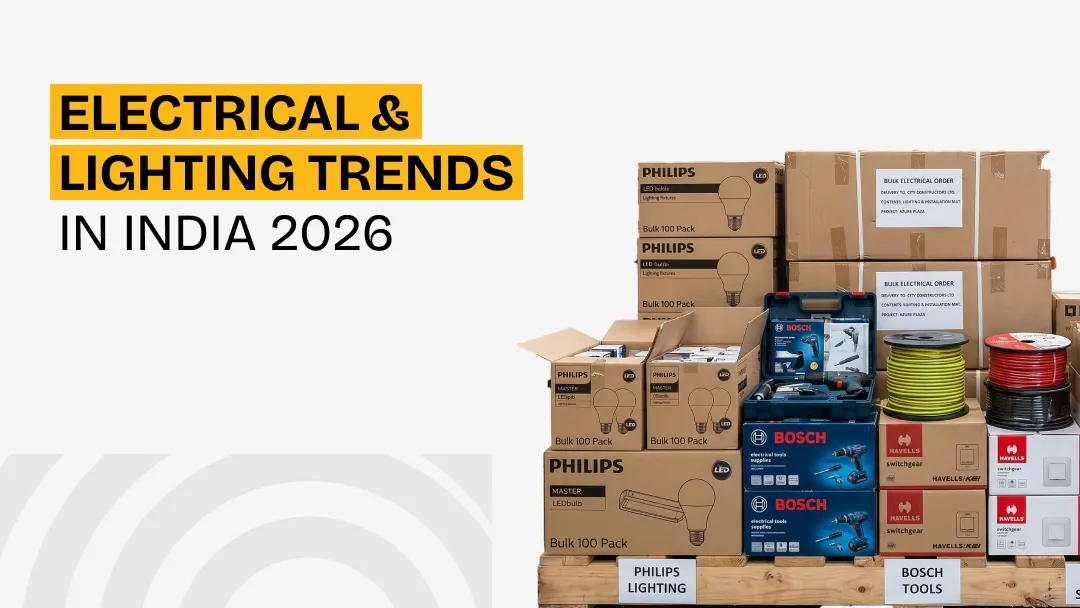
6 Trends Reshaping India’s Electrical & Lighting Trade in 2026 for Dealers and Wholesalers
What dealers and wholesalers need to watch in a year of LED dominance, copper price swings, and smart city demand
India’s electrical and lighting trade is in an unusual position right now. The macro picture has rarely looked better. LED dominance is functionally complete. Smart cities have moved from concept to procurement. The PLI scheme has pulled major manufacturing capacity onto Indian soil. By any sensible measure, this should be a comfortable year for the dealers and wholesalers who carry the trade. But ask any wholesaler in Jaipur’s Bhagirath area, or in Delhi’s electrical markets, what their average day looks like, and the comfort disappears quickly.
The reality on the ground is that copper rates move daily, the LED catalogue keeps splitting into newer sub categories, dealer credit is stretched, and the demand surges during festival weeks and harder than ever. So the trade is growing on paper, and the people running it are working harder than ever. This piece walks through six shifts that explain the gap, and what they mean for the wholesaler operating in 2026.
The state of India’s electrical and lighting trade in 2026
Start with the numbers. The Indian LED lighting market is valued at around USD 12.54 billion in 2026 and is projected to grow at 8.44% annually to reach USD 18.8 billion by 2031, according to Mordor Intelligence. The broader lighting market sits at roughly USD 4.8 billion in 2025 and is heading toward USD 7.4 billion by 2034. Within all of this, LED has captured 72.4% of the lighting market by share, up from around 41% in 2019. The shift to LED is functionally complete.
The UJALA scheme has been the biggest single lever behind that shift. Over 36.87 crore LED bulbs are distributed nationally, with annual energy savings of 47 billion kWh. Average bulb prices have dropped 85% or more since 2014, which has pushed LED into rural homes and small businesses that would have stayed on CFL or incandescent otherwise. Add to this the Street Lighting National Programme, which has installed roughly 1.34 crore LED streetlights through EESL, and the public sector demand for lighting has become a structural part of the market rather than an occasional procurement event.
Behind these aggregate numbers, the operational reality is shaped by three other facts. Brands like Polycab, Havells, Finolex, Anchor, Bajaj Electricals, Crompton, and Wipro continue to revise dealer pricing weekly or sometimes daily because copper and aluminium rates move on LME daily. LED has fragmented into many sub categories, each with dozens of variants. And smart city procurement has created a parallel project tender workflow alongside the regular dealer trade. The wholesaler in 2026 is balancing all three things at once. With that backdrop, here are the six shifts to track.
Six trends shaping the electrical and lighting industry in 2026
Trend 1: LED dominance is complete, but the SKU catalogue keeps splitting
Five years ago, a dealer asked for an LED bulb. Today the same dealer asks for a 12W LED panel, recessed mount, 4000K colour temperature, in a specific brand. The product has not changed in any fundamental way. The catalogue around it has multiplied. LED today is decorative lighting, panel lights, downlights, streetlights, industrial high bay, smart connected fixtures, each with their own sub variants. For a wholesaler carrying 5,000 plus SKUs, this is genuinely overwhelming when the workflow underneath the catalogue has not kept pace.
The brands driving this are predictable. Brands like Havells, Crompton, Bajaj Electricals, Wipro Lighting, Signify (Philips), Syska, Halonix, and Polycab all keep adding tiers and finishes. Online platforms have grown at 8.88% CAGR, partly because dealers cannot move through the catalogue fast enough during a customer conversation, and the customer turns to Amazon or Flipkart for clarity. This is the SKU sprawl that defines the trade in 2026, and it is not slowing down. The wholesalers winning here are not the ones with bigger godowns. They are the ones whose teams can find the right SKU in seconds rather than minutes.
Trend 2: Smart lighting has moved from concept to actual purchase
For years, smart lighting felt like a category that was always two years away from mattering. Bluetooth mesh, PoE lighting, IoT connected fixtures, LiFi enabled luminaires. All sounded interesting in trade journals, but actual dealer orders stayed minimal. That has changed in 2026. Havells, Signify, Wipro, Crompton, Polycab, Bajaj Electricals, Jaquar, Syska, and Halonix are all running real product lines in this space. Network installation has dropped roughly 30% in complexity over three years. Smart home adoption in metros is past the early adopter phase.
For a dealer, the question is whether to stock smart variants now or wait for adoption to mature. The answer depends heavily on geography. In Delhi NCR, Mumbai, Bangalore, and Hyderabad, smart lighting is now a routine line on dealer orders, even from residential builders and interior designers. In tier 2 and tier 3 cities, demand is still concentrated in commercial projects. So the choice is less about whether to stock smart lighting and more about how much of the portfolio to allocate to it. The wholesalers who picked a position early have an advantage now. The ones still on the fence are losing higher margin orders to competitors who committed.
Trend 3: Copper price volatility is quietly the biggest margin killer
This trend does not get the airtime it deserves. Cables and wires form a major chunk of electrical wholesale revenue, and these are the SKUs where copper rate movements hit hardest. London Metal Exchange prices move daily. Polycab, Havells, Finolex, and Anchor revise dealer pricing accordingly, sometimes weekly, sometimes twice a week. A wholesaler who is still quoting Monday’s price on Wednesday is either eating margin on every order or having uncomfortable conversations with dealers who already received the lower quote.
Most wholesalers manage this by updating their Excel sheets manually. The Excel sheets are usually a day or two behind, which means the team at the front desk is unknowingly quoting wrong prices. Over a month, this manual rate management costs more than any other single operational gap in the trade. The wholesalers who have figured out daily rate sync, with a clean rate lock between quote and order confirmation, are protecting margin in a way their competitors cannot match. This is not about technology being clever. It is about the daily reality of running a business where input costs move faster than your workflow can track.
Trend 4: Smart cities have made government procurement a real channel
The Smart Cities Mission has done something that very few previous government initiatives managed. It has made institutional procurement a steady, predictable source of demand for the electrical and lighting trade. EESL alone has installed over 1.34 crore LED streetlights. Smart streetlight platforms from Signify, Wipro, and Bajaj Electricals are now operational across more than 100 cities. State governments like Odisha have sanctioned dedicated budget outlays, with Rs 200 crore in 2024 directed at LED retrofit work.
For wholesalers in cities tied to active smart city projects, this is now 15 to 25% of their category demand. Indore, Bhopal, Surat, Coimbatore, Jaipur, Ahmedabad, Bhubaneswar, Pune, all of these have meaningful smart city procurement pipelines. But the operational catch is that institutional procurement does not behave like dealer trade. Specifications are tight, documentation requirements are heavy, payment cycles are different. A wholesaler running both project and dealer workflows through one disorganized pipe gets neither right. The trade is fundamentally bifurcating between dealer business and project business, and the smartest wholesalers are starting to treat them as separate operational tracks rather than one continuous flow.
Trend 5: Order management is becoming the difference between scaling and stalling
Every trend above has the same operational subtext. Daily rate updates need to flow through pricing automatically. LED sub variants need clean structured catalogues with proper attributes. Smart city orders need their own workflow. Festival demand surges need a system that does not collapse under volume. None of this is solvable through more effort or more staff. It needs a different workflow underneath the business.
This is where the trade is starting to split. Wholesalers who have moved to structured order management systems are reducing rate quoting errors, protecting margin in a category where margin pressure is daily, and handling the project versus dealer split cleanly. They are also onboarding new staff faster, because the workflow lives in the system rather than in the owner’s head. Wholesalers still managing through WhatsApp and Excel are not failing, exactly, but they are working harder for less margin every quarter.
Platforms built for this kind of trade, including Biizline, are designed around the actual workflow of an Indian electrical wholesaler. Dynamic pricing with rate lock at order confirmation. Brand specific scheme application. Multi variant SKU structures for the LED catalogue. Customer wise pricing that applies automatically rather than being recalled by memory. Partial dispatch tracking that does not sit on a notepad. The point is not the software itself. It is the operational reset that the software makes possible, and the protection it gives to margin that would otherwise leak away in small daily increments.
Trend 6: Online platforms are eating share, but selectively
The last shift to flag is the slow but real growth of online channels in lighting in particular. E-commerce in lighting is growing at 8.88% CAGR, with particular strength in smart bulb sales and DIY buyers in tier 2 and tier 3 cities. Amazon, Flipkart, Industry Buying, Moglix, and the brands’ own D2C sites all have a piece of this. For commodity LED bulbs and basic smart products, online is clearly winning.
For everything else, online has not really cracked the trade. Project work, customised specifications, the kind of multi line orders an electrician or interior designer places, all still flow through traditional wholesale. The reason is straightforward. Hardware trade runs on relationship credit, immediate stock confirmation, and trusted recommendation. An app does not replace any of those well. So the smart wholesaler does not pretend online does not exist. They use online channels for discovery and small ticket commodity orders, and protect the relationship driven wholesale business as the high value channel. That part is not going anywhere soon.
Regional clusters: where the electrical trade concentrates
The electrical and lighting trade in India is a cluster trade. A handful of dense markets carry a disproportionate share of national volume. Knowing where these clusters sit helps make sense of how brands target distribution and where competition is heaviest.
- Jaipur is the largest electrical market in the country, particularly for decorative and festival lighting
- Delhi’s Bhagirath Palace is the national wholesale hub for electrical fittings, switchgear, and cables
- Ahmedabad’s Relief Road and the broader Gujarat electrical trade have grown sharply on the back of construction demand
- Mumbai’s Lohar Chawl is the traditional electrical wholesale market
- Surat has a growing industrial electrical segment connected to its textile machinery trade
- Coimbatore in the south, anchored by its pump and motor industry, is the engineering and electrical hub.
- Beyond these, Hyderabad, Bangalore, Kolkata, and Ludhiana all have significant regional electrical trade.
A wholesaler in any of these clusters is rarely competing on a clean field. There are dozens of others nearby selling overlapping ranges. When the product is broadly similar and the prices are close, the thing that separates one wholesaler from the shop next door is service. Faster answers, accurate stock, clean billing, fewer mistakes. Operations is the competitive edge precisely because the product is not.
What electrical wholesalers and lighting dealers should prepare for in 2026
Pulling the trends together, here is what is worth doing something about this year. Four things, kept practical.
1. Build a daily rate update workflow before the festival season starts
Diwali and Navratri demand spikes will land hard on cable and wire SKUs, and the manual rate management that is already breaking will break worse under volume. The copper price swing is structural, not seasonal, so the fix needs to be structural too. This is the single highest impact operational change a wholesaler can make in 2026.
2. Pick a smart lighting position deliberately.
Either commit to stocking the premium tier seriously, with the training and inventory investment that comes with it, or stay focused on volume LED. The middle position, where you carry a thin smart lighting range without really backing it, is the most expensive place to be. Customers either get directed to a serious smart lighting dealer or to Amazon. Either way, the wholesaler in the middle loses the order without ever quite knowing why.
3. Build a separate workflow for institutional orders before they grow into a real share of revenue.
Especially if you serve any smart city project geography. Project orders behave nothing like dealer orders. Mixing them in the same disorganized pipe is how delivery commitments get missed, documentation gaps appear during audits, and margin gets eroded by rework. The wholesalers who treat project business as a distinct operational track are the ones winning the next tender.
4. Online discovery is now a real channel.
Use it for new dealer acquisition and for the small commodity orders where a relationship adds no value. Keep deep dealer relationships as the high value moat. For wholesalers at scale, Biizline handles the multi-brand pricing logic, daily rate sync, and project versus dealer workflow split that this trade actually needs. The tools exist. The decision is whether to adopt them now, while the change is still a choice, or later, when it becomes an emergency.
Electrical and lighting wholesalers across Jaipur, Delhi, Surat, and Ahmedabad have made this transition over the last two years. See what they are saying about how the shift from WhatsApp and Excel to structured order management changed their day to day operations.
Final Thoughts
The electrical and lighting trade in 2026 is a sector where the macro is working firmly in the dealer’s favor. LED dominance, smart cities, PLI driven manufacturing, growing residential and commercial construction, all of these are real tailwinds. But the micro reality on the ground is brutal in its own way. Copper volatility, SKU sprawl, project versus dealer workflow strain, and online pressure on commodity categories. These are not going away. If anything, they will intensify through the year.
Which means the dealers and wholesalers who build operational discipline now will absorb the growth. The ones who keep working around the daily chaos will watch margin tighten week after week, without quite being able to name why. The trade is splitting between businesses that compress and businesses that expand. The line between the two is not size, and it is not which brands you carry. It is whether your operations can carry the weight of everything that 2026 is going to bring.
Frequently Asked Questions
How big is India’s lighting market in 2026?
The Indian LED lighting market is valued at around USD 12.54 billion in 2026 and is projected to reach USD 18.8 billion by 2031, growing at 8.44% annually. The broader lighting market sits at roughly USD 4.8 billion in 2025 and is heading toward USD 7.4 billion by 2034. LED has captured 72.4% of the lighting market by share.
Which city is the largest electrical wholesale hub in India?
Jaipur is widely considered the largest electrical market in the country, particularly for decorative and festival lighting. Delhi’s Bhagirath Palace is the national wholesale hub for electrical fittings, switchgear, and cables. Ahmedabad, Mumbai’s Lohar Chawl, Surat, and Coimbatore are also major regional clusters.
How is copper price volatility affecting electrical wholesalers?
Copper rates move daily on the LME, which means brands like Polycab, Havells, Finolex, and Anchor revise dealer pricing weekly or sometimes more often. Wholesalers managing prices manually fall a day or two behind, which causes margin erosion on cable and wire SKUs. The fix is daily rate sync and rate lock at order confirmation.
Is smart lighting a profitable segment for dealers?
Yes, particularly in metros and tier 1 cities where smart home adoption has moved past the early stage. Smart variants typically carry better margin than commodity LED, but they require training, inventory investment, and a deliberate stocking position. Dealers in the middle, carrying a thin range without backing it seriously, tend to lose orders to either committed smart lighting dealers or to e-commerce.
Will online B2B replace traditional electrical wholesale?
Not in the foreseeable future. Online channels are growing at around 8.88% CAGR in lighting and have taken meaningful share in commodity LED and basic smart products. But project work, customised specifications, and multi line orders still flow through traditional wholesale because they need relationship credit, immediate stock confirmation, and trusted recommendation. Online is a real channel, not a replacement.