
Updated on
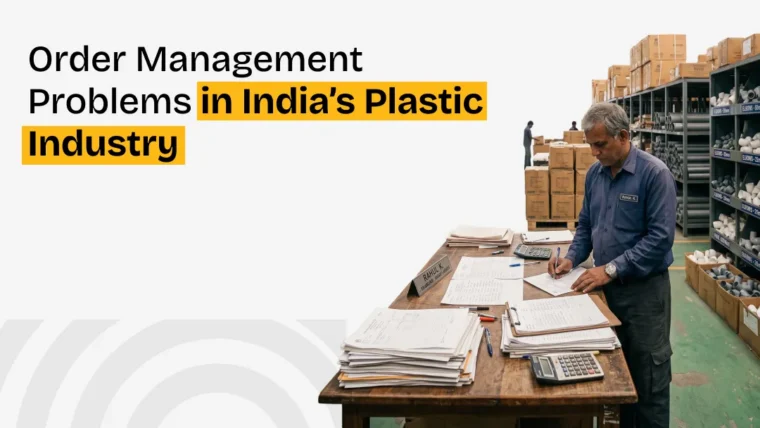
11 Order Handling Errors Silently Cutting Plastic Manufacturers’ Profits
The operational leaks that quietly erode 8 to 15 percent of margin every year, and the structural fixes that close them.
The Indian plastic processing sector is valued at over USD 47 billion in 2026 and is growing at 6% a year. Roughly 30,000 processing units are in operation, and 85-90 percent of them are MSMEs. The growth story is real. But ask any plastic manufacturer or trader handling 50+ dealers what their actual margin looks like compared to five years ago. The answer is almost always the same. “It’s tight, in fact much tighter.”
Most of that margin compression is not coming from raw material costs or from competition taking your customers. It is coming from operational leakage that nobody tracks because each individual leak looks too small to bother with. This piece walks through eleven of those leaks, what they actually cost, and what closes them.
Why Plastic Order Management Is Uniquely Complex
Plastic SKUs are multidimensional in a way that most other B2B trades are not. A single product can have variants by grade, colour, size, and pack count. What starts as 5 SKUs becomes 25 once you account for all the combinations. A distributor carrying a hundred base products may actually be managing six hundred variants in the godown.
Then there is the pricing. Polymer raw material rates change weekly, sometimes daily, and those changes need to flow through to dealer pricing without delay. The customer mix is messy too. Bulk dealers, retail traders, and project based buyers each expect a different pricing logic for the same product. And EPR documentation requirements have shifted from annual to monthly, adding a record keeping load that manual workflows were never built to carry. If your current order tracking setup is still running on Excel, the problems below will be familiar.
Pricing Inconsistency Problems
Pricing is where the largest margin loss sits in plastic trade, which is why it leads this list.
Problem 1: Polymer rate changes do not reach dealer pricing in time
To understand this, let’s take an example: PVC or polypropylene rates move on Tuesday. The dealer is still quoting Monday’s price on Wednesday. By the time the price list gets updated, a week of orders have already gone out at rates that eat into the margin. For a manufacturer doing ten crore in monthly volume, even a 50p per kg lag in price update can cost lakhs. This is not an occasional problem. It is a daily one.
Problem 2: Dealer wise negotiated pricing lives in memory
Take for instance, a long standing dealer in Naroda has a special rate agreed eight months ago. The new accountant at the billing desk does not know about it. So, the invoice goes out at the standard rate. The dealer notices but now either the manufacturer absorbs the difference or there is an uncomfortable phone call. Multiply this across 40 dealers, several of whom have their own version of the special rate, and the erosion becomes a structural problem.
Problem 3: Bulk pricing tiers get applied incorrectly
The dealer orders 800 kg of fittings, which qualifies for tier 2 pricing. The team applies tier 1 because nobody cross checked the slab. The dealer sees the invoice, pushes back, eventually gets the tier 2 rate retroactively. The effect of this is that the manufacturer has to eat the price difference, the rework cost, and he also loses the dealer’s trust in one transaction.
Problem 4: Advance payment discounts get forgotten
A dealer paid in advance to lock in a better rate. Two weeks later, the order is being billed and the team forgets to apply the discount or apply it to the wrong order. The dealer keeps a record of these things even when the manufacturer does not. And the dealer remembers at the next negotiation.
Order Intake Chaos
Problem 5: Orders arrive on 3 channels and get consolidated by hand
WhatsApp from one dealer, phone call from another, an Excel sheet emailed by a third. Someone at the desk consolidates all of them into a master sheet every morning. Or tries to. Missed orders are routine, not exceptional. If you are managing multiple orders without a system, this is where the cracks show first.
Problem 6: SKU variant errors during order entry
The dealer ordered 25mm PVC pipes, schedule 40, white. The order got logged as 25mm, schedule 80, white. Or the right pipe but the wrong colour. By the time the dispatch team catches it, the truck has left. So now there is a return, a re-dispatch, and an annoyed dealer who has a customer waiting. SKU variant errors are the single most expensive intake problem in the plastic trade.
Problem 7: Voice notes and verbal orders create disputes later
The dealer sent a voice note specifying quantities. Whoever transcribed it heard ‘pachees’ (25 in Gujarati) instead of ‘pachaas’ (50 in Gujarati). 25 was ordered, 50 was billed, or the other way round. The dealer says one thing, the team remembers another, and there is no clean record to settle it. These disputes happen often enough that some manufacturers have stopped accepting voice note orders entirely, which costs them convenience and sometimes the customer.
Inventory and Dispatch Mismatch
Problem 8: Overselling against stock that does not exist
Sales commits to a 1,500 kg dispatch by Thursday because nobody checked actual godown levels at the moment of commitment. By Wednesday, the team realized only 900 kg were available. Now there is a difficult call to the dealer, a delayed dispatch, and potentially a cancelled order. This happens because stock visibility lives in a different system from order acceptance. Or sometimes in no system at all.
Problem 9: Partial dispatch tracking is messy
The dealer ordered 10 items but only 7 are available in stock. The manufacturer dispatches 7 and tells the team to send the remaining 3 next week. Three weeks later, the remaining items are still not dispatched because the partial dispatch tracking lives on a notepad on someone’s desk. The dealer follows up, finds the lapse, and a piece of trust gets chipped away.
Dealer Trust Erosion
Problem 10: No clean audit trail when pricing disputes happen
The dealer says the rate quoted on the call was INR 92/-. The manufacturer’s invoice shows INR 94/-. There is no recording, no written confirmation, just two people remembering different things. These disputes happen weekly in the plastics trade and each one chips at the relationship. Even when the manufacturer is technically right, the dealer remembers the argument.
Problem 11: EPR and batch documentation gaps surface during audits
State pollution control board visits or large buyer audits ask for batch records, EPR compliance trails, and suppliers to dispatch traceability. The records exist but they are spread across notebooks, emails, and a couple of Excel sheets. Putting them together takes days. For an MSME under audit pressure in 2026, this is genuinely a business risk. Not just paperwork friction.
What These Problems Cost a Plastic Manufacturer
- SKU error and rework cost: typically fifty thousand to two lakh rupees per month for a mid sized processor
- Rate lag margin loss: 1 to 3 percent of revenue on polymer rate sensitive SKUs
- Negotiated pricing leaks: 0.5 to 1.5 percent of revenue, mostly invisible until annual reconciliation
- Partial dispatch and follow up missed orders: 2 to 4 percent of monthly volume in dealer churn risk
- EPR compliance gap exposure: variable, but state penalties have risen sharply in 2026 enforcement
Add it all up and a typical plastic MSME running on manual order management is losing 8 to 15 percent of theoretical margin to operational leakage. For a five crore processor, that is between 40-75 lakh rupees leaving the business each year through error rather than competition. That is not a rounding error, it’s actually the difference between a business that grows and one that just gets busier.
How to Fix Plastic Order Management Problems
The fix is structural, not effort based. Hiring two more people to track orders better will not close the leaks because the problem is the workflow, not the staffing.
Structured order management platforms are built to handle exactly these workflows. Biizline is designed for plastic manufacturers and traders running the operation described above. Customer specific pricing, bulk tiers, and advance payment discounts apply automatically the moment an order is entered, so the correct rate hits every invoice the first time. Polymer rate updates push through to all relevant dealer price lists at once. SKU variants are structured properly with grade, colour, and size as separate searchable fields rather than free text. Partial dispatch tracking sits inside the system, not on a notepad.
For plastic processors and traders in particular, the platform handles the variant complexity and rate volatility that general purpose software treats as awkward exceptions. The key features page walks through how each of the eleven problems above maps to a specific feature, from variant aware order entry to dealer specific rate locks at order confirmation.
Action Takeaways for Plastic Manufacturers
- Pick the leakiest problem from this list first
For most processors, it is rate lag pricing or SKU variant errors. Fix one, measure for a quarter, then move to the next. - Audit your dealer wise pricing records
If a junior at the billing desk cannot pull every dealer’s negotiated rates without asking the owner, the records are not records. - Introduce monthly batch tracking
If you handle EPR for packaging customers, monthly batch tracking is no longer optional. The compliance window has tightened sharply. - Use tools that fit your business
Talk to processors who have already made the operational shift before deciding what tools fit your business.
Plastic manufacturers across Gujarat and Maharashtra have moved through this transition over the last two years. Explore how Biizline works for plastic trade, or talk to processors who are already running their operations on it.
Final Thoughts
11 problems sounds like a lot but most plastic manufacturers will recognise 7-8 of these as things they deal with every day without ever calling them problems. When operational friction is normalised, the cost becomes invisible. Each leak is small but the sum of 11 small leaks leads to a large number.
The manufacturers who name the leaks and fix them are the ones absorbing the growth that 2026 is bringing. The ones who keep working around them are paying the same operational tax forever, and wondering why margins keep getting thinner even though the business keeps getting bigger.
Checkout the pricing of Biizline →
Frequently asked questions
1. What is the most common order management mistake in plastic trade?
SKU variant errors during order entry and rate lag on polymer pricing are the two most frequent mistakes. Variant errors are costly because they trigger returns, re-dispatches, and relationship damage. Rate lag is costly because it silently erodes margin on every order placed at stale prices.
2. How do pricing errors hurt plastic manufacturers?
Pricing errors in plastic trade typically cost 1 to 3 percent of revenue on rate sensitive SKUs and another 0.5 to 1.5 percent on negotiated pricing leaks. For a five crore business, that adds up to twenty to forty lakh rupees annually. Most of it is invisible until annual reconciliation.
3. Can WhatsApp work as an order management system for plastic businesses?
WhatsApp works for communication. It does not work for structured order capture, SKU variant tracking, or pricing logic. Voice notes get transcribed wrong. Orders get lost in group chats. There is no audit trail for disputes. At a small scale it holds together but beyond 50 dealers, it breaks consistently.
4. How do plastic SKU variants make order management harder?
A single plastic product can have variants by grade, colour, size, and pack count. Five base SKUs can become twenty five once combinations are accounted for. When these variants are tracked as free text entries rather than structured fields, order entry errors multiply and the wrong product gets dispatched more often than anyone would expect.
5. What does a typical SKU error cost a plastic processor?
Wrong dispatches costs the original sale margin, the return logistics, restocking time, and a piece of the dealer relationship. Across a month, SKU errors typically cost a mid-sized processor fifty thousand to two lakh rupees directly, with an uncounted cost in dealer trust that shows up later.
Share this Blog