
Updated on
Is Your Business Too Dependent on You? Escaping the Switchboard Trap
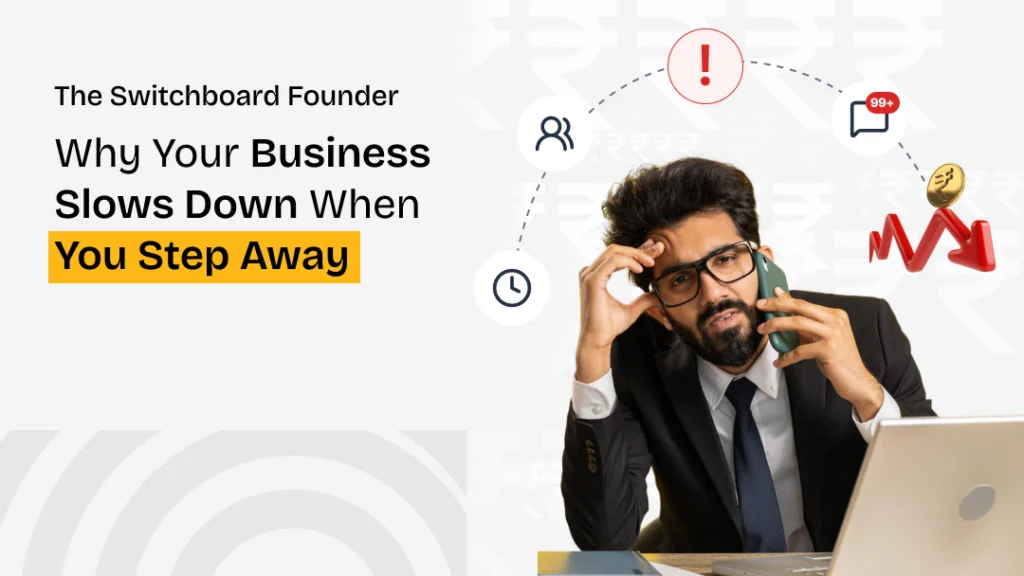
Why your business slows down the moment you step away, and what that tells you about how it is actually built.
A switchboard founder is someone who, without planning to, has become the central routing point for every decision, piece of information, and approval in their business. The analogy is to an old telephone switchboard, where every call had to pass through a single operator before it could connect to anyone else. In the same way, every order question, every pricing clarification, every customer update, and every operational decision passes through this one person before anything can move forward.
This is not a failure of leadership, and it is not a character flaw. It is the natural consequence of how most MSMEs are built. In the early days of a business, with the founder as the switchboard, it is genuinely efficient. They carry all the context, make fast decisions, and the business moves because they are always there to move it. The problem is not how this dynamic starts. The problem is what it quietly becomes as the business grows past the point where one person can reliably hold everything.
The clearest test of whether a business has a switchboard problem is simple: does it slow down, lose track of decisions, or stop acting on orders whenever the founder is unavailable for a few hours? Not in a crisis. Just on a long call, in a meeting, or traveling somewhere with poor connectivity. If the answer is yes, that is not a reflection of the team’s capability. It is a reflection of where the business’s operational information lives, and it almost always points back to how orders are being managed.
How the Switchboard Founder Is Built, Not Born
Understanding the switchboard problem requires tracing how it develops, because it does not arrive fully formed. It builds gradually over the business’s growth, through a series of decisions that were all individually reasonable at the time they were made.
The Early Stage: When Manual Order Management Actually Works
With five to ten customers, a founder managing orders manually is doing the right thing. The volume is low enough for memory to be a reliable system. They know every pricing agreement, every delivery preference, and every outstanding order without needing to write any of it down. The team, if there is one, defers to them not because they have been instructed to but because the founder is the fastest and most accurate source of answers. This is not a dependency; it is efficiency, and it serves the business well at that stage.
The operational picture at this point is familiar to most MSME founders: orders come in over calls and WhatsApp, the details are consolidated manually, pricing is applied from memory, and dispatch is coordinated through messages. Everything flows through one person, and that one person is more than capable of handling it. The system works because the system is, in effect, that person.
The Inflection Point: Where Efficiency Becomes Dependency
Somewhere between thirty and sixty customers, the same approach that made the business fast begins making it fragile. The founder is still the routing point for everything, but the volume of things routing through them has multiplied considerably. More customers mean more pricing relationships to remember, more order histories to hold in context, more exceptions to manage and communicate. The team has grown, but it has grown around the founder rather than independently of them, which is a distinction that matters more than it initially appears.
The inflection point is rarely visible when it is happening. It tends to show up in retrospect, when the founder looks back and realizes that the team has quietly stopped attempting to make decisions independently, not because they are incapable, but because they learned through experience that everything goes through the founder, regardless. That learned behavior is the highest and least visible cost of the switchboard dynamic. A process can be changed in a week. A team’s learned dependency takes considerably longer to undo.
The switchboard problem is not created in a single moment. It is the cumulative result of a thousand small decisions, each individually correct.
What Breaks When the Switchboard Founder Steps Away
The most direct way to understand the switchboard problem is to trace what actually happens across a business when the founder is genuinely unavailable for half a working day. Not in an emergency, just occupied in a way that makes them unreachable. The following patterns appear consistently across growing MSMEs that have not yet separated their operational information from any one person’s memory.
Orders stall because pricing lives with one person
A customer calls with an order. The team member who answers knows the product range but not the pricing structure for that specific customer, because the applicable rate depends on order volume, payment terms, or a negotiation the founder handled several months ago and never formally documented anywhere accessible.
The team member cannot quote with confidence, so they say they will call back. The customer waits. The order does not move until the founder is reachable again, which may be hours later.
This is manual order management at its most direct point of failure. The information needed to process the order is available. It is simply stored in the wrong place, in one person’s memory rather than in a system the team can access independently.
Dispatch decisions wait because context is not visible to the team
An order is ready to be fulfilled, but a question has come up about partial dispatch:
Can the customer receive 70% of the order now and the remainder in 4 days, or do they need to wait for the full quantity before anything ships?
The dispatch team understands the operational side of the question but not the customer relationship side, which determines the correct answer. The founder would resolve this in under a minute. Without them, the order sits while the dispatch team moves on to work that does not require a judgment call.
Customer follow-ups go unanswered because order tracking is not visible
A customer calls to check the status of an order placed two days ago. If the team member who answers does not have visibility into the order’s status in the process, they cannot check the system. So they end up checking with the person who last touched it, who checks with someone else, and finally, the answer either reaches the customer like a Chinese Whispers. Either way, the experience quietly and consistently erodes trust.
This is precisely the gap that order-tracking tools for small businesses are designed to close, not by making the team faster at answering questions, but by making the questions unnecessary in the first place.
The team stops attempting to solve problems independently
This consequence takes the longest to surface and the longest to reverse. When a team consistently observes that decisions are left to the founder, they stop trying to resolve issues independently. Not from any lack of ability, but from a rational adaptation to the environment in which they work.
Over time, the founder’s availability becomes the effective operational tempo of the entire business. When they are present, things move at one speed. When they are not, things move at another. The gap between those two speeds is a direct measure of how deep the switchboard dependency runs.
Why Adding More People Does Not Fix the Bottleneck
The most instinctive response to a switchboard problem is to hire. Another operations person. A sales coordinator. Someone whose designated responsibility is to manage the order flow so the founder is not pulled into every decision. And for a short period, this produces results. The new person absorbs some of the routing load, the founder regains a degree of breathing room, and the business moves with slightly less friction.
But the underlying structure has not changed. The new person becomes a secondary switchboard, receiving questions they cannot fully answer and routing them upward to the founder for anything outside their own knowledge. Because the critical operational information, the pricing logic, the customer history, and the exception-handling context still live with the founder rather than in a shared, accessible system, the new hire’s effectiveness is bound by how much access to the founder they can secure on any given day.
Hiring addresses the symptom. The cause is that the business has not yet built a way for its operational information to exist independently of any one person’s availability. Until that structural condition changes, every new team member added to the operation inherits the same dependency in a slightly different form.
You can hire around a structural problem indefinitely. The problem does not get smaller. The payroll does.
The Fix Is an Order Management System, Not Delegation
Delegation is the recommendation that tends to follow when hiring alone proves insufficient.
Give the team more authority. Trust them to make calls. Step back from the operational detail and allow the business to function without constant input from the top. This is reasonable in principle. But it rests on an assumption that is often not true in practice: that the team has the information they need to exercise the authority they have been given.
A team member can only make a sound decision about a customer order if they have access to the information that supports the decision. The agreed pricing for that customer. The order history that explains their expectations. The current stock levels that determine what can actually be committed to.
The delivery timelines already promised to other customers. If that information is scattered across WhatsApp threads, notebooks, and one person’s memory, no amount of delegated authority will yield the outcomes the founder hopes for. The team will either wait for confirmation anyway, which is the switchboard problem in its unchanged form, or make decisions with incomplete information, which produces a different set of problems. This is why signs your business has outgrown manual order management often include delegation failures alongside the more visible operational symptoms.
The structural fix is to move the information itself out of people and into a system that the whole team can access and act on independently…
- When customer-specific pricing is documented in the order management system and applied automatically at the point of booking, a team member does not need to consult the founder to quote the correct price.
- When order status is visible to everyone with appropriate access, the team can answer customer questions without chasing anyone.
- When stock levels are accurately reflected before a commitment is made, dispatch decisions do not require escalation to someone who knows the inventory situation off the top of their head.
This is what order management automation actually accomplishes at the operational level. It does not replace the founder’s judgment on complex decisions. It replaces the founder’s memory with routine ones, which is precisely the part that was creating the bottleneck.
What Changes When Information Moves into a B2B Order Management System
The change that comes from moving order information into a connected, accessible system is less visually dramatic than a structural transformation might suggest, but the cumulative operational effect is significant and relatively rapid. Here is what the business looks like once the coordination layer is no longer running through one person:
- A customer calls with an order, and any team member with access can confirm the correct pricing immediately, because the logic is embedded in the system and applied at the point of booking rather than recalled from memory
An order moves from confirmation through to dispatch without the founder being consulted at any stage, because everyone involved has access to the same complete information from the moment the order was placed
A customer asking for a status update receives an answer within a minute, because order tracking is visible to the team rather than stored in one person’s awareness of where things currently stand
A new team member reaches operational usefulness within days rather than weeks, because the knowledge they need is accessible in the system rather than acquired gradually through proximity to the founder
The founder can be genuinely unavailable for a full working day without the business losing operational tempo, because the decisions that previously required their input have been absorbed by the system
None of these outcomes require the founder to change how they lead, how they relate to customers, or how they build the business. They require the operational information to live somewhere other than with one person. That is a system change, not a people change, and it is the only intervention that actually moves the bottleneck rather than redistributing it.
The operational benefits of this kind of connected system are most clearly felt not in any individual feature but in what disappears from the daily experience of running the business: the constant availability requirement, the decision queue that builds up whenever the founder is occupied, and the quiet erosion of the team’s confidence in their own ability to act.
Where Biizline Fits for Founders at This Stage
Biizline is built for the specific operational gap this blog has been describing: a growing Indian MSME where the information required to process orders reliably has outgrown the capacity of any one person to hold it, but where the business is not yet at the scale that justifies ERP complexity.
As a private B2B order management platform designed around how Indian B2B trade actually works, it places the relevant operational information where the whole team can use it: customer-specific pricing applied automatically at the point of order booking, real-time stock visibility before commitments are made to customers, and order status accessible to both supplier and buyer throughout the fulfillment process without requiring manual updates from either side.
The practical outcome for a founder is not that they become less important to the business. It is that the business no longer requires their physical presence to function at its normal pace.
- Decisions that previously required their input can now be made directly by the system
- Orders move without escalation
- Customers receive updates without someone having to chase them manually
The founder is freed to focus on the decisions that genuinely require their judgment rather than those that required their memory. You can review the key features in detail, or if you are still weighing whether the investment is right for your current stage, this guide on whether order management software is worth it covers that question directly.
For founders who recognise the switchboard pattern in how their business currently operates, reading what other MSME owners have said about the transition tends to be more useful than any feature description, because the experiences described there reflect the same operational stage this blog has been examining.
Final Thoughts: What the Switchboard Pattern Is Telling You
The switchboard founder is not a failure state. It is a transitional one, and almost every MSME that has grown past a certain point has passed through it. The founder who built the business by being the person who knew everything, decided everything, and approved everything was doing exactly what the business needed at that stage. The behaviour that made the business fast at ten customers is the same behaviour that makes it fragile at sixty. That is not a contradiction. It is simply what growth looks like when the operating model does not keep pace with the order volume.
- First step: Name the pattern to change it
- Second step: Understand the change required is structural rather than personal
- Third: The information that currently lives in one person needs to move into a system that the whole team can access and act on independently.
When this shift happens, the founder does not become less central to the business, instead, they become free to focus on the parts of it that actually require them. This is what the business needs at the next stage of growth, and which is what the switchboard dynamic, for all its early usefulness, has been quietly preventing.
Share this Blog