
Updated on
Six Forces Reshaping Food and Agri Distribution in India This Year
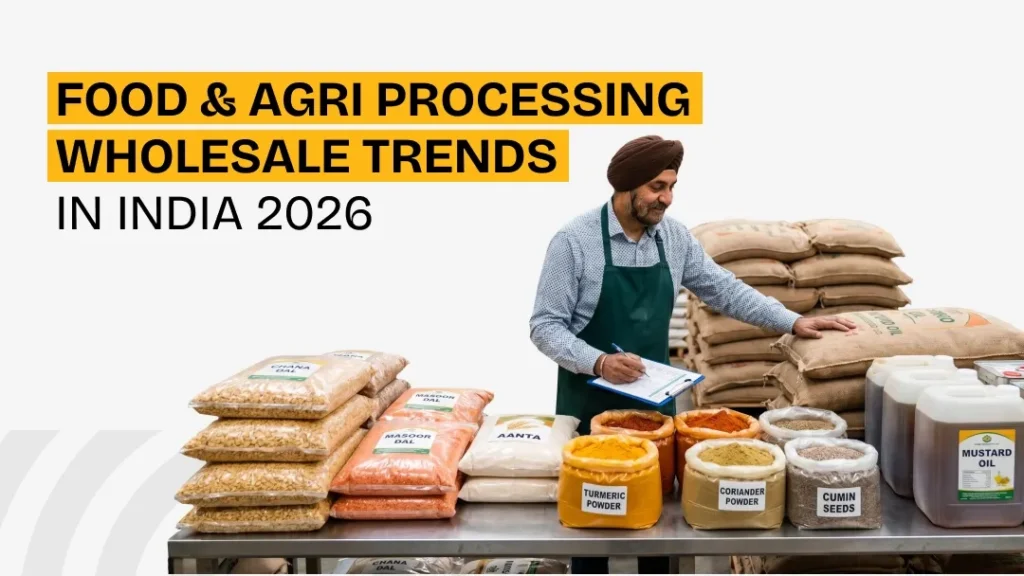
What distributors and wholesalers need to watch in a year of tighter FSSAI enforcement, export quality pressure, and shifting sourcing patterns
India’s food and agri processing sector is in an unusual position. The macro numbers tell a strong story. The sector contributes 8.8% to manufacturing GVA, 8.39% to agriculture GVA, and 13 percent of national exports. The PLI scheme has pulled in Rs 9,000 crore of cumulative investment with double digit export growth since 2019 onwards. The Union Budget allocated Rs 4,364 crore to MoFPI in 2025 to 2026. By any sensible measure, the sector is growing well and the policy environment is supportive.
But ask any food wholesaler in Khari Baoli or Unjha what their daily reality looks like, and the answer is not about growth. It is about FSSAI inspections, batch traceability requirements that did not exist three years ago, mandi rate changes that move faster than the price list, and large buyers who now refuse to accept dispatches without proper documentation. So the trade is growing and the operational pressure is mounting at the same time. This piece walks through six shifts that explain the gap, and what they mean for the wholesaler running a food and agri operation in 2026.
The state of India’s Food & Agri Industry in 2026
Start with the sector size. Food processing accounts for 8.80% of Manufacturing GVA and 8.39% of Agriculture GVA, going by MoFPI data via IBEF references. The sector contributes 13% of India’s exports and 6% of overall industrial investment. India is the world’s largest producer of spices, milk, and tea, the second largest producer of fruits and vegetables, and the third largest producer of fish. So the raw material base alone is structurally strong, and the processing industry sits on top of that.
The PLI scheme has accelerated the pace of formalization in the sector. 170 applications approved, Rs 9,000 crore in cumulative investment, exports compounding at 13.23% annually since 2019 onwards. Food processing capacity has increased by 35 lakh metric tonnes per annum under PLI, with 3.39 lakh direct and indirect jobs created. The Union Budget 2025 to 2026 allocated Rs 4,364 crore to the Ministry of Food Processing Industries. So policy support is real and the formalization wave is reshaping who manufactures and how distributors source.
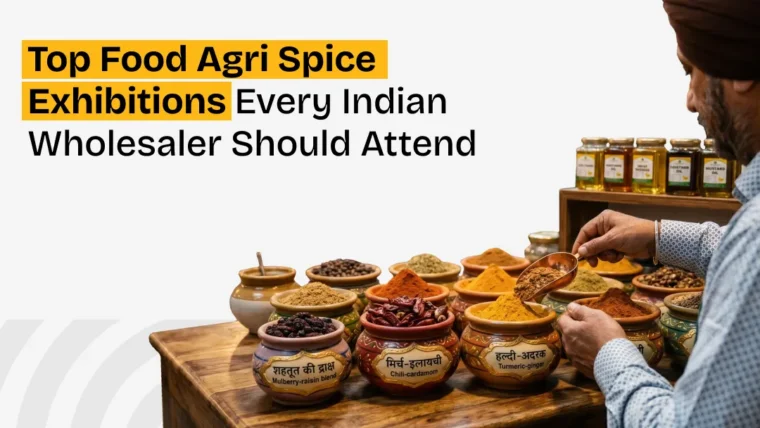
On the spice side, the numbers tell their own story. India’s spice market is valued at around USD 7.63 billion in 2026 and is projected to reach USD 11.55 billion by 2033 at 6.1% annual growth. Spice exports stood at USD 4.35 billion in 2023 to 2025, up from USD 3.78 billion in 2022 to 2023. The export trade went through a significant quality reckoning in 2024 when Singapore and Hong Kong recalled certain MDH and Everest products over ethylene oxide contamination concerns. FSSAI subsequently ordered nationwide testing of spice manufacturers. That entire episode has reshaped what buyers, both domestic and export, expect from food and spice wholesalers in 2026. With that backdrop, here are the six shifts to track.
Six trends shaping food and agri wholesale in 2026
Trend 1: FSSAI enforcement has shifted from warnings to actual penalties
For years, FSSAI compliance felt like a paperwork exercise. Annual returns, license renewals, the occasional sampling. The 2024 episode changed that posture in a way that is still being felt. FSSAI ordered nationwide inspections at all spice mix manufacturers, testing close to four lakh samples in the period that followed. Enforcement teams are now actively sampling, testing, and penalising. Twenty five% of samples tested across recent years have failed regulatory standards, which means the inspection regime is no longer theoretical.
For wholesalers, the implication is operational, not just legal. The batch records, supplier traceability documentation, and dispatch logs that used to live in a drawer now need to be retrievable in 24 hours during an inspection. Many wholesalers are realizing their record keeping was never built to withstand this kind of audit pressure. The smart ones are using 2026 to build the documentation discipline before the inspector walks in, rather than after. The cost of getting caught unprepared is now significant enough to be a business risk rather than a paperwork inconvenience.
Trend 2: The 2024 ethylene oxide bans changed global perception of Indian spice quality
The Hong Kong and Singapore recalls in April 2024 were about specific products from two of India’s largest spice brands. The impact has been broader than those specific recalls. The EU enforces near zero tolerance for ethylene oxide, with a 0.05 mg per kg limit, and has driven a surge in rejections of turmeric, black pepper, cumin, and curry powder shipments from India. Some Indian processing units were still using ETO because it was cheaper and faster than alternatives like steam sterilization, and the practice has now become a clear export risk.
The downstream pressure has reached domestic wholesalers more than most expected. Large export oriented food processors now demand batch test certificates and pesticide residue documentation from their wholesale suppliers. Wholesalers who sell to these processors are facing the same scrutiny indirectly, even if they themselves do not export anything. The wholesalers who built batch documentation discipline early are picking up the contracts that less prepared competitors are losing. This is a quiet but real shift in who wins which contracts in 2026.
Trend 3: PLI is reshaping the supplier base
Rs 9,000 crore in cumulative PLI investment has created a new tier of larger, more compliant manufacturers in the sector. Brands and processing units that previously operated semi formally are either scaling up under the PLI umbrella or being squeezed out by competitors who did. Capacity has grown by 35 lakh tonnes per annum under PLI alone. For wholesalers, this means the supplier base is consolidating in ways that change sourcing economics.
The wholesalers who built relationships with regional smaller manufacturers are seeing those manufacturers either grow significantly (and renegotiate terms) or exit the market. Sourcing is becoming more concentrated, which means a wholesaler has less flexibility on supplier choice but also fewer compliance questions to ask, because the larger PLI supported manufacturers tend to come with cleaner documentation. The net effect is a trade that is becoming more formal, more concentrated at the supplier end, and more demanding in terms of who can play.
Trend 4: Spice parks and One District One Product are creating new sourcing geography
The government’s Spice Park program has set up dedicated processing and grading clusters at Guntur for chilli, Erode for turmeric, Vazhakulam in Kerala for cardamom, and similar locations for other major spices. These parks consolidate processing infrastructure, upgrade quality control, and offer export grade facilities under one roof. The ‘One District, One Product’ scheme is creating regional specialization that runs alongside the traditional mandi based sourcing pattern.
For wholesalers in established hubs like Unjha and Khari Baoli, this is a competitive shift to be aware of. Buyers can now source directly from Spice Parks for institutional and export needs, which changes the wholesaler’s traditional role from inventory holder to value added service provider. The wholesalers who adapt to this, by building stronger packaging, grading, and customer specific blending capabilities, are positioning themselves above the procurement only role. The ones who stay purely as bulk traders are facing margin compression as the trade routes around them.
Trend 5: Order management is becoming critical for wholesalers handling 100 plus retailers
Each of the trends above has the same operational subtext. FSSAI compliance needs batch records tied to specific dispatches. Quality documentation needs to be retrievable on demand. Customer specific pricing across HoReCa, retail, and institutional buyers needs to apply automatically. Spice park sourcing needs cleaner record keeping at the wholesaler end. None of this is solvable by working harder. It needs a different workflow underneath the business.
Food and agri wholesalers deal with perishable inventory, batch and expiry tracking, weight based pricing in kilograms and quintals, mandi rate fluctuations that move daily, and FSSAI documentation requirements that vary by category. The wholesalers who have moved to structured order management are protecting margin in a category where margin is genuinely thin (often 4 to 8% on basic categories) and operational errors compound quickly. They are also handling the inspection visits with significantly less stress than competitors still pulling records together from notebooks and Excel sheets.
Platforms built for this kind of trade, including Biizline, handle the specific needs of food and agri wholesale. Batch tracking at the order level. Weight based pricing with tolerance handling for actual dispatched weights versus ordered weights. Customer specific rates that apply automatically across HoReCa, retail, and institutional categories. Order linked dispatch records that preserve traceability from supplier through to retailer. For wholesalers in 2026, this is not a productivity tool. It is the operational foundation that makes compliance manageable rather than a recurring crisis.
Trend 6: Quick commerce is now sourcing direct from agri wholesalers
Blinkit, Zepto, Swiggy Instamart, and Amazon Now have moved beyond packaged FMCG and are now sourcing fresh agri products, dals, atta, spices, and oils directly from wholesalers and producers. For wholesalers in spice clusters like Unjha and Khari Baoli, or in dal mill clusters like Latur, Akola, and Indore, quick commerce represents a new buyer profile with very specific requirements.
Quick commerce buyers want tight dispatch windows, batch consistency across orders, FSSAI documentation per dispatch, and high frequency reorders. The volume is real and the margins are typically better than retail kirana trade, but only if the wholesaler can meet the operational bar. Distributors who can service this profile cleanly are seeing meaningful volume growth in 2026. Those who cannot are losing the opportunity to better organized competitors who built the operational discipline first. The dynamic is similar to what happened in FMCG distribution two years ago, just one level upstream in the supply chain.
Where India’s food and agri wholesale concentrates
The food and agri trade in India is built around specific clusters, each with their own history, brand affiliations, and operational rhythms. Knowing the clusters helps make sense of how sourcing, pricing, and competition actually work.
- Unjha in Gujarat is Asia’s largest cumin and spice mandi, anchoring the spice trade for much of north and west India.
- Khari Baoli in Delhi is the largest wholesale spice market in India by volume, serving the entire northern belt and a significant export channel.
- Vazhakulam in Kerala is the central hub for cardamom and other south Indian spices.
- Guntur in Andhra Pradesh handles the majority of India’s chilli trade.
- For dal and pulses, Latur and Akola in Maharashtra and Indore in Madhya Pradesh are the major clusters.
- Surat handles dry fruits, packaged foods, and export oriented processing.
- Coimbatore and Erode in Tamil Nadu manage south Indian agri processing including turmeric and grocery items.
Each of these clusters has its own competitive intensity. A wholesaler in Khari Baoli is surrounded by hundreds of similar wholesalers, and the differentiation that worked five years ago, mainly trust and rate, is no longer enough. Buyers, especially the larger ones, now want documentation, traceability, and reliable dispatch on top of the traditional relationship. The clusters where wholesalers have invested in operational discipline are pulling ahead. The ones still running on memory and personal relationships are facing slow erosion.
What food and agri wholesalers should prepare for in 2026
Pulling the trends together, here is what is worth acting on this year. Four things, kept practical.
1. Audit your batch and lot record system before the next FSSAI inspection
If you cannot pull six months of dispatch records by batch number in under 30 minutes, the system needs work. This is not theoretical. FSSAI inspections have intensified and the cost of being caught unprepared has risen sharply. Spending a quarter cleaning up batch records is cheaper than dealing with the consequences of failing an inspection.
2. Build a quality documentation layer for any supplier whose product reaches export channels.
The pressure that started with the 2024 ethylene oxide situation has not eased. Larger buyers, especially those who export or supply to organised retail and quick commerce, now expect this documentation as standard. The wholesalers who build it proactively are picking up the contracts that less prepared competitors lose.
3. The manual rate management and batch tracking is now the operational ceiling
Especially, if you serve 100 plus retailers across multiple categories. Focus not on the volume, but the workflow underneath it. For wholesalers at this scale, Biizline keeps the batch reference attached to every order and every dispatch record, applies customer specific pricing automatically, and handles weight based pricing with tolerance for actual dispatch variations. The transition pays for itself within a quarter for most wholesalers at this scale.
4. Quick commerce platforms are a new and growing buyer profile worth pursuing actively
Make sure your batch and dispatch discipline can meet their standards. The opportunity is real and the margins are typically better than traditional kirana retail. The operational bar is genuinely higher than what most wholesalers are currently running. Use 2026 to either build to that bar or to consciously stay focused on traditional retail channels.
Food and spice wholesalers across Unjha, Khari Baoli, and other clusters have moved through this transition over the last two years. See what they are saying about how the shift from manual coordination to structured order management changed their compliance workflow and their customer relationships.
Final Thoughts
Food and spice wholesale is a thin margin, high frequency business where operational discipline is genuinely the difference between profit and survival. The macro tailwinds in 2026 are real. PLI is driving formalization, export demand is growing, FSSAI enforcement is forcing quality upgrades across the sector. The wholesalers who treat record keeping, batch tracking, and quality documentation as core operations rather than overhead are positioning themselves to absorb that growth. The ones who treat compliance as paperwork are facing escalating penalties and slowly losing the contracts that demand higher operational standards.
The shift this year is not about technology adoption for its own sake. It is about whether your operation can carry the documentation and traceability load that the trade now demands. The wholesalers who answer that question clearly will spend 2026 picking up contracts. The ones who do not will spend the year scrambling. There is no third path that involves growth without operational change. That used to be possible. It is not anymore.
Frequently asked questions
How big is India’s food processing sector in 2026?
Food processing accounts for 8.80% of Manufacturing GVA, 8.39% of Agriculture GVA, 13% of national exports, and 6% of overall industrial investment. The PLI scheme has driven Rs 9,000 crore in cumulative investment with export CAGR of 13.23% since 2019 onwards. India’s spice market alone is valued at around USD 7.63 billion in 2026 and is projected to reach USD 11.55 billion by 2033.
What changed for spice wholesalers after the 2024 ethylene oxide bans?
Hong Kong and Singapore recalled specific MDH and Everest spice products in April 2024 over ethylene oxide contamination. FSSAI subsequently ordered nationwide testing of spice manufacturers, with close to four lakh samples tested. Larger buyers now demand batch test certificates and pesticide residue documentation, and the pressure has reached domestic wholesalers indirectly even if they do not export.
Which city is the largest spice wholesale market in India?
Khari Baoli in Delhi is the largest wholesale spice market in India by volume, serving the entire northern belt and a significant export channel. Unjha in Gujarat is Asia’s largest cumin and spice mandi, anchoring the spice trade for much of north and west India. Vazhakulam in Kerala and Guntur in Andhra Pradesh are major regional spice hubs.
How are quick commerce platforms changing agri wholesale?
Blinkit, Zepto, Instamart, and Amazon Now have moved beyond packaged FMCG and are now sourcing fresh agri, dals, atta, spices, and oils directly from wholesalers. The buyer profile demands tight dispatch windows, batch consistency, FSSAI documentation, and high frequency reorders. Margins are typically better than traditional retail, but only if the wholesaler can meet the operational bar.
What FSSAI compliance is required for food wholesalers?
Wholesalers need valid FSSAI licenses at the appropriate scale, batch tracking from supplier through to dispatch, retrievable records for at least the previous 12 months, and supplier level documentation including quality certificates for regulated categories. The enforcement regime intensified after 2024, with active sampling and meaningful penalties for non compliance, so documentation needs to be operational rather than paper only.
Share this Blog