
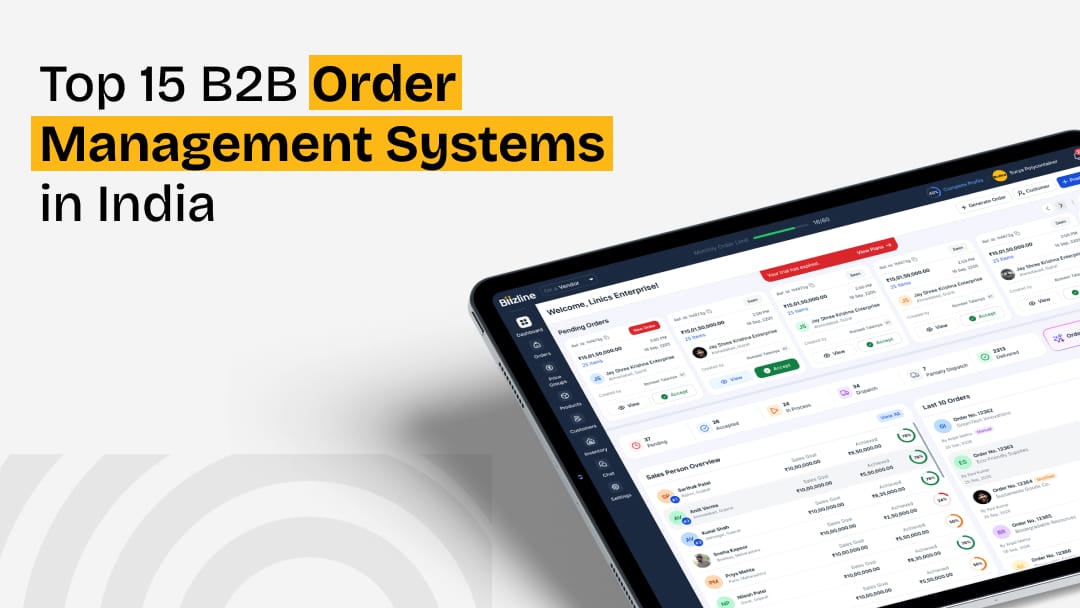
Top 15 B2B Order Management Systems in India
A practical comparison for wholesalers, distributors, and manufacturers looking for the right system in 2026 Every list of order management systems in India starts the same way. Twenty platforms, most of them built for D2C e-commerce brands shipping through Shopify and Amazon, ranked by features that matter to online retailers with marketplace integration, shipping label generation, and returns automation. This is only useful if you are running a fashion brand but utterly useless if you are into an MSME business processing orders for 50-60 dealers throughout the day.
That’s why this list is different. It is built for the person running a B2B operation in India. It’s for someone like a Plastics manufacturer, a Hardware wholesaler, or an FMCG distributor. Someone who deals with dealer specific pricing, trade schemes, partial dispatch, credit management, and SKU catalogues that run into thousands. The 15 platforms listed below are evaluated on whether they actually fit that workflow, not on how many marketplace integrations they offer.
Some of these platforms are excellent for specific use cases. Some are popular but wrong for B2B wholesale. The comparison is honest about both. If a platform is not a good fit for an Indian MSME running a B2B operation, this piece says so, even if it is a well known name.
How this comparison is structured
Each platform is evaluated on eight criteria that matter for Indian B2B operations:
- B2B order workflow: Can it handle multi line dealer orders, customer credit, and the kind of repeat ordering that B2B trade runs on?
- Customer specific pricing: Does it support per dealer negotiated rates that apply automatically at billing, without manual recall?
- Trade scheme logic: Can it manage scheme rules (buy X get Y, volume discounts, expiry dates) and apply them without manual checking?
- Partial dispatch tracking: Can it track which items from a multi item order have shipped and which are still pending?
- Mobile and field ordering: Can sales reps place orders from the field that the desk sees immediately?
- India and MSME fit: Is it priced for a three to ten crore business? Does it work in Hindi or Gujarati? Can the existing team learn it without IT support?
- Industry depth: Does it handle the specific needs of plastics, FMCG, hardware, electrical, auto parts, or food wholesale?
- Accounting compatibility: Can order data flow into Tally or Zoho Books for billing and GST compliance?
Top 15 OMS in India
1. Biizline
Type: B2B order management platform for Indian MSMEs
Biizline is purpose built for Indian wholesalers, distributors, and manufacturers running B2B operations. The platform handles per dealer negotiated pricing that applies automatically the moment an order is entered, so the billing desk does not need to recall rates from memory. SKU variants are structured as searchable fields (grade, colour, size, pack count) rather than free text entries. Partial dispatch tracking lives inside the order record. Rate lock at order confirmation holds the price even if input costs shift between the quote and the dispatch. Credit positions per dealer are visible at any moment.
The platform works on mobile, supports Hindi and Gujarati, and the existing billing team can typically learn it within a week without IT support. Implementation takes weeks, not months.
Design focus: The Indian B2B MSME doing three to fifty crore in revenue with fifty to five hundred dealers. Industry specific workflows for plastics, FMCG, hardware, electrical, auto parts, and food wholesale are core features, not add-on modules. See the full feature set.
What it does not do: Biizline is not an ERP. It does not cover production planning, HR, or full accounting. It is designed to work alongside Tally or Zoho Books, handling the order workflow that sits before the billing layer.
2. Vyapar
Type: Invoicing and accounting app for Indian SMEs
Vyapar is one of the most widely used business apps in India, with millions of downloads. Per its documentation and Capterra reviews, it handles GST invoicing, inventory tracking with batch and expiry support, barcode scanning, delivery challans, purchase orders, expense tracking, and payment reminders. The mobile app works in Hindi and multiple Indian languages. Customer records can be maintained with payment history and outstanding balance tracking.
Design focus: Billing, invoicing, and accounting for Indian small businesses across industries. Vyapar serves kirana stores, pharmacies, hardware shops, distributors, and service businesses. G2 reviews highlight ease of use and efficient billing as the strongest features, with limited customization and platform integration noted as common limitations.
Where it differs from a B2B OMS: Vyapar handles billing and inventory well. The order management layer, where per dealer negotiated pricing applies automatically at the point of order entry, trade scheme rules get enforced by the system, and partial dispatches are tracked against each order, is not the platform’s primary design focus. For a wholesaler whose pain is billing and GST compliance, Vyapar addresses that directly. For one whose pain is the order workflow sitting before the billing, Vyapar’s feature depth in that area is more limited.
3. Zoho Inventory
Type: Inventory and order management. Part of the Zoho suite. Indian company, global product.
Zoho Inventory supports price lists that can be assigned to specific customers or customer groups, per its official documentation. A 10% loyalty discount, a regional pricing tier, or a volume based rate can be configured as a price list and attached to the relevant contacts. The platform also supports composite items, batch tracking, serial number tracking, multiple warehouses, and integration with Zoho Books and major e-commerce platforms. The June 2026 update to Zoho Books added automatic batch assignment with FIFO, FEFO, and LIFO strategies.
Design focus: A horizontal inventory and order platform that integrates into the broader Zoho suite. Strong for businesses already using Zoho Books or Zoho CRM who want a connected stack. Capterra reviews praise the learning curve and reporting, while noting that advanced customization can be confusing and some features are locked to higher pricing tiers.
Where it differs from a B2B MSME OMS: Zoho Inventory supports customer level price lists, which covers a significant part of the dealer pricing requirement. Where the fit gets less direct is in trade scheme logic (buy X get Y, quantity slabs with expiry dates, stacking rules), which is not a native Zoho Inventory feature. The interface is English only, which affects team adoption in businesses where the billing staff works primarily in Hindi or Gujarati. And the pricing tiers, starting free but scaling to USD 249 per month at enterprise, position the product for a different budget range than most three to ten crore Indian MSMEs operate in.
4. Unicommerce
Type: e-commerce supply chain platform. Indian company. NSE and BSE listed.
Unicommerce processes over 20 percent of India’s e-commerce order volume, per the company’s own reporting. The platform handles marketplace integration (Amazon, Flipkart, Myntra, Meesho), warehouse management, order routing, bulk invoicing, shipping label generation, and returns management. Clients include Lenskart, Sugar Cosmetics, mCaffeine, and Jack and Jones. A Goodfirms interview with Unicommerce confirms that the platform offers batch management, expiry management, and bulk order processing for B2B companies.
Design focus: It’s an e-commerce supply chain automation. The platform is designed to manage the flow from marketplace order to warehouse pick, pack, ship, and return. Per Capterra data, 78 percent of reviewers are small businesses and 43 percent are in apparel and fashion. G2 reviews mention strong inventory sync and order processing, with B2B API issues and limited report customization as noted drawbacks.
Where it differs from traditional B2B order management: Unicommerce handles B2B orders but its architecture is built around e-commerce workflows, channel management, and marketplace integration. For a wholesaler whose daily operation is dealer specific pricing, phone and WhatsApp order intake, godown level dispatch, and trade scheme management, the platform’s strengths align with a different workflow. Pricing is available on request, not published, which is typical of enterprise SaaS positioning.
5. Vinculum
Type: Omnichannel OMS and WMS. Indian company, operating since 2007.
Vinculum’s Vin eRetail platform covers order management, warehouse management, and omnichannel retail with a broad connector library. Clients include Jockey, Fabindia, and Decathlon. Per the Base.com comparison (July 2026), Vinculum has an established enterprise presence and a strong WMS module, with implementation timelines of 8 to 12 weeks per the same source. Capterra rates it 4.6 with notes about occasional downtime and bulk upload limitations.
Design focus: Large retailers and offline first brands managing orders across stores, warehouses, and online channels. The platform serves the enterprise omnichannel use case.
Where it differs from MSME B2B: Vinculum’s architecture, implementation timeline, and pricing are designed for enterprise retail operations. For an MSME wholesaler or manufacturer doing five to ten crore, the implementation investment and feature focus are oriented toward a different scale and type of business.
6. Tally (with add ons)
Type: Accounting and compliance platform. Indian. Widely adopted.
Tally is the de facto accounting and GST compliance software for Indian businesses. It handles invoicing, financial reporting, statutory compliance, and bank reconciliation. With third party add ons and plugins developed by Tally’s partner network, some order management functionality can be layered on top of the accounting base.
Design focus: Accounting, billing, and GST compliance. Tally’s strength is in what happens after the order is confirmed: generating the invoice, applying GST, recording the transaction, and producing the financial reports. A massive network of CAs, accountants, and support professionals across India makes Tally the most supported accounting platform in the country.
Where it differs from an OMS: Tally manages the billing layer. An OMS manages the operational layer that sits before billing: order intake from multiple channels, customer specific pricing logic, trade scheme application, partial dispatch tracking, and stock commitment validation. These are different problems that Tally’s core architecture does not address natively. The add ons that exist for order management are third party workarounds, not native Tally features, and their depth varies. Most B2B businesses that adopt an OMS continue using Tally for billing, running the two systems in tandem.
7. ApnaERP
Type: ERP for Indian manufacturers.
ApnaERP covers production, inventory, sales, purchase, and accounting in one system. The platform lists plastics, metals, and engineering manufacturing on its website. For a processor who needs production planning alongside order and dispatch management, this is a more comprehensive solution than a standalone OMS.
Design focus: Indian manufacturers who want a single system covering the factory floor through to billing. The value proposition is integration across manufacturing, inventory, and sales.
Where it differs from a standalone OMS: ERP covers more ground, which means longer implementation, more training, and a higher cost. For an MSME whose production workflow is already managed (even informally) and whose core pain is the order and pricing layer with dealers, the additional ERP modules add complexity without addressing the primary bottleneck. For processors who genuinely need production and order management in one system, the comprehensiveness is an advantage.
8. Busy Accounting
Type: Accounting and inventory management. Indian.
Busy is a well established Indian accounting tool, particularly in north India. It handles billing, inventory tracking, GST compliance, and basic sales order management. The interface supports Hindi. Pricing is affordable for small businesses with annual license options.
Design focus: Accounting and compliance for Indian SMEs, with inventory tracking as a complementary feature. Busy serves a similar role to Tally, with a somewhat different user base concentrated in north India.
Where it differs from a B2B OMS: Similar to Tally, Busy handles the billing and accounting layer. The order management capabilities (per dealer pricing logic, trade scheme rules, partial dispatch tracking, field ordering) are not core features. For a business that needs accounting with basic sales tracking, Busy does that well. For one that needs the operational order workflow fixed, the feature depth in that area is limited.
9. GoFrugal
Type: Retail POS and business management. Indian company.
GoFrugal combines billing, POS, inventory, and order management for retail operations. The platform is strong in grocery, pharmacy, restaurant, and general retail verticals. It handles store level inventory, consumer facing order workflows, and multi location retail management.
Design focus: Retail store operations. The order workflows are built around consumer facing POS transactions, restaurant KOT processing, and pharmacy dispensing, not around B2B dealer trade with negotiated pricing and multi line orders.
Where it differs from B2B wholesale: GoFrugal’s architecture serves the retailer selling to consumers, not the wholesaler selling to dealers. Per dealer pricing, trade scheme management, partial dispatch tracking, and B2B credit management are not core features because they are not relevant to the retail POS use case the platform was designed for.
10. EasyEcom
Type: e-commerce order and inventory management. Indian company.
EasyEcom offers a lighter alternative to Unicommerce for smaller e-commerce brands. Per Base.com’s comparison, it is positioned as a quick setup option for brands that want marketplace integration without heavy ERP requirements. The platform handles order routing, inventory sync, and basic fulfillment workflows.
Design focus: Small to mid sized e-commerce sellers managing orders across online marketplaces.
Where it differs from B2B: EasyEcom is designed for the e-commerce order flow (marketplace to warehouse to courier to consumer). The B2B wholesale workflow (dealer orders, negotiated pricing, trade schemes, godown dispatch, credit management) is a different operational model that the platform is not built around.
11. WizCommerce
Type: AI powered B2B commerce platform. Global.
WizCommerce includes order management, B2B e-commerce, catalog management, and payment processing. The AI sales copilot feature assists with order writing and product recommendations. Per its documentation, the platform supports customer specific pricing, real time inventory, and ERP integration. The B2B wholesale focus is genuine and the feature set is designed for wholesale and distribution operations.
Design focus: B2B wholesale and distribution, primarily for North American and European markets. The AI ordering assistant is a differentiator for operations with large catalogues and repeat ordering patterns.
Where it differs for Indian MSMEs: WizCommerce is a global SaaS product with pricing and feature priorities aligned to Western wholesale workflows. Indian specific needs like trade scheme logic, Hindi or Gujarati interface, INR based rate management, and EPR or FSSAI documentation are not part of the platform’s design focus. For an Indian MSME doing five crore in revenue, the cost structure is likely above the operational budget for order management software.
12. QuickBooks Enterprise
Type: Business management suite with order management module. Global (Intuit).
QuickBooks Enterprise includes sales order management with pick, pack, and ship workflows, barcode scanning, shipping label generation, and multi location inventory. The platform is well documented and integrates with a wide range of accounting and payment tools.
Design focus: US and global small to mid sized businesses. The accounting, tax, and compliance logic is built around US standards (GAAP, US tax codes). The order management module is strong for businesses operating in QuickBooks’ primary markets.
Where it differs for Indian B2B: QuickBooks is not designed around Indian GST, INR pricing workflows, or the Indian B2B dealer trade model. Customer specific pricing for Indian dealer networks, trade scheme logic, and Hindi or Gujarati interfaces are not part of the product. For Indian businesses with US or global operations, QuickBooks may be relevant. For a purely domestic Indian MSME, the platform’s design assumptions do not align with the operating reality.
13. Cin7 (Core)
Type: SMB inventory and order management with manufacturing support. Global.
Cin7 Core supports manufacturing workflows, multi-channel order processing, and inventory management. Per Capterra and Software Advice reviews, it handles product assembly, stock tracking, and order routing across channels. The platform is one of the few global SMB tools that covers production alongside orders.
Design focus: Product brands that manufacture and sell across multiple channels, primarily in English speaking markets.
Where it differs for Indian MSMEs: Cin7 is a global product without Indian specific features. No Hindi or Gujarati, no Indian trade scheme logic, no INR based rate management for dealer networks. Pricing is in USD and oriented toward global SMBs, which places it outside the budget range of most three to ten crore Indian MSMEs.
14. SimplyDepo
Type: B2B order management for wholesale distribution. Global.
SimplyDepo focuses on B2B ordering, invoicing, delivery planning, and real time account visibility for wholesale distributors. The interface is clean and mobile friendly. Per its website, the platform supports customer specific pricing and basic order management workflows. A free trial is available.
Design focus: Wholesale distributors in Western markets who want a clean, modern B2B ordering tool.
Where it differs for Indian MSMEs: SimplyDepo is built for Western wholesale workflows. Indian specific requirements, GST integration, trade scheme logic, Hindi or Gujarati language, INR based dealer pricing, and the kind of credit management that Indian B2B runs on, are not part of the platform’s design. The B2B ordering concept is right, but the market fit is different.
15. OrderEase
Type: B2B ordering portal with ERP integration. Global.
OrderEase standardizes how orders move from intake channels to ERP. Per its documentation, it keeps catalogs, pricing rules, and customer ordering aligned so every order is validated before submission. The platform integrates with major ERPs including SAP and NetSuite.
Design focus: Businesses with established ERP systems that need to clean up and standardize their B2B order intake channels.
Where it differs for Indian MSMEs: OrderEase’s value proposition is strongest for companies already running SAP, NetSuite, or similar enterprise ERPs. Most Indian MSMEs in the three to ten crore range do not use enterprise ERP, which makes the platform’s primary strength less relevant. No Indian language support, no Indian trade scheme logic, and no GST integration.
Which Order Management Software is best for my business?
Best for Indian MSME wholesale and manufacturing: Biizline. It’s purpose built for the workflow. It’s affordable, and easy to use so it doesn’t need an IT team to manage it.
- Invoicing and accounting first: Vyapar (mobile, Hindi, affordable) or Busy Accounting (north India, desktop)
- Businesses already on Zoho: Zoho Inventory for the connected stack, with awareness that trade scheme logic is not a native feature
- e-commerce order management: Unicommerce (established, NSE listed) or EasyEcom (lighter, quicker setup)
- Full manufacturing ERP: ApnaERP (India focused, covers production and orders)
- Retail POS: GoFrugal (grocery, pharmacy, restaurant)
- Accounting and GST: Tally (pair with an OMS for the order workflow that sits before billing)
- AI assisted B2B ordering for international operations: WizCommerce
Pricing reality for Indian MSMEs
Most Indian MSMEs running three to ten crore in B2B revenue have a realistic software budget of Rs 1,000 to Rs 5,000 per month for order management. At that range, the shortlist narrows significantly.
- Biizline: MSME pricing, monthly subscription, no setup fees
- Vyapar: Free tier available, paid plans affordable for invoicing and accounting
- Busy: Affordable annual license for accounting and basic order tracking
- Zoho Inventory: Free for very small usage, scales with volume, higher tiers in USD
- Tally: License or subscription for accounting, third party OMS add ons vary in cost
- ApnaERP: Custom pricing, typically higher given full ERP scope
- Unicommerce, Vinculum: Pricing on request, enterprise SaaS positioning
- WizCommerce, QuickBooks, Cin7, SimplyDepo, OrderEase: Global SaaS pricing in USD
For an Indian MSME whose core need is B2B order management at an affordable price, the realistic options are Biizline, Vyapar (for billing with basic orders), and Zoho Inventory (for Zoho suite users). Of these, Biizline is the only platform designed around the B2B dealer trade workflow as its primary function. Check current pricing.
How to decide
The most common mistake is not choosing the wrong software. It is choosing software designed for a different kind of business. An e-commerce OMS will not fix a wholesaler’s dealer pricing problem. A manufacturing ERP will not fix a distributor’s dispatch tracking problem. And an accounting tool will not fix an order intake problem, regardless of how many add ons are layered on top.
Start with the problem, see if the pain is billing and GST, Tally and Vyapar already handle that well. If the pain is e-commerce order flow, Unicommerce and EasyEcom are strong. If the pain is the B2B order and pricing workflow, the daily reality of dealer orders, negotiated rates, partial dispatches, and a team managing everything through WhatsApp, then Biizline was designed for exactly that.
Businesses across plastics, FMCG, hardware, electrical, auto parts, and food wholesale have already made this choice. See what they are saying about the transition.
Frequently asked questions
What is the best B2B order management software in India?
For Indian MSMEs running B2B wholesale or manufacturing operations, Biizline is the most direct fit because it is purpose built for that workflow. For e-commerce, Unicommerce is the strongest. For full manufacturing ERP, ApnaERP. The best choice depends on the specific business type and problem.
How much does order management software cost in India?
For MSMEs, realistic pricing ranges from Rs 1,000 to Rs 5,000 per month. Vyapar and Busy offer affordable accounting with basic order features. Biizline offers MSME priced B2B order management. Zoho Inventory has a free tier that scales with usage. Enterprise platforms like Unicommerce and Vinculum are priced higher.
Is OMS the same as ERP?
No. OMS focuses on orders, pricing, dispatch, and dealer management. ERP covers the full business including production, HR, accounting, and CRM. Most MSMEs need the order layer fixed, not a full ERP. OMS is faster to implement, cheaper, and more focused on the specific pain.
Can I use OMS alongside Tally?
Yes. Tally handles accounting and GST. An OMS handles orders, pricing, schemes, and dispatch. They serve different functions. Most Indian businesses that adopt an OMS continue using Tally for billing.
Which OMS works in vernacular languages like Hindi or Gujarati?
Among the platforms on this list, Biizline and Vyapar offer Hindi and Gujarati support. Most global platforms (Zoho, WizCommerce, QuickBooks, Cin7) are English only. Language support matters because team adoption drops sharply when the interface is in a language the billing team does not read comfortably.