
Published on
Top FMCG Exhibitions Every Indian Distributor Should Attend
A practical calendar of B2B events from mid 2026 through 2027, focused on retail distribution, brand dimemorscovery, and channel expansion
FMCG distribution in India is still a relationship business at its core. The best partnerships between brands and distributors do not start over email or a cold call. They start at exhibitions, where you can look someone in the eye, see their product range laid out on a table, and figure out in 20 mins whether the business makes sense or not. That kind of speed is hard to replicate on WhatsApp.
The list below is built for FMCG distributors and suppliers in particular. Not food processors, not commodity wholesalers, those are different audiences with different events. These are the exhibitions, conferences, and sourcing platforms where distribution deals happen, new SKU ranges get discovered, and the conversations that shape next year’s business take place.
The events worth blocking your calendar for
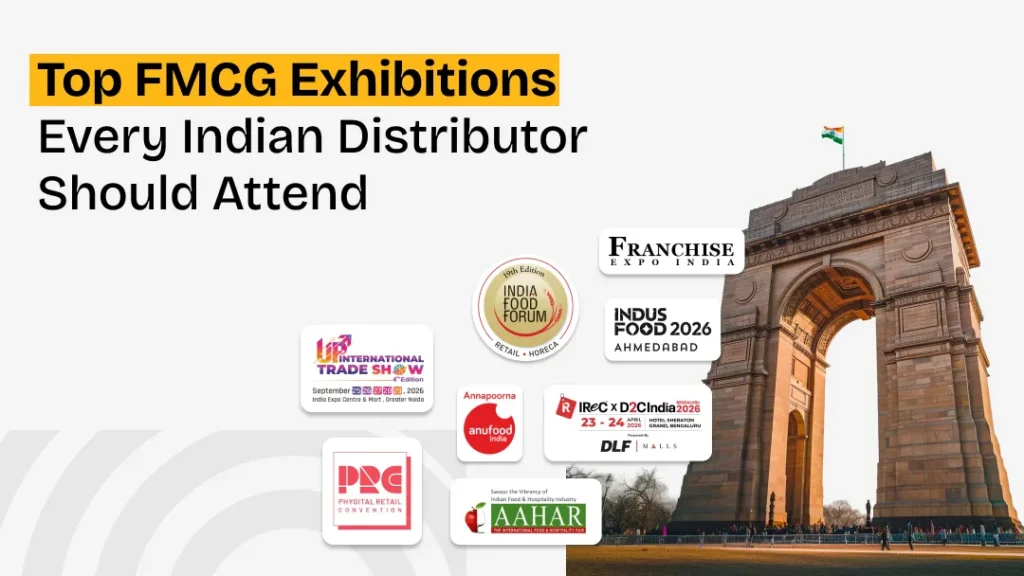
IndusFood (three editions)
Dates: Ahmedabad Jul 24 to 26, 2026 | South India, Chennai Nov 25 to 27, 2026 | Greater Noida Jan 8 to 10, 2027
Venue: Varies by each edition
IndusFood is Asia’s premier F&B sourcing platform, and it runs three editions a year, each serving a different geography. The Greater Noida flagship drew 1800+ exhibitors, 7500+ international buyers, and over USD 1.5 billion in on site business at the 2025 edition. The Ahmedabad edition is strongest for western India and the South India edition covers the southern belt. For a distributor, this is where you discover new brands actively looking for their first distribution partner. Come prepared with your retailer coverage map and current product range. The brands that are serious will ask for both.
UPITS 4.0 (UP International Trade Show)
Date: Sep 25 to 29, 2026
Venue: Greater Noida
Multi sector but with strong FMCG presence through the ODOP (One District One Product) pavilions. The 2025 edition saw participation from 80 countries. For tier 2 distributors in particular, this is a good place to explore regional brands and new product lines that larger exhibitions sometimes skip. The government scheme awareness sessions are also worth sitting through if you have not worked through MSME support programmes before.
India Food Forum
Date: TBD (annual, typically Q1 or Q2 of 2027)
Venue: Mumbai
This is not a traditional exhibition. It is a conference with product launch stages, brand showcase zones, and curated buyer meetings. The audience here is retail business heads, FMCG brand managers, and distribution decision makers. Several past speakers include leadership from companies like Reliance Retail, Godrej Consumer, ITC, and Nestle India. For a distributor, this is where you understand how brands are thinking about channel strategy, which directly affects your margin and role. This event is worth attending even if you do not walk away with a single new brand, because intelligence alone is valuable.
IITF (India International Trade Fair)
Date: Nov 14 to 27, 2026
Venue: Pragati Maidan, Delhi
Annual. The MSME pavilion and NSIC Techmart are the relevant sections for distributors. The event itself is massive and multi sector, so the FMCG content is one piece of a much larger show. Good for general exposure, government scheme awareness, and meeting MSMEs from adjacent sectors that might need distribution. Not the most targeted event on this list, but the footfall is unmatched.
Phygital Retail Convention (PRC)
Date: May 12 to 13, 2027
Venue: Jio World Convention Centre, Mumbai
India’s largest retail intelligence event. 300+ speakers. Sessions cover how FMCG brands split focus across general trade, marketplaces, D2C, and quick commerce, and what that means for distribution economics. For a distributor, this is less about finding new products and more about understanding the strategic direction the industry is moving in. If quick commerce is eating into your urban categories, the conversations here will give you a clearer picture of what comes next.
iRec Asia Bengaluru
Date: TBD
Venue: Bengaluru
Retail and D2C conference with strong FMCG brand representation. Sessions on omnichannel strategy, general trade relevance, and distribution economics. Particularly relevant for south India distributors. Smaller and more intimate than PRC, which can actually make the networking more productive since you are not competing with three thousand other attendees for the same speaker’s attention.
Franchise India
Date: TBD
Venue: typically Delhi
Asia’s largest retail and franchise show. Relevant for distributors exploring franchise and modern trade partnerships. If your distribution business is at the stage where you are thinking about whether to add a franchise retail outlet alongside wholesale, this is where you see what that looks like in practice. Also good for understanding how retail is expanding in tier 2 and tier 3, which is where the FMCG growth is sitting right now.
Annapoorna ANUFOOD India
Date: TBD (typically September)
Venue: Mumbai
International food and beverage sourcing platform with strong HoReCa and institutional buyer presence. For FMCG distributors, the HoReCa buyer connections here are of high value because institutional pricing almost always carries a better margin than retail. If you have been thinking about expanding into the hotel and restaurant supply channel, this is where those conversations start most naturally.
Aahar 2027
Date: March 2027 (exact dates TBD)
Venue: Bharat Mandapam, Delhi
The 41st edition of Asia’s largest food and hospitality fair. Organised by ITPO and MoFPI. While Aahar leans more toward food processing, the FMCG brand presence is substantial and the buyer traffic includes large retail chains and institutional procurement teams. For a distributor attending IndusFood and Aahar in the same quarter, the overlap is minimal because the buyer profiles are genuinely different.
How to make the most of these events
First, know what you are looking for before you go. Walking the floor hoping something catches your eye is a waste of a day. Pick the three categories you want to expand into, identify which exhibitors cover them, and schedule meetings before the event opens. Most large exhibitions now have online scheduling tools and buyer matchmaking programmes. Use them.
Second, bring your numbers. The brands worth partnering with will ask about your retailer count, geographic coverage, and monthly throughout before they discuss terms. Having these ready, ideally in a format that is clean and verifiable, makes the conversation move faster. Distributors who run their operations on a structured order management platform, Biizline being one, can pull this data in minutes because it already lives in the system. The distributor still running on notebooks and memory has to reconstruct it, and that reconstruction usually happens after the event when the urgency has faded.
Third, follow up within a week. The number of promising exhibition conversations that die because nobody followed up is genuinely surprising. Send a message, reference the specific conversation you had, and propose a concrete next step. Speed matters more than polish.
Where this leaves you
The events on this list are where the FMCG industry still meets in person, and the relationships built there carry the business for the next twelve months. A distributor who attends the right two or three events a year, prepares properly, and has the operational depth to follow through on the conversations will have a measurably better year than one who skips them or attends unprepared.
The operational depth part is worth underlining because it is where most distributors lose the thread. You can discover ten new brands at IndusFood, but if onboarding each one takes a month of manual pricing setup and scheme configuration, you will lose most of them to a competitor whose backend is faster. The events open the door to sales but the operations shouldn’t close the deal.
See what FMCG distributors across India are saying about how getting the operational layer right changed what they could do with the relationships they built at events like these.
Frequently asked questions
Which FMCG exhibition is the biggest in India?
IndusFood Greater Noida is the largest by exhibitor count and on site business volume, with 1800+ exhibitors and USD 1.5 billion in business at the 2025 edition.
Are these events open to small distributors?
Yes. Most events have specific MSME registration categories and some offer subsidised or free entry for registered MSMEs. IndusFood, IITF, and UPITS all have dedicated MSME pavilions and buyer programmes.
What should a distributor bring to an FMCG exhibition?
Your retailer coverage map, monthly throughput numbers, current brand portfolio, and a clear idea of which categories you want to expand into. The brands worth partnering with will ask for all four before they discuss terms.
Are there government subsidies for MSMEs attending exhibitions?
Yes, through various central and state MSME schemes. NSIC, state industrial development corporations, and MSME ministry schemes offer partial reimbursement for stall costs and travel for registered MSMEs attending designated exhibitions. Check with your local DIC office for current schemes.
How is IndusFood different from Aahar?
IndusFood is a dedicated B2B sourcing platform focused on connecting food brands with distributors and international buyers. Aahar is a broader food and hospitality fair covering everything from raw ingredients to kitchen equipment. Both are worth attending but the buyer profile and exhibitor mix are different.
Share this Blog