
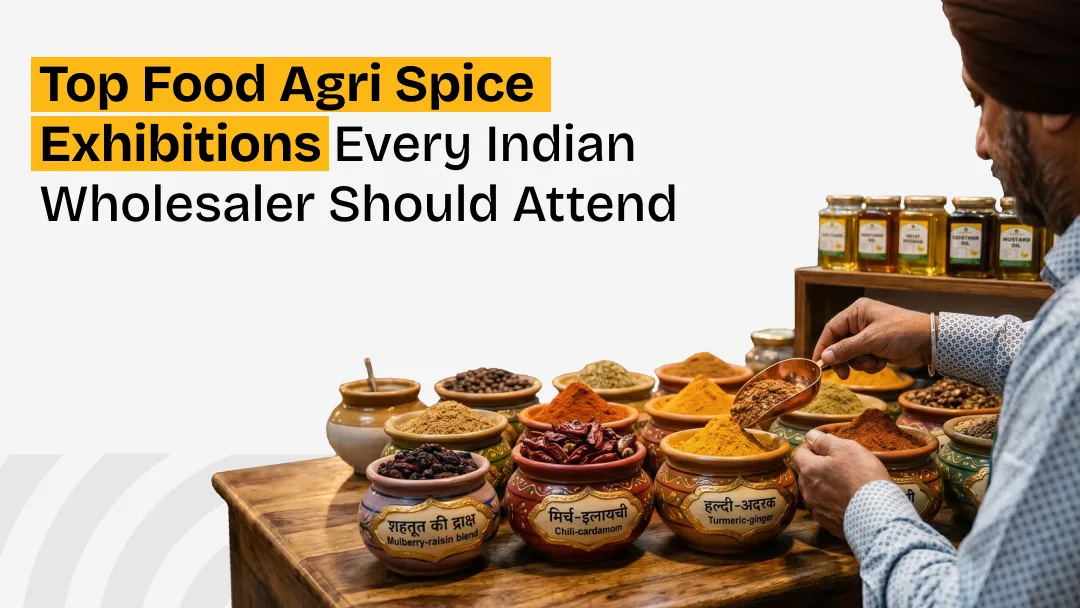
Top Food Agri Spice Exhibitions Every Indian Wholesaler Should Attend
A practical calendar of food processing and commodity sourcing events from mid 2026 through 2027
Of all the industries covered in this series, food and agri processing has the strongest exhibition calendar. The reason for that is PLI investment has crossed Rs 9,000 crore. Spice exports are compounding at 13 percent annually. FSSAI enforcement has gone from occasional inspections to nearly four lakh in a single year, with penalties crossing Rs 154 crore. The buyers walking exhibition floors in 2026 and 2027 are not just looking for the cheapest supplier anymore. They are looking for the supplier who can show batch certificates, pesticide residue documentation, and FSSAI compliance records on the spot.
That shift in buyer expectations is what makes exhibitions more relevant for food wholesalers now than they have been in years. The conversations happening on the exhibition floor are about sourcing quality and compliance depth, not just price per quintal. For a wholesaler in Unjha, Khari Baoli, or any of the major food clusters, attending the right two or three events this year is not optional anymore. It is where the serious contracts are being decided.
The events
IndusFood (three editions)
Ahmedabad Jul 24 to 26, 2026 | South India Chennai Nov 25 to 27, 2026 | Greater Noida Jan 8 to 10, 2027.
IndusFood hosts three annual editions, with each iteration tailored to a specific geographic region and buyer demographic. The flagship event in Greater Noida drew over 1,800 exhibitors and 7500 international buyers for its 2025 edition. For wholesalers in the Gujarat and Rajasthan corridor, the Ahmedabad edition provides the highest relevance due to its robust emphasis on agriculture and spices, while the South India edition addresses the southern belt.
For food and agri wholesalers, IndusFood is where you meet export buyers, institutional procurement teams, and processing companies looking for commodity suppliers with proper documentation. The conversation has shifted noticeably since 2024. Buyers now ask about batch traceability and quality certification before they ask about price. The wholesaler who walks into IndusFood with clean documentation and FSSAI compliance records ready has a measurable advantage over the one who says I will send it later.
UPITS 4.0
Sep 25 to 29, 2026. Greater Noida.
The food processing and ODOP pavilions at UPITS are worth a visit, especially for agri MSMEs exploring channels they have not sold into before. The ODOP showcases surface products from specific districts, which is useful for two reasons. You might find a sourcing opportunity you did not know existed. And you might see what competing products from other districts look like, which helps you position your own range better. Not the most targeted event on this list, but the cross sector buyer traffic adds a dimension the pure food shows do not have.
IITF Delhi
Nov 14 to 27, 2026. Pragati Maidan, Delhi.
The food and agri MSME pavilion draws institutional buyers and government procurement teams. Useful for general visibility. If you are a food processor or wholesaler who has not yet connected with government procurement channels, IITF is a reasonable starting point. For a wholesaler who already has an established buyer network, this is a lower priority than IndusFood or Aahar.
Aahar 2027
March 2027 (exact dates TBD). Bharat Mandapam, Delhi.
The 41st edition of Asia’s largest food and hospitality fair. Organised by ITPO and MoFPI. Aahar has a different buyer profile from IndusFood. The institutional buyer and exporter traffic is strong, and the agri processing equipment section is worth walking through if you are thinking about adding value to raw commodities rather than just moving them in bulk. A spice wholesaler who currently sells whole spices but is considering moving into blends or packaged mixes will find the processing technology section genuinely useful. The two events complement each other well and happen in different months, so attending both in the same quarter is feasible.
KhadhyaKhurak
Dates TBD. Gujarat.
Smaller than IndusFood and more tightly focused on the Gujarat food processing community. Covers grains, spices, packaged food, and food processing equipment. For wholesalers in the western belt, especially those near Unjha and the Gujarat spice clusters, this is a more targeted event than the national shows. The conversations here are between people who already know each other’s markets, which means they get to the point faster. Good for deepening relationships in your own region rather than chasing national exposure.
Annapoorna ANUFOOD India
Dates TBD (typically September). Mumbai.
International food and beverage sourcing platform with strong HoReCa and institutional buyer presence. If you have been thinking about expanding from kirana retail into hotel, restaurant, and catering supply, this is where those buyer relationships form most naturally. HoReCa pricing almost always carries better margins than retail, and the buyer relationships tend to be more predictable once established. The institutional procurement teams walking this floor are high value connections for any food wholesaler who can meet their documentation requirements.
World Food India
Dates TBD (biennial, government organised). Delhi.
MoFPI flagship event. Large scale, investment focused, export oriented. The 2023 edition drew significant international buyer delegations. This is not a typical exhibition where you walk in and meet dealers. It is a policy and investment event that shapes what happens in the food processing industry over the next two years. Worth attending to understand where PLI support is going, which processing categories are being prioritized, and which export markets are opening. The conversations here are strategic rather than operational, which makes it a different kind of value from the other events on this list.
India International Spice Congress
Dates TBD. Organised by Spices Board of India.
If you are a spice wholesaler, this is the most directly relevant event on the calendar. Export trends, quality standards, processing technology, and structured buyer meetings. After the 2024 ethylene oxide episode, the quality and compliance sessions here carry real operational weight. The discussions about testing protocols, acceptable residue limits, and documentation requirements are the kind of intelligence that saves you from a compliance problem six months down the line. For any wholesaler whose product touches export channels, even indirectly, the compliance intelligence from this event is worth the trip on its own.
FoodPro Chennai
Dates TBD. Chennai.
South India food processing equipment and ingredients exhibition. Good for processors and wholesalers looking at south Indian supply chains. The equipment section is useful if you are considering adding processing capability to your wholesale operation, which is a path more wholesalers are taking as the margin on pure commodity distribution gets thinner.
SIAL India
Dates TBD (biennial).
International food exhibition. Product launches and brand discovery. For wholesalers looking to source internationally certified products or find new processed food brands that need Indian distribution. The biennial format means editions are less frequent, so check the schedule early.
Getting real value from these events
Food wholesalers attending these events in 2026 and 2027 are operating in a different reality from three years ago. The buyer sitting across the table at IndusFood or the Spice Congress is going to ask for your FSSAI license, your recent batch records, your quality certifications, and your supplier documentation before the pricing conversation even starts. That is the new normal. The wholesaler who walks in with this documentation clean and ready will close contracts that the one who says I will send it next week will lose.
The other bottleneck is the time between meeting a new supplier at the exhibition and shipping the first order to a buyer. That gap is where most exhibition value gets lost. Setting up batch tracking, customer specific pricing across HoReCa and retail and institutional categories, and dispatch records for a new product line takes time if it is being done from scratch. A structured order management platform with batch tracking built in, Biizline being one, makes that setup happen in days rather than weeks because the operational layer is already in place. The exhibition opens the sourcing relationship. The operations close it.
One practical note. Bring physical copies of your FSSAI license, recent batch records, and quality certifications to every event on this list. Export buyers and institutional procurement teams now ask for them at the stall. Having them ready changes the tone of the conversation.
Where this leaves you
This industry has the strongest exhibition calendar of any sector covered in this series. IndusFood alone runs three editions. Aahar, the Spice Congress, KhadhyaKhurak, and Annapoorna each add a different angle. A food wholesaler in the right geography should plan to attend at least two or three from this list per year. The combination of IndusFood for sourcing, Aahar for institutional buyers, and the Spice Congress for compliance intelligence covers the three main angles most wholesalers need.
The real question is whether your operation can absorb what you bring back. New suppliers, new product lines, new buyer relationships, all of them need batch tracking, pricing setup, and dispatch records that are clean from day one.
See how food wholesalers across Unjha, Khari Baoli, and other clusters are handling this. The transition from exhibition conversation to operational reality is where the serious wholesalers separate from the rest.
Frequently asked questions
Which is the biggest food exhibition in India?
IndusFood Greater Noida is the largest F&B sourcing event by exhibitor count and on site business volume, with 1800 plus exhibitors and USD 1.5 billion in business at the 2025 edition. Aahar Delhi is the largest by overall footfall but covers the broader food and hospitality spectrum.
Are there exhibitions for spice wholesalers?
The India International Spice Congress, organised by the Spices Board of India, is the most directly relevant exhibition. IndusFood Ahmedabad has a strong spice and agri presence. KhadhyaKhurak in Gujarat is focused on the western India food and spice community.
What documentation should a food wholesaler bring to an exhibition?
Your FSSAI license, recent batch records, quality certifications (ISO, HACCP, organic if applicable), supplier documentation for regulated categories, and your current product catalogue with pricing. Export buyers and institutional procurement teams now expect these before they discuss terms.
How many IndusFood editions happen each year?
Three. Ahmedabad, South India (Chennai), and Greater Noida. Each serves a different geography and buyer base. The Greater Noida edition is the largest. They are not interchangeable.
Are there government subsidies for attending food exhibitions?
Yes. MoFPI, NSIC, and state food processing departments offer partial reimbursement for stall costs and travel under various MSME support schemes. The Spice Board also supports participation in spice events. Contact your local DIC or state food processing directorate for current schemes and application deadlines.