
10 Order Management Problems FMCG Distributors Face Daily
And the operational fixes that quietly recover the margin most distributors did not even know they were losing
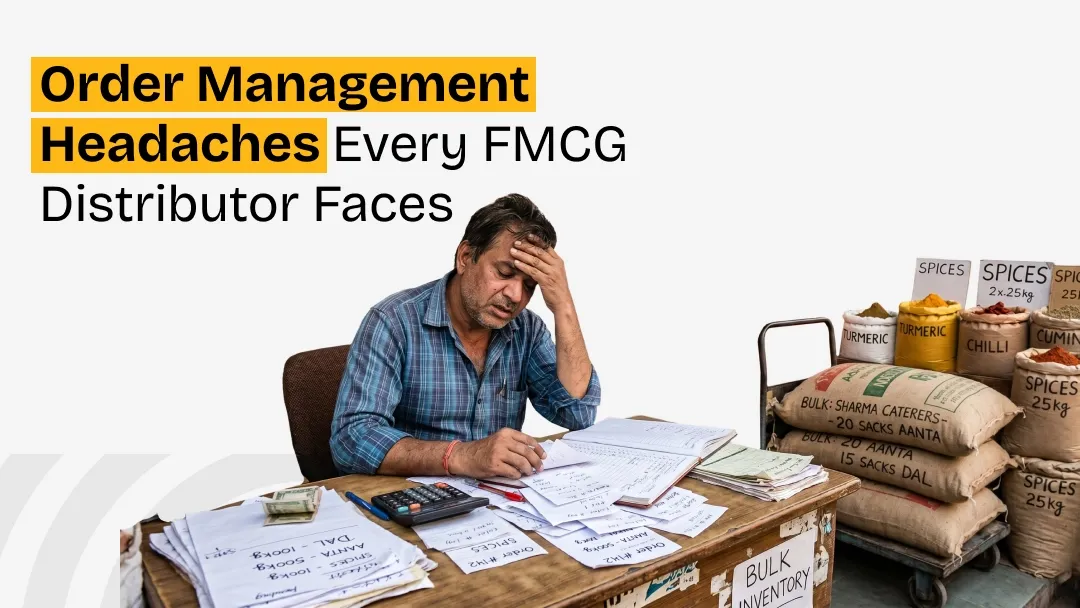
The salesman comes back from his beat with thirty eight orders scribbled in a notebook. Half of them came through WhatsApp. Two voice notes from a storekeeper at 9 PM last night. By the time the team unpacks all of it, prices it correctly, applies the right trade schemes, and gets dispatch moving, half the day is already gone. And this is not a festival week, it’s a normal day.
Every FMCG distributor lives some version of this. The problems in this piece are not dramatic or unusual. They are the everyday operational tax that most distributors have quietly learned to absorb. The question is whether that tax has finally gotten large enough to be worth fixing. For most distributors handling more than a hundred retailers, the honest answer is yes. It has.
Why FMCG Order Management Is Uniquely Hard
Volume is the thing that makes FMCG distribution different from almost every other B2B trade. A mid-sized distributor handles 100-500 retailers placing orders weekly, sometimes daily. Even a single brand like ITC or HUL has hundreds of variants. A multi brand distributor easily carries two to five thousand SKUs across their godown.
On top of that, trade schemes change every fortnight, sometimes weekly. A distributor carrying three or four brands may have twenty to thirty active schemes running at any given time. Pricing is not just one number. It is layered: MRP, PTR, PTS, scheme adjusted, and customer specific rates that sit on top of all of that. When this is managed by hand, margin leaks every single day. And most distributors do not even see the leak until month end reconciliation, by which point the money is already gone. If this sounds familiar, you might also recognise the patterns in this piece on manual order management problems MSMEs face.
Order Intake Chaos
Problem 1: Orders arrive across five different channels
WhatsApp, Phone, beat route salesmen, email from larger retailers, the occasional walk in – these are all the different channels through which orders arrive. There’s no single inbox. The person at the desk has to consolidate all of them by hand every morning. And every morning, something slips. Missed orders are not a question of if. The main question is how many this week.
Problem 2: Orders get noted wrong before they even reach dispatch
A voice note says pachees (25) Surf Excel ka case. It gets written down as pachees Surf Excel ka piece. That is not a typo. That is a 12,000 rupees mistake that nobody catches until the retailer calls back the next day, annoyed. This is one of the most expensive errors in FMCG distribution. Almost nobody tracks it because each instance looks small. Across a month, it is not small at all.
Problem 3: Salesmen forget to pass orders until the evening
A sales rep takes an order at 11 AM. He logs it at 6:30 PM when he gets back to the office. By then, dispatch is already loading vehicles for tomorrow morning. The order misses the delivery cycle. The retailer notices and often, the retailer does not wait for your rep. He calls someone else who is faster, more efficient.
Pricing and Trade Scheme Errors
This is where most margin actually leaks. Industry research suggests manual scheme handling causes 3 to 6% margin leakage. One missed promotional window can cost 5 to 10 lakh rupees in lost scheme driven revenue per cycle.
Problem 4: Trade schemes get applied to the wrong customer
Customer A gets the bulk quantity scheme that was meant only for Customer B. Customer C gets a scheme that expired last week. Over a month, these unclaimed and misapplied schemes silently eat 1 to 2 percent of margin. Most distributors find out at month end reconciliation, by which point it is too late to claw back.
Problem 5: Customer specific pricing lives in someone’s head
A long standing customer has a special rate negotiated three months ago. It was never properly documented anywhere. The new junior at the billing desk does not know about it. The customer spots the wrong price on the invoice, calls, and now the relationship has friction. This is the kind of problem that Excel based order tracking> creates silently and repeatedly.
Problem 6: Scheme expiry tracking is manual
The brand sent a scheme valid till the 20th. Today is the 22nd. The salesman is still pitching it to retailers on his route. The order comes in priced with the expired scheme. Now the distributor has two bad options. Absorb the difference, which is margin loss. Or have a difficult conversation with the retailer, which is trust loss. Either way, this is what manual scheme management quietly costs.
Dispatch and Inventory Mismatch
Problem 7: Stock gets committed without anyone checking
The salesman commits fifty cases to a retailer because he assumes stock is available. Nobody actually checked. By the time the order reaches dispatch, only thirty two cases are in the godown. Now someone has to call the retailer back with bad news. Lost sales from these blind spots average 4 to 7 percent of monthly throughput.
Problem 8: Expiry near SKUs get dispatched to the wrong customer
A perishable or near expiry SKU should go to a high velocity retailer who will move it in days. Instead it goes to a small kirana who keeps it on the shelf till it expires. Without an expiry aware dispatch view, the wrong allocation happens routinely. Industry data puts expiry losses at 0.5 to 2 percent of revenue. Most of it is preventable.
Dealer Trust and the Scale Ceiling
Problem 9: Returns and short supply complaints have no clean audit trail
A retailer says he never received 4 cases. The dispatch register says he did. There is no signature, no photo, no system record. The argument that follows is unwinnable for both sides. Either the distributor swallows the loss or the retailer leaves. Over time, this quiet friction creates distrust and costs accounts.
Problem 10: The owner becomes the single point of memory
- Which retailer pays on time?
- Which one always asks for extra credit?
- Who got the last special scheme?
All of it lives in the owner’s head. The business cannot scale past the point where the owner’s memory gives out. Any day the owner is unwell or travelling, decisions wait. This is the ceiling problem that nobody calls a problem until they actually hit it. If your business is at this stage, these are the signs you have outgrown manual order management.
What These Problems Cost an FMCG Distributor
Specific numbers, not vague claims. Based on current industry research:
- Manual scheme handling: 3 to 6 percent margin leakage
- Billing errors: 0.15 to 0.5 percent of revenue
- Unclaimed scheme incentives: 0.5 to 1.5 percent of revenue
- Lost sales from stockout blind spots: 4 to 7 percent of monthly throughput
- Expiry losses: 0.5 to 2 percent of revenue
- Collection defaults: 0.25 to 1 percent of revenue
Add it all up and the operational tax sits between 6 and 12 percent of revenue for a distributor running on manual systems. For a 5 crore distributor, that is 30 to 60 lakh rupees leaving the business each year through error rather than competition. Most distributors would never accept that number if they saw it on paper. The problem is that it never shows up on paper. It hides across 10 different leaks, each one too small to look like a problem on its own.
How to Fix FMCG Order Management Problems
Software alone does not fix this. Operational discipline does. But software is what makes the discipline hold at scale. Without it, the discipline depends on the owner’s memory, and memory has a ceiling.
This is where structured order management comes in. Biizline is built for the kind of FMCG distribution operation described in this piece. Orders from WhatsApp, phone, and field reps flow into one place. Customer specific pricing and trade schemes apply automatically the moment an order is placed, so the correct rate hits every invoice the first time. Stock is visible before commitment, not after. Salespeople can place orders from the field and the team at the desk sees them the same second.
The platform handles the things that general purpose software treats as edge cases like multiple price lists, scheme expiry, bulk versus retail pricing. For a distributor moving from manual to structured, the difference is not just speed, it is the recovery of that 6 to 12 percent operational tax that manual systems impose. The key features page walks through how each of the ten problems above maps to a specific fix at the system level.
Action Takeaways for FMCG Distributors
Not every distributor needs to fix all ten problems at once. Start with the leakiest one. Four practical moves:
- Audit the accuracy of your trade scheme application first. The fastest margin recovery in any FMCG operation sits here.
- Track which retailer asked for what price, and when. If this lives in one person’s head, your business has a hidden ceiling.
- If your team is still sending dispatch lists on WhatsApp, the time saved by a system pays for itself in months, not years.
- Pick one problem from this list, fix it cleanly, and measure the impact for a quarter before tackling the next.
FMCG distributors across India have already moved through this transition. See what they are saying about how the shift from WhatsApp and Excel to structured order management changed their operations.
Final Thoughts
None of these problems is dramatic on its own. That is exactly why they persist. Each one looks small. Fixable next week. Not urgent today. But ten small leaks add up to one large hole in the margin sheet, and the hole gets bigger with every new retailer you add.
The FMCG distributors who treat order management as the operational backbone of their business, not a back office task somebody handles between other things, are the ones absorbing the growth that 2026 is bringing. The others are stuck managing the chaos that comes with it. And the longer that continues, the harder it becomes to switch, because the chaos grows with the business.
Frequently Asked Questions
What is the biggest FMCG distributor headache?
Trade scheme misapplication and expiry tracking are consistently the costliest problems. Manual scheme handling alone causes 3 to 6 percent margin leakage according to current industry research. Most distributors do not quantify this because the errors are spread across hundreds of small transactions.
How do trade schemes complicate FMCG orders?
A mid sized FMCG distributor may have 20 to 30 active schemes running at any time across 3 or 4 brands. Each scheme has its own rules for eligibility, quantity slabs, and expiry dates. When applied by hand, the wrong scheme goes to the wrong customer routinely, and expired schemes get pitched without anyone realising.
What does an order error cost in FMCG distribution?
Individual errors look small. A wrong scheme here, a missed order there, a billing mistake on one invoice. Added together, current industry estimates place the all in operational tax at 6 to 12 percent of annual revenue for a manual distributor. For a five crore business, that is thirty to sixty lakh rupees a year.
How do expiry sensitive SKUs add complexity to FMCG orders?
Near expiry stock should go to high velocity retailers who will move it in days. Without expiry aware dispatch logic, the stock goes to whichever retailer ordered next, which is often a small kirana with slow turnover. The stock expires on the wrong shelf. The distributor either absorbs the write off or deals with a return.
Can a software actually fix FMCG Order Management problems?
Software alone cannot. What it does is make operational discipline hold at volume. Without a system, discipline depends on the owner’s memory and attention, which has a hard ceiling. A structured order management platform like Biizline removes that ceiling by applying pricing, schemes, and stock checks automatically, so the discipline holds even when the owner is not personally watching every transaction.