
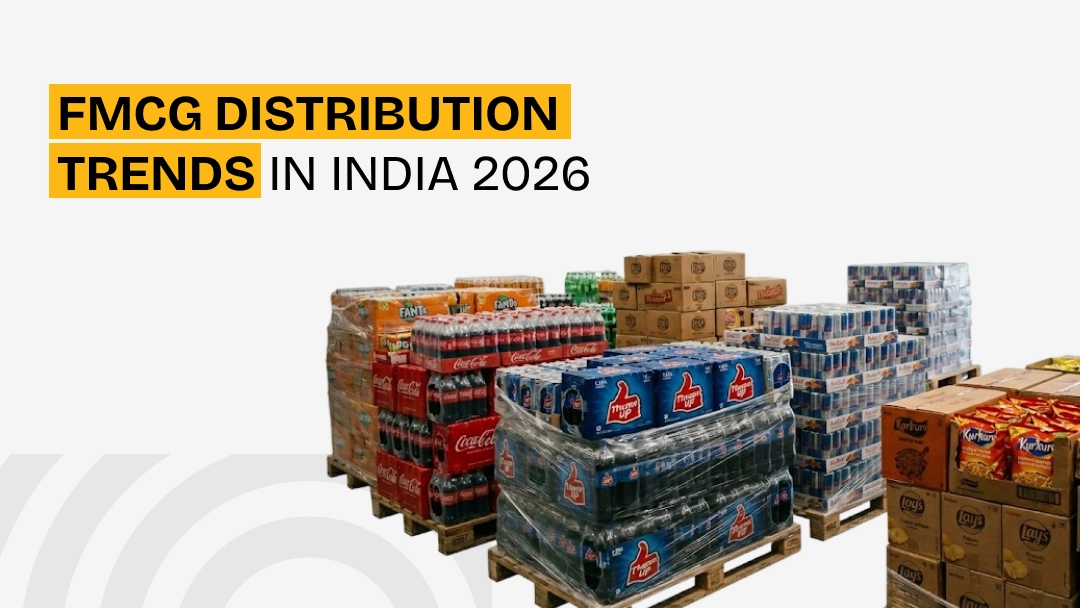
How FMCG Distribution in India Is Evolving in 2026: Trends, Margins and Category Shifts
Looking Beyond General Trends.
For a long time, FMCG distribution in India had one main story. The goods moved from the company to the distributor, then to the wholesaler and the kirana shop, and finally to the customer. That chain held for decades. It is still the biggest part of the business. But in 2026, it is no longer the only story being told, and any distributor who has not noticed the change is probably already feeling it in the monthly numbers.
Quick commerce now takes a real bite out of some categories. The D2C brands that ignored distributors a few years ago are calling them now. Rural demand has been growing faster than urban for six quarters straight. So there is opportunity here, plenty of it, but it is not sitting where it used to. This piece walks through six shifts worth your attention, and tries to be honest about which ones are threats and which ones are openings.
The State of FMCG Distribution in India
Start with the size of the thing. India’s FMCG market generated revenue of around Rs 25 lakh crore, roughly USD 289 billion, in 2025, going by IBEF data. It is the country’s fourth largest sector and it employs close to three million people directly. Most forecasts put FY26 revenue growth in the 6 to 8% band, with volume growth somewhere around 4% to 6%. Not a boom year, but a steady one, and the second half of the year is expected to be stronger than the first.
The interesting part is where the growth is coming from. Rural India has outpaced urban demand for six quarters in a row, and average rural basket sizes have gone up sharply, from about 5.8 items in 2022 to 9.3 in 2024. The urban segment still brings in roughly 62% of revenue, but the gap is closing. Then there is quick commerce, the number everybody quotes. The IBEF presentation pegs its current penetration at only about 7% of a total addressable market of USD 45 billion. Small share, but concentrated in exactly the urban categories where distributors used to make easy money.
So the headline is simple enough. The pie is growing. But the slices are being recut, and the distributor who understands the recutting will do well. The one who assumes 2026 works like 2019 will not.
Six Trends Redefining FMCG Distribution in 2026
Trend 1: Quick commerce is no longer just a metro story
A couple of years ago, you could tell yourself that quick commerce was a Bangalore and Gurgaon problem. Rich urban customers, ten minute deliveries, not your market. That comfort is gone. Blinkit, Zepto, Swiggy Instamart, and Amazon Now now run across eighty plus cities, and they are pushing hard into places like Raipur, Patna, Guwahati, and Cuttack.
- The customer who used to walk into the kirana shop you supply is now ordering a few items on an app instead. Not the whole basket, usually, but enough to dent the shop’s daily sale, which eventually dents your offtake.
- The brands you carry are quietly renegotiating channel terms, deciding how much to push through quick commerce versus general trade. You may not be in those meetings, but the outcomes land on your margin sheet.
Worth noting that the distributor lobby has not stayed quiet about this. The All India Consumer Products Distributors Federation has openly raised concerns about how fast quick commerce is expanding and what it does to the traditional network. Whether that pushback changes anything is hard to say. The smarter response, honestly, is to assume it does not, and plan for a market where quick commerce is simply one more channel you have to work around.
Trend 2: Margin compression is real, and it is structural
Every distributor feels the margin getting thinner. The mistake is treating it like a temporary thing that will pass once costs settle. It will not. The compression is built into how the market is changing.
Here are the mechanics of it:
Quick commerce is expensive to run. By most estimates it takes 62 to 64 people for every Rs 100 crore of GMV, far more than traditional distribution needs. That cost sits somewhere in the chain, and a good part of it gets absorbed by squeezing the margins of everyone else, distributors included. In the fast moving urban categories, your share of the brand’s pie is simply smaller than it was.
But, and this matters, the same pressure is not hitting every part of your business equally. Rural and tier 2 categories, where general trade still does almost all the heavy lifting, are holding up much better. The margin has not vanished. It has moved. It has shifted away from the urban metro shelf and toward the tier 2 and tier 3 counter. A distributor who keeps chasing the urban categories that quick commerce now owns will keep feeling squeezed. The one who follows the margin to where it actually went will be fine.
Trend 3: Tier 2 and tier 3 cities are doing the real work
If there is one trend to take seriously this year, it is this one. Rural and semi urban demand is leading the 2026 volume recovery. NielsenIQ data has shown rural volume growth running well ahead of urban for several quarters now.
The corporate results tell the same story. Nestle India posted around 19% revenue growth in a recent quarter, and rural expansion was named directly as a driver. Dabur, Marico, Godrej Consumer, all of them have been saying versions of the same thing in their quarterly updates. Rural is carrying the load.
Now here is the part that distributors sometimes miss. This trend does not weaken the distributor model, it actually strengthens it. Quick commerce economics do not work well in a town of sixty thousand people. The dark store math falls apart. What works in those markets is exactly what a good distributor already does, which is a salesperson who knows the route, a relationship with the shopkeeper, credit that is extended on trust, and stock that reaches the counter reliably. The tier 2 and tier 3 opportunity is real and it belongs to distribution. The only question is whether your operation can handle the order volume that comes with it.
Trend 4: D2C brands are coming back to distributors
This one is almost funny if you have been in the trade long enough. A few years ago, the D2C wave was supposed to make distributors irrelevant. Brands would sell straight to the customer online, cut out the middle layer, and keep the margin. Some of that did happen. The D2C market in India crossed Rs 6.96 lakh crore in 2024, so it was not a small movement.
But here is what those brands found out. Selling online gets you only so far. Customer acquisition costs keep climbing, the same customer is hard to hold, and at some point every D2C brand hits a ceiling on pure online growth. The shelf in a tier 2 kirana shop, it turns out, is still valuable. So a lot of these brands are now looking for general trade and stockist partners to push them into the markets they cannot reach on their own.
For a distributor, this is a genuinely good opening. New brands, new SKUs, often better margins than the tired old categories. But there is a catch, and it is an operational one. These brands move fast and expect their partners to move fast too. They want a distributor who can onboard a new SKU range in a week, apply the right pricing, and start dispatching cleanly. If your setup takes a month to add a new product line properly, you will lose these brands to a distributor whose backend is quicker. The opportunity is real, but it is gated by how good your operations are.
Trend 5: Order management is quietly becoming the real edge
Most of the trends above point back to one thing. The distributor who wins in 2026 is not necessarily the one with the best brands or the biggest godown. It is the one whose operations can take the strain of everything that is changing.
Think about what FMCG distribution actually involves on a normal day. High volume, lots of repeat orders, hundreds of SKUs, salespeople running fixed routes, and a pricing system full of trade schemes that change every few weeks.
Most distributors still run all of this on WhatsApp messages and Excel sheets. It works, in the sense that the business does not collapse but it leaks: Orders get noted wrong; a scheme gets applied to the wrong customer; a salesperson forgets to pass on an order until the evening, etc. None of these are disasters on their own, but across a month and three hundred retailers, they add up to real money and real trust lost.
The distributors who have moved to a proper order management system are seeing the difference in plain terms. Fewer wrong orders, discounted rates and schemes applied correctly the first time. Most importantly, they now have the ability to take on more retailers without hiring a proportional number of new people to manage the chaos. This matter the most because the tier 2 growth from Trend 3 only helps you if you can actually service it.
Platforms designed for Indian FMCG distribution, Biizline among them, are built to handle the things that general purpose software treats as awkward exceptions. Negotiated customer rates. Trade schemes with their own logic. Salesperson order workflows. For a distribution business, these are not edge cases. They are the everyday, and the system underneath the business should be built around that fact rather than fighting it.
Trend 6: GST cuts and policy support are lifting demand
The last trend is the macro backdrop, and for once it is mostly good news. The GST rationalisation has made a range of everyday FMCG products a little cheaper, which feeds straight into consumption. The Union Budget kept the PLI schemes going, with a total outlay in the range of Rs 1.91 lakh crore across sectors, and the food processing supply chain gets a share of that support.
You can see the effect in the recent quarterly numbers. FMCG companies have been reporting volume led growth, with the GST relief and a good festive season both being named as reasons. After roughly eighteen months of slow going, the sector has been showing a clearer recovery.
For a distributor, the takeaway is straightforward but not automatic. The tailwind is real. Demand is being helped along by policy in a way it was not two years ago. But a tailwind only helps a business that can move. If your operation is already stretched at its current order volume, a demand uptick does not feel like an opportunity. It feels like more pressure. The macro is offering you growth. Whether you can take it depends entirely on the state of your own backend.
FMCG Margin Pressure: Where It Is Coming From
One thing is worth saying plainly, because the usual way of talking about margin is too gloomy to be useful. Margin is not vanishing, it’s moving, and the direction is clear. In the urban metro categories where quick commerce has planted itself, the pressure is heavy and will not ease.
In tier 2 and tier 3 markets, general trade still moves more than 90% of FMCG volume, and that margin is intact, even growing as rural consumption rises. So the real divide in 2026 is not big distributors versus small ones. It is between distributors who keep fighting for the urban categories they are losing, and distributors who shift their energy to the markets where distribution still wins.
FMCG Distribution by Category in 2026
Trends are easier to act on when you can see them inside the categories you actually carry. So here is a quick category-wise, with the brands that lead each one and the shift that defines it right now.
Snacks and Namkeen
The big names here are Haldiram’s, Bikaji, Balaji Wafers, Bikanervala, and Lay’s. India’s snack market is large, somewhere around Rs 46,500 crore, and still growing. Quick commerce has become a primary growth channel for the category, since snacks suit a ten-minute delivery well. The distributor who can onboard a new namkeen range in a week, not a month, gets first pick.
Packaged Atta and Staples
Aashirvaad from ITC, Fortune from Adani Wilmar, Pillsbury, Patanjali, Annapurna from HUL. Staples look like a stable, boring category from outside, but the SKU mix has been quietly widening. Protein-fortified, multigrain, and chakki fresh variants have multiplied the items a distributor carries per brand, which stretches a workflow built for a simpler range.
Spices and Masalas
MDH, Everest, Catch, Eastern Condiments, Aachi, Patanjali. After the 2024 ethylene oxide bans in Singapore and Hong Kong, quality scrutiny jumped, and FSSAI ran close to four lakh inspections in FY25-26 with penalties crossing Rs 154 crore. Larger buyers now ask for batch level traceability that most distributors were never set up to provide.
Beverages and Dairy
Amul, Mother Dairy, Britannia, Coca Cola, PepsiCo, Parle Agro. Indian dairy firms are expected to grow 11 to 13% in FY26, led by value added products. The catch is cold chain and route discipline. Dairy does not forgive a sloppy delivery schedule, and distributors with tight route based delivery are taking share from those still running on phone calls.
Personal Care and Home Care
HUL with Surf, Lifebuoy, Dove, and Vim, plus Dabur, Marico, Godrej Consumer, Colgate, and P&G. The channel mix here is shifting toward modern trade and quick commerce, and HUL alone has talked about investing around Rs 2,000 crore into premium beauty and home care. Even so, general trade still moves roughly 70% of volume, which makes this the category to defend hardest.
Confectionery and Bakery
Britannia, Parle, ITC with Sunfeast, Mondelez with Cadbury, Nestle with KitKat and Munch, Patanjali. This category lives, and dies by the festival calendar, and the demand spikes are sharpest in tier 2 and tier 3 cities. A distributor who cannot forecast a festival surge and pre-stock for it leaves money on the counter every season.
The Tier 2 and Tier 3 Distributor Opportunity
Since so many 2026 points toward the smaller cities, they are worth a closer look. Jaipur, Indore, Pune, Lucknow, Bhopal, Nagpur, Coimbatore. A lot of the FMCG volume growth is sitting in cities like these this year. They are not small markets in any real sense. Large populations, rising incomes, and a retail base expanding steadily. What they do not have, mostly, is deep quick commerce coverage, which leaves the field open for distributors who know how to run them.
The categories pulling hardest in these markets are predictable once you have spent time in the trade. Namkeen and snacks. Packaged atta. Spices. Mouth fresheners, which move in surprising volume. And the HoReCa supply line, the hotels, restaurants, and caterers, with its own pricing and rhythm.
A distributor who serves these segments well in a tier 2 city has a solid business, arguably more solid than a metro distributor fighting quick commerce for the same shelf. The challenge there is not demand, it is spread. A longer list of smaller retailers across a wider area, more salespeople on more routes, more orders to track. The economics are good, but only if the operation can carry the load without everything routing through the owner’s head.
What FMCG Distributors Should Prepare for in 2026
Pulling all of it together, here is what is worth doing something about this year. Four things, kept practical.
1. Stop treating quick commerce purely as the enemy
It is a competition in some categories, no argument there. But it is also pushing D2C brands back toward distribution, and it is leaving the entire tier 2 and tier 3 map wide open. Treat it as a force that is reshaping the market, not just an attacker, and you will spot the openings it creates.
2. Build the operational backbone before you chase the growth, not after.
This is the unglamorous one, and it is the most important. If your operation cannot cleanly handle two hundred retailers today, it will not magically handle four hundred next year. The growth in tier 2 markets is real, but it only turns into profit if the orders, the schemes, and the dispatches are running through a system that does not depend on memory.
3. Take the tier 2 city opportunity seriously, and resource it properly.
That means route based salesperson management and trade scheme accuracy that holds up across a wider, messier retailer base. A platform built for distribution, Biizline being one example, handles the salesperson workflows and scheme logic that general software tends to break on. The tools exist. The question is whether you adopt them before the growth arrives or after you are already drowning in it.
4. Treat pricing transparency as a trust issue, not just an accounting one.
When schemes are applied by hand, mistakes happen, and every mistake makes a retailer trust you a little less. In a market where the retailer has more options than ever, that slow erosion of trust is expensive. Getting the price right, every time, automatically, is one of the cheapest ways to hold a relationship together.
Final Thoughts
Step back from the details and 2026 comes down to a single question for FMCG distribution. The market is splitting into distributors whose businesses will compress this year and distributors whose businesses will expand. The line between the two groups is not size, and it is not which brands you carry. It is operational readiness.
The macro is genuinely on your side. Rural demand is rising. GST cuts have made products more affordable. D2C brands are knocking on the distributor’s door again after years of ignoring it. Every one of those is a tailwind. But a tailwind is only useful to a business that can actually move with it. So the honest question to end on is a simple one. Are your orders flowing through a system that can take more weight, or are they still flowing through your own memory and a stack of WhatsApp messages? The answer to that, more than any market trend, decides which side of the line your business lands on.
Frequently Asked Questions
How big is FMCG distribution in India?
India’s FMCG market generated revenue of around Rs 25 lakh crore, roughly USD 289 billion, in 2025. It is the fourth largest sector in the country and employs close to three million people directly. The vast majority of this volume still moves through traditional distributors, wholesalers, and kirana retailers rather than online channels.
What is putting the pressure on FMCG distributor margins?
Margin pressure mainly comes from quick commerce, which is expensive to run and absorbs cost by squeezing margins across the chain. The pressure is heaviest in fast moving urban categories. It is much lighter in tier 2 and tier 3 markets, where general trade still moves more than 90% of FMCG volume, so the margin has shifted rather than disappeared.
How does quick commerce affect traditional distribution?
Quick commerce now operates across eighty plus cities and pulls impulse and top up purchases away from kirana shops in urban areas. It also pushes brands to renegotiate channel terms. At the same time, it has barely entered tier 2 and tier 3 markets, where the distributor model still works well, so its effect is uneven across the country.
Are Indian FMCG distributors going digital?
A growing number are. Distributors who have moved from WhatsApp and Excel to structured order management systems report fewer order errors, more accurate trade scheme application, and the ability to take on more retailers without adding staff in proportion. It is becoming a practical necessity for distributors who want to scale into tier 2 and tier 3 markets.
What is the future of general trade in India?
General trade is not disappearing. It still moves the overwhelming majority of FMCG volume, especially in tier 2, tier 3, and rural markets where quick commerce economics do not work. Its future lies in those markets, and in distributors building tighter operations so they can service a wider retailer base profitably.