
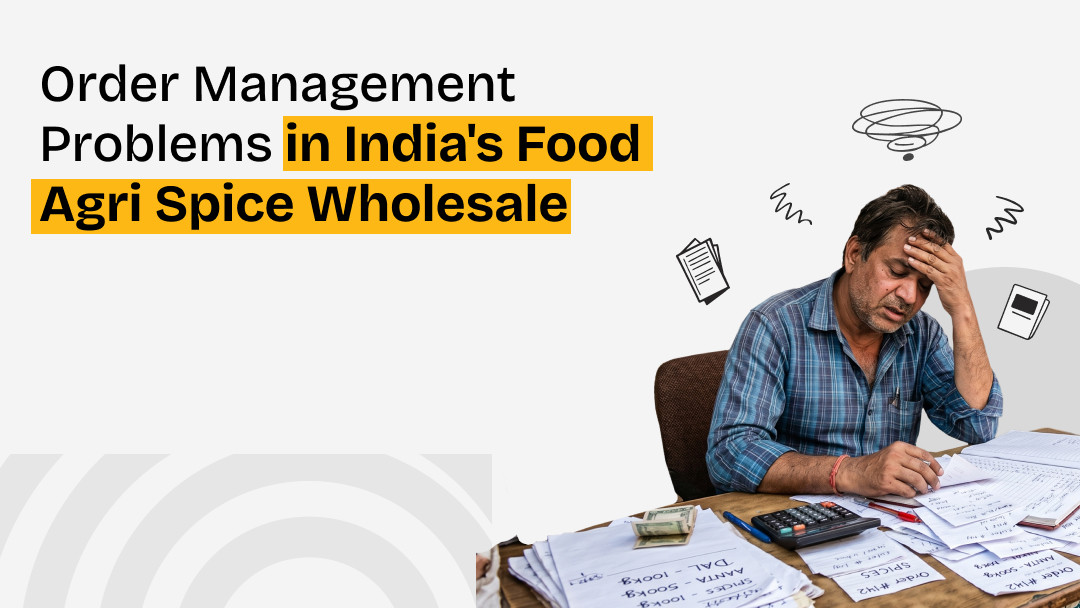
Order Management Problems in India’s Food Agri Spice Wholesale
What every wholesaler needs to know about the compliance, pricing, and perishability gaps eating their margin
In May 2024, the All India Consumer Products Distributors Federation did something unusual. It issued an advisory to its own members telling them to limit stocking of certain packaged spice brands. The reason was FSSAI. After the ethylene oxide contamination recalls in Singapore and Hong Kong, the Food Safety Authority had launched nationwide testing of spice manufacturers, and the AICPDF’s assessment was that some brands were likely to come under regulatory action. The advisory was blunt: reduce your exposure before the enforcement catches up.
For a spice wholesaler in Khari Baoli or Unjha holding three months of MDH or Everest inventory when that advisory landed, the implications were immediate. The stock sitting in the godown was suddenly a compliance question, not just an inventory question. And the records needed to answer that question, which batch came from which supplier, when it was received, where it was dispatched to, were scattered across notebooks, WhatsApp messages, and a couple of Excel sheets that nobody had updated since the last quarter.
That moment is the defining condition of food and agri wholesale in 2026. A wholesaler who had been operating the same way for twenty years suddenly needed batch level traceability that the existing record system could not provide. The compliance pressure is new. But the mandi rate volatility, the weight based pricing confusion, the expiry management gaps, those have been there all along. What changed is the cost of running with them. FSSAI inspected close to four lakh samples with penalties crossing Rs 154 crore. The operational gaps that used to be an inconvenience are now a genuine business risk. This piece walks through where those gaps sit and what they actually cost.
What makes food wholesale operationally different from every other category
Compliance is not optional anymore
FSSAI enforcement shifted from annual paperwork to active inspections with real consequences in 2024 and 2025. Batch records, supplier certificates, and dispatch traceability are no longer things the accountant handles in March. They are things an inspector may ask for on any Tuesday. And the records need to be retrievable within hours, not days. The wholesalers who discovered this the hard way during the 2024 wave paid for the lesson in penalties and lost contracts. The ones who learned from watching are now building the documentation discipline before the inspector walks in.
Pricing is weight based and volatile
Mandi rates for spices, dals, and agri commodities move daily. A wholesaler quoting yesterday’s cumin rate at 11 AM today is either losing margin or losing the dealer to someone who quoted fresh. And when the order specifies 47 kg but the actual bag weighs 48.3 kg, the billing confusion between ordered weight and dispatched weight is a friction point that Excel was never designed to handle. The rounding decisions, the tolerance adjustments, the arguments about whether the invoice should reflect the order or the dispatch, all of this happens on nearly every transaction in the food business. No other B2B category deals with this particular kind of pricing ambiguity at this frequency.
Inventory is perishable and lot tracked
Batch numbers, manufacturing dates, expiry dates, FIFO dispatch discipline. Every product in the godown has a clock ticking on it. A bag of cumin received in February and another received in May sit next to each other on the same shelf. The dispatch team grabs whichever is closer. If they grab the May batch and the February batch sits for another three months, it is past its prime and possibly past its expiry. Without a system that tells the team which lot should go out first, the default behaviour is always proximity, not freshness.
The customer base has three different pricing logics
Kirana retail, HoReCa (hotels, restaurants, caterers), and institutional buyers (schools, canteens, government procurement) each expect a different rate for the same product. HoReCa pricing carries a better margin but requires documentation that Kirana stores do not. Institutional pricing requires tender compliance that neither of the others does. Running all three through one informal system, where the billing team is supposed to remember which customer is in which category, is where pricing errors become a monthly constant rather than an occasional mistake.
Five problem areas costing food wholesalers real money
1. Batch traceability exists in theory, not in practice
The wholesaler has batch records. Somewhere. Incoming lot numbers in a notebook. Supplier certificates in an email folder. Dispatch logs in Excel. FSSAI documentation in a filing cabinet. When someone needs to trace a specific batch from supplier to customer, the reconstruction project takes two to three days. A surprise FSSAI inspection does not give two to three days. And the inspector is not interested in hearing that the records exist but are spread across five places.
The bigger risk in 2026 is not the inspection itself. It is the contracts. Quick commerce platforms like Blinkit and Zepto, organised retail chains, and institutional procurement teams have started requiring batch certificates and pesticide residue documentation before they accept delivery. Not as nice to have. As a condition. The wholesaler who cannot produce these cleanly does not get a second conversation. The contracts go to competitors who built batch discipline earlier, and those contracts do not come back easily.
2. Mandi rates change daily but price lists do not
The Unjha mandi closes at one cumin rate. The wholesaler in Khari Baoli is still quoting yesterday’s number at 11 AM the next morning. By the time the price list updates, the dealer has either taken the order at the stale rate, in which case the wholesaler absorbs the loss, or moved to a competitor quoting fresh.
This is daily for spice traders and weekly for dal and oil wholesalers. The lag between rate movement and price list update is where margin disappears in food wholesale. And the lag is structural, not accidental. The person responsible for updating rates is also the person handling orders, dispatches, and customer calls. The rate update is always the thing that gets done last because everything else feels more urgent. By the time the update happens, the stale rate has already gone out on three or four orders.
3. Weight based pricing creates silent billing friction
The dealer orders 47 kg. The bag weighs 48.3. The billing can go three ways. Bill the ordered weight and eat the extra 1.3 kilos. Bill the dispatched weight and have a discussion about why the invoice says more than what was ordered. Or round to the nearest number and accept that neither side is fully satisfied. Each option has a cost. Each one happens on nearly every transaction. And across a month of two hundred transactions, the cumulative friction, whether measured in absorbed weight or in strained relationships, is real. It is perhaps the least dramatic problem on this list and one of the most persistent.
4. FIFO discipline breaks down at the loading dock
Same product, two batches in the godown. One from February, one from May. The dispatch team loads whichever bag is closest to the dock. The February batch sits. Ages toward expiry. Eventually gets written off. This is not a process failure in the traditional sense. It is the default behaviour of a manual system that gives the dispatch team no visibility into batch dates without physically checking every bag.
Industry estimates put expiry write offs at 1 to 3 percent of perishable inventory value annually. For a wholesaler with two crore in perishable stock, that is two to six lakh rupees a year walking out the godown door. Preventable entirely through dispatch logic that enforces older batches going out first. But manual systems do not enforce this, and the dispatch team is not going to check expiry dates voluntarily when they have fifteen other orders to load before the truck leaves at 8 AM.
5. Three customer categories, one messy pricing system
A hotel buys at one rate. A kirana at another. A school canteen at a third. The billing team is supposed to know which customer falls in which category and apply the right rate every time. They get it wrong often enough that the margin leakage is consistent rather than occasional. HoReCa customers in particular catch pricing errors quickly because their volumes are large enough to make even a small per kg difference visible on the invoice. And a hotel procurement manager who catches a pricing error twice does not call a third time. General purpose tools do not solve this because category based pricing needs to be structural, applied automatically at order entry, not recalled from memory by a billing team that is also answering phones and coordinating dispatches.
What it adds up to
- FSSAI compliance exposure: variable, but penalties reached Rs 154 crore nationally in FY25 to FY26 and continue to rise
- Mandi rate lag: 1 to 3 percent of revenue on volatile SKUs, daily for spices, weekly for dals and oils
- Expiry write offs: 1 to 3 percent of perishable inventory value annually, mostly preventable through basic FIFO enforcement
- Customer category pricing errors: 0.5 to 1.5 percent margin leakage monthly from wrong rates on HoReCa, retail, and institutional orders
- Lost large buyer contracts from batch documentation gaps: the hardest to quantify and the most consequential, because quick commerce and organised retail contracts are the fastest growing channel for food wholesale
For a 4 crore food wholesaler, the combined friction sits between twenty four and forty eight lakh rupees annually. The compliance exposure on top of that is harder to put a number on, but in 2026 it is a genuine business risk. Not a paperwork inconvenience. Not something the accountant handles later. A risk that can cost contracts and attract penalties in ways that were not true three years ago.
Why generic tools do not work for order management of food wholesale
Excel cannot attach batch numbers to dispatch records automatically. It cannot enforce FIFO at the loading dock. It cannot apply weight based pricing with tolerances so that the 47 versus 48.3 kg argument stops happening. And it cannot produce the kind of traceability report that an FSSAI inspector or a Blinkit procurement team expects. Excel is a data tool. Food wholesale needs an operational tool.
Tally handles GST and invoicing. It does not manage batch tracking at the dispatch level, lot based FIFO, mandi rate updates to price lists, or customer category pricing logic. Tally does its job well. Its job is accounting, not order management.
ERP systems designed for food manufacturing cover production and quality control but not the wholesale distribution layer. A food manufacturer needs batch tracking in the production line. A food wholesaler needs batch tracking in the order and dispatch workflow. These are different systems for different problems. Manufacturing ERP does not address the wholesaler’s daily reality of mandi rate lag, weight based billing, and customer category pricing.
What the right system does for food wholesale
Biizline is built for food and spice wholesale operations. Batch tracking attaches to every order and dispatch record automatically, so FSSAI traceability is one search away instead of a three day reconstruction. Mandi rate updates push through to dealer price lists immediately. Weight based pricing handles tolerances at the order level so the billing team does not have to make a judgment call on every transaction. FIFO dispatch logic sends older lots out first without the dispatch team needing to manually check every bag. Customer category pricing, HoReCa versus retail versus institutional, applies automatically based on the customer profile.
The feature set is designed around the specific compliance and perishability constraints of Indian food wholesale. Batch tracking, weight tolerances, FIFO enforcement, and category pricing are core functions, not modules bolted onto a generic B2B platform. The system is built for how food wholesalers in Unjha and Khari Baoli and Latur and Guntur actually work, not for how a software architect imagines wholesale should work.
Implementation takes weeks. Most food wholesalers see the compliance benefit immediately because batch records and dispatch documentation become clean from day one. The margin recovery on pricing accuracy and reduced expiry write offs typically shows up in the first quarter. And the peace of mind on FSSAI readiness, knowing that a surprise inspection can be answered from the system in minutes rather than reconstructed over days, is worth something that does not show up on a margin sheet but matters to every food wholesaler who has been through one.
Food wholesalers across Unjha, Khari Baoli, and other major clusters have already made this transition. See what changed for them.
Where to start
Start with batch traceability. Pick a product that left the godown three months ago and try to trace it back to the supplier lot and forward to the customer it shipped to. If that exercise takes more than thirty minutes, the records are not audit ready. And in 2026, audit readiness is not a future goal. It is a current requirement.
Then check your mandi rate process. How many hours pass between the rate moving and your price list reflecting the change? If the answer is more than a few hours, every quote during that gap is at the wrong price. Explore how Biizline handles rate management and batch tracking and map it against the five gaps in this piece. Most food wholesalers find that three or four of the five apply directly to their operation.
India’s food processing sector contributes 8.8 percent to manufacturing GVA and 13 percent of national exports. The PLI scheme has driven Rs 9,000 crore in cumulative investment. Spice exports compound at 13 percent annually. The growth is real and policy backed. Whether a food wholesaler captures that growth as profit or absorbs it as compliance pressure and operational chaos depends entirely on the order management layer underneath the business. That layer is where both the margin and the risk sit. In 2026, leaving it unfixed is not a neutral decision. It is an expensive one.
Frequently asked questions
What is the biggest order management problem for food wholesalers in 2026?
Batch traceability. FSSAI inspections now actively check batch records and dispatch documentation. Most wholesalers have the records scattered across notebooks, emails, and Excel. Reconstructing traceability during a surprise inspection takes too long, and the consequences of non compliance have shifted from warnings to real penalties and lost contracts.
How does mandi rate volatility affect food wholesale margins?
Mandi rates for spices, dals, and agri commodities change daily. A wholesaler quoting yesterday’s rate is either losing margin on the order or losing the dealer to a competitor quoting the current rate. Without daily rate sync to the price list, the gap costs 1 to 3 percent of revenue on volatile SKUs.
Why are expiry write offs so common in food wholesale?
Without FIFO dispatch discipline, the dispatch team loads whatever is closest to the dock. Older stock sits in the back, ages past its date, and gets written off. This is preventable through system level FIFO enforcement, but manual systems do not enforce it because the team has no visibility into batch dates without physically checking every bag.
What FSSAI compliance do food wholesalers need?
Valid FSSAI licenses at the appropriate scale, batch tracking from supplier through to dispatch, retrievable records for at least twelve months, and supplier documentation including quality certificates for regulated categories. The enforcement regime intensified after 2024 with active sampling and meaningful penalties for non compliance.
Can one system handle kirana, HoReCa, and institutional pricing?
Yes, if the system supports category based pricing that applies automatically at order entry. The three customer types need different rates for the same product. Applying these manually leads to consistent errors. A system that assigns customer categories and applies the corresponding rate automatically removes the billing team’s reliance on memory for something that should be structural.