
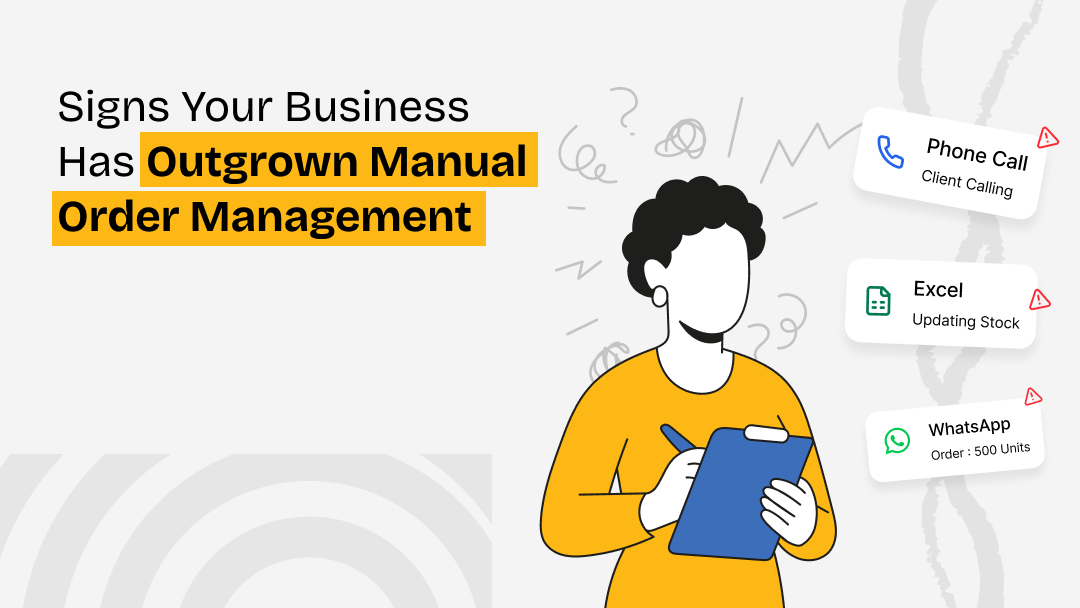
6 Clear Signs Your MSME Needs to Move Beyond Manual Order Management
Most MSMEs hit the ceiling somewhere between 30 and 60 customers.
There is a thought most MSME founders have at some point, usually somewhere around their 40th or 50th customer: maybe this is just what growth feels like. The team is busier. Orders are harder to track. Things that used to happen automatically now require a follow-up call or a reminder message. It feels like a busy patch, the kind that settles once the team gets used to the volume.
For a lot of businesses, it does not settle. The pressure grows with the order count, and what felt like a temporary stretch becomes the normal way of operating. The morning starts with figuring out where things stand. The day fills with questions that should already have answers. The founder ends up at the center of everything, not because they want to be, but because the information lives with them and nowhere else.
The signs were there earlier. They just did not have a name. This blog is about learning to read them, so the decision about whether to change something can be made from a clear picture rather than a vague sense that things are harder than they should be. If you want the full context on what B2B order management should look like at this stage, that is worth reading first. What follows here is specifically about recognizing when the current approach has reached its limit.
The Customer Count That Changes Everything
Manual order management has a ceiling. Not a vague one. A specific, operational point where the informal approach stops being manageable and starts costing the business in ways that are easy to miss until they add up.
For most MSMEs, that ceiling sits somewhere between 30 and 60 customers.
At 10 customers, one informed person can hold the entire operation in their head. They know every order, every pricing agreement, every delivery timeline. The system is their memory, and it works fine when the volume is low enough to be reliable.
At 30 customers, the same approach starts requiring more effort. More follow-up calls. More double-checking before dispatch. More time at the start of the day, figuring out what is pending. The person at the center is working harder, but the process is still holding together.
At 60 customers, it usually breaks. Not in one moment, but quietly and consistently. Orders get missed or recorded incorrectly. Pricing errors show up at the end of the month. The team waits for one person before anything can move. Customers call because nobody has updated them. The founder spends more of each day managing coordination than managing the business.
That pattern is not a sign of a struggling business. It is a sign of a growing one that has not yet updated its operating system. The business outgrew the process. The process did not keep up.
The Signs: What the Ceiling Actually Looks Like
The ceiling does not announce itself. But it leaves signs, and they tend to appear in a fairly predictable order as the customer count increases. Here are the ones that appear most consistently.
One person holds the full picture, and everyone else waits
There is one person in the business, often the founder, sometimes a senior operations person, who knows where everything stands. Which orders are pending, which customers have special pricing, which deliveries are running behind, and which supplier to call when something is urgent. When they are available, things move. When they are not, decisions wait.
This is sometimes called the switchboard problem, and it is worth naming directly. The information does not live in a system. It lives in a person. And a person cannot be in two places at once, cannot hand off full context the way a documented record can, and cannot scale with the business without becoming increasingly stretched.
The same questions come up every week
- What price did we agree on for this customer?
- Has this order been dispatched?
- Did the customer confirm the revised quantity?
These questions are not asked once and answered permanently. They surface again and again because the answers are not recorded anywhere that everyone can access. Someone spends real time each week finding information that should already be visible and that someone else found last week.
Orders take longer to process than the work should require
An order arrives. Before it reaches dispatch, it has to be noted, confirmed, checked against stock, priced, approved, and relayed. Each step involves a different person and often a different channel.
The order is not slow because everyone is inefficient. It is slow because it travels through too many handoffs before anything actually happens. This is the structural delay that faster-order-processing tools are built to remove, not by making people quicker, but by reducing the number of steps the order has to go through.
Pricing errors show up at the end of the month
Customer-specific rates, bulk discounts, and advance-payment pricing all live in memory or are scattered across old chat threads. When the person with pricing knowledge is unavailable, the wrong rate goes out. The error does not surface until the invoice is raised or the customer raises it, by which point the margin is already gone, and tracing it back is a half-day job with no guarantee of a clean answer.
New team members take too long to become useful
When operational knowledge lives in people rather than a system, onboarding is slow by design. A new team member cannot look anything up. They have to ask, wait, ask again, and build their own understanding through repetition and mistakes. The business pays for this learning period with time, errors, and the senior team members who have to stop their own work to answer questions that a documented system would have answered automatically.
You hesitate before taking on more customers
This one deserves particular attention. When a founder starts turning down growth not because the market is wrong or the product is not ready, but because the backend already feels stretched, the process has become a ceiling on the business itself. The informal approach is no longer just creating friction. It is determining how far the business can go.
Why These Signs Get Ignored for So Long
Most founders experiencing these signs have already noticed them. The reason they have not acted is not that they lack awareness. It tends to be a combination of three things that work together to keep the situation stable just long enough to feel manageable.
1. Each sign feels small on its own
A pricing error here, a delayed order there, a week where things piled up because one person was out. This doesn’t feel like a crisis; it seems to be a cost of doing business.
2. The instinct is to solve it with effort
Hiring someone new, checking in more often, and building a better spreadsheet are temporary solutions that produce results for a while, which makes it easy to believe the problem is solved when it has actually just been deferred. The structural cause is still there. It is just being managed more actively.
3. Switching feels riskier than staying
Customers are used to how things work. The team has built routines around the current process. What if something gets lost in a transition? These are real concerns. But they tend to get weighed against a current situation that has been normalized over months, so the bar for change keeps rising while the cost of staying quiet accumulates.
The businesses that move earlier tend to find the transition considerably simpler than they expected. Those who wait usually find that the longer they hold on, the more embedded the workarounds become, and the harder it is to untangle them without disrupting something that is, in its own way, still working.
What Changes When the Order Management Process Is Replaced
The instinct when these signs appear is to improve what is already there. A better spreadsheet. A shared group for order updates. A weekly sync to align the team on what is pending. These are attempts to add coordination on top of a fragmented process, and they tend to reduce the symptoms without addressing the cause.
What actually shifts things is replacing the coordination layer itself. When an order enters a system once and is immediately visible to everyone who needs to act on it, the handoffs disappear. When pricing logic is built in and applied automatically at the point of booking, the memory dependency disappears. When order status updates as the order moves, the follow-up calls disappear.
The team does not have to work harder or faster. The order just travels less before it reaches the people who need to act on it. That is the structural difference between improving a broken process and replacing the part of it that was broken.
Where Biizline Fits for MSMEs at This Stage
Biizline is built for the stage between informal coordination and ERP complexity. As a private B2B order management system built for Indian MSMEs, it handles the structural layer that breaks down at scale: orders entered once and visible to the full team immediately, customer-specific pricing applied automatically at the point of booking, stock levels visible before a commitment is made, and order status trackable by both supplier and customer without manual relay.
It is not a marketplace. It is not an ERP. It sits at the point where informal order communication needs to become a formal, traceable record, which is exactly where most of the signs above point.
The relationships, the negotiations, the flexibility that makes B2B trade work, none of that changes. What changes is the operational layer underneath it, so those relationships have fewer errors to absorb and fewer miscommunications to repair.
You can read more about the specific benefits here, or see how other MSME owners are using it.
Final Thoughts: The Signs Were There Earlier
The ceiling is not a warning about failure. It is a marker of growth. Most businesses hit it somewhere between 30 and 60 customers, and most stay on the wrong side of it longer than they need to, not because they lack urgency but because the signs did not have a name.
Each one on its own is easy to absorb. A slower process here, a pricing query there, a week where things piled up. Together, they are telling you something specific about where the business is and what it needs to keep going.
Now they do have a name. What you do with that is up to you.