
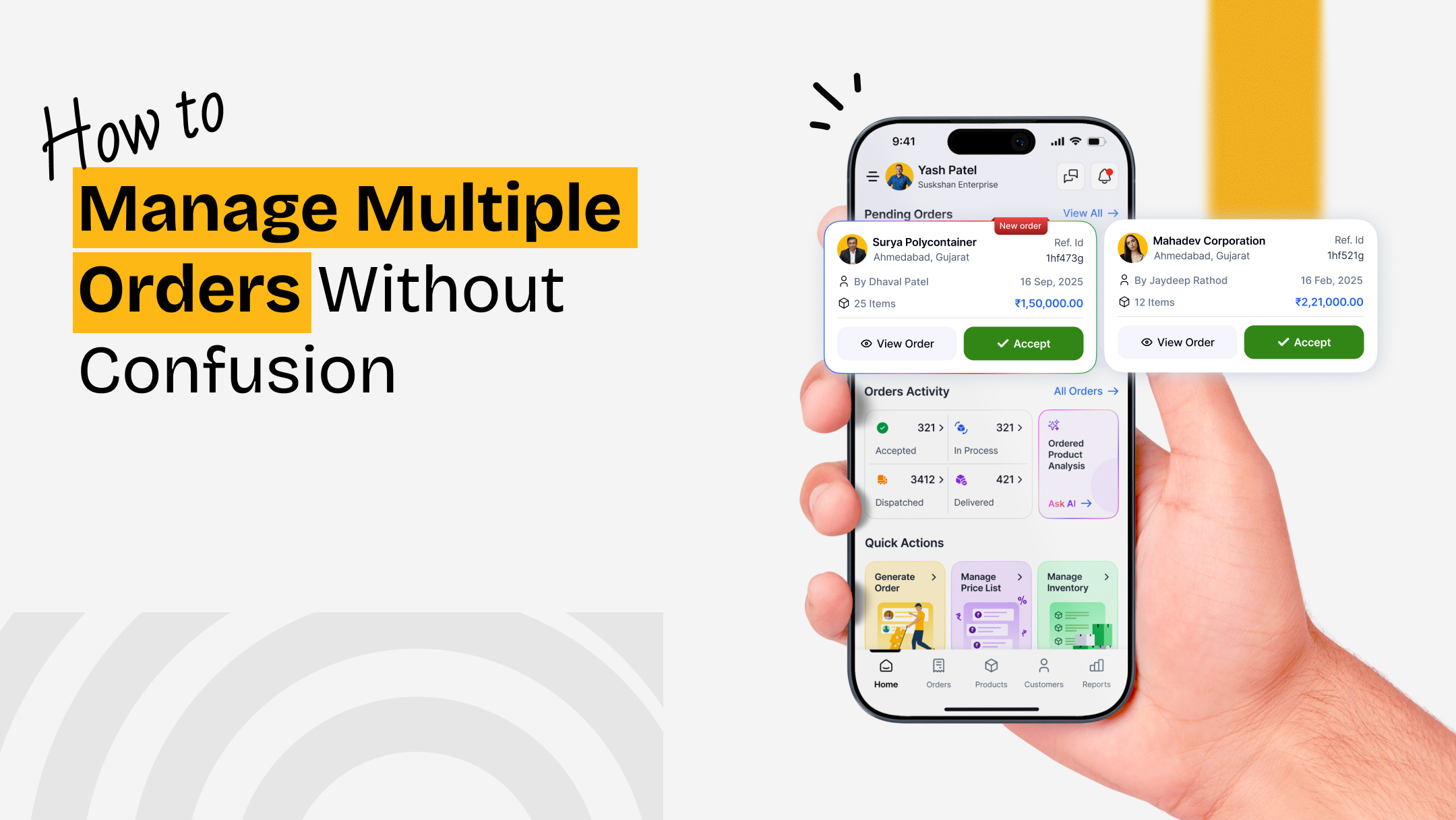
How to Manage Multiple Orders Without Confusion
Three customers want an update on the same order. Two deliveries are going out today. One voice note came in last night and nobody is sure what it said or whether anyone acted on it. It is 10 in the morning and you have not started actual work yet.
Nothing catastrophic is happening. This is just Tuesday. And this is exactly where most growing wholesale businesses are stuck. Not failing. Just spending more time managing the chaos of orders than building the business those orders are supposed to support.
This guide covers why that happens, what it actually costs the business, and what changes when orders flow through a connected system rather than scattered across calls, messages, and spreadsheets. If you are still building a foundation for how B2B order management should work at your business, this complete guide to B2B order management for MSMEs covers the basics before we go further here.
Why Managing Orders Gets Harder as You Grow
There is a point most distributors and traders cross where the informal approach stops working. Not dramatically. It just starts producing more friction than it used to. Orders get missed or partially recorded. A revised quantity comes in after the original has already been processed. A customer calls with a question that nobody on the team has a clear answer to. None of this happens because anyone is doing something wrong. It happens because the system that worked for 10 customers was never built to handle 60.
In a growing MSME, orders tend to arrive from everywhere at once. A call in the morning, a WhatsApp message while someone is at lunch, an email from a formal buyer, a voice note from someone who was too busy to type. Each channel introduces its own room for error. A message gets buried. A quantity gets misheard. A revision arrives after the original has already been sent to dispatch.
And with no single place where it all lands, the person at the centre of the operation ends up becoming the informal connective layer between everything. The founder, or one senior manager, is the one who knows where each order stands, which customers have special rates, and roughly what is in stock. Multichannel order management is not inherently complicated.
What makes it complicated is the absence of a single place where it is all visible at once. That is the gap. And the longer a business runs without closing it, the more expensive that gap becomes.
The Real Order Management Problems That Come with Volume
Most of what goes wrong in a growing wholesale or distribution business is predictable. The problems below are not random. They follow directly from the absence of a connected order layer, and they tend to appear in roughly this order as customer volumes rise
Orders get recorded wrong from the start
A customer sends a voice note. Someone listens, writes it down, and gets the quantity slightly wrong or misses one item entirely. The note gets buried under 40 other messages before anyone double-checks it. By the time the error surfaces, the customer is already waiting on a delivery that was never properly recorded in the first place. This is not carelessness on anyone’s part. It is what happens when order placement lacks a structured format and every channel introduces its own room for error.
Pricing agreed on the call never appears on the invoice
Customer-specific pricing is standard in the Indian B2B trade. Different customers have different rates, based on order volume, payment history, the length of the relationship, or sometimes a conversation from three months ago that nobody wrote down formally. When that pricing logic lives in someone’s head or an old chat thread, the person raising the invoice often does not have the full picture. Undercharging quietly erodes margin, sometimes for months before anyone notices. Overcharging creates disputes that take time to resolve and leave the customer feeling like they cannot trust the numbers they are given.
Operations finds out about orders too late
Sales commits to a delivery date based on a general sense of what is available. Operations finds out about the order two days before it is due. Dispatch is still running on a schedule built last week, before any of these new orders came in. Everyone is working hard, but they are working off different information at different times. The post-mortem conversation always ends the same way. A communication breakdown that no individual effort could have prevented, because the information was never in one place to begin with.
Stock gets committed without checking what is actually available
The pressure to say yes quickly is real. Checking inventory takes time, and customers expect fast responses. So a rough estimate becomes a commitment, and the scramble to fulfil it happens later.
Overselling is one of the more avoidable problems in wholesale operations, but it keeps recurring because order booking and inventory visibility are not connected at the moment the commitment is made. Tracking multiple orders across different customers becomes nearly impossible when nobody knows the actual stock position until after a promise has already been given.
No record of when something changes
When an order is modified, it is rarely clear who approved the change. When a price is adjusted or a delivery is delayed, there is no log of what the customer was told or when the decision was made. Disputes become a matter of he-said-she-said with no reference point to resolve them. The trust that underpins B2B relationships erodes quietly, often before either side fully realises it is happening.
The founder becomes the switchboard
One person knows which supplier is reliable for urgent deliveries, which customer always needs extra buffer time on their orders, and where the current dispatch plan stands at any given moment. That person is, in practice, the system. When they are on a call, traveling, or unwell, decisions wait. Orders sit. The business slows down not because anything went wrong, but because the information that should live somewhere accessible is held by one person instead.
What These Problems Actually Cost the Business
The costs are rarely visible all at once. They show up in small ways, and it takes a while to notice how much they add up to.
Pricing errors that go unnoticed until month-end represent margin that was already spent before the loss was identified. Manual discount calculations going wrong is not a one-off event. It happens across orders, across customers, and it compounds. By the time someone reviews the numbers, the damage is already done.
Customer trust is harder to quantify but arguably more consequential. Customers do not always complain before they leave. Small operational errors accumulate over time. A missed delivery window, a wrong price on the invoice, a status question that nobody could answer confidently.
By the time the relationship is visibly strained, it has usually been building for months. Silent attrition is harder to diagnose and harder to reverse than a complaint you can actually address.
And then there is growth hesitation, which is perhaps the least visible cost of all. Founders at this stage are often reluctant to take on new customers or expand into new markets because the backend already feels unstable. Growth is happening, but it does not feel manageable. That hesitation is the growth wall showing up not as a hard ceiling but as a quiet reluctance to push further.
What a Digital Order Management System Actually Does
It is worth being direct about this because the phrase “digital order management system” is used in ways that can obscure what it actually means in practice. It is not a dashboard full of reports nobody reads. It is not a tool that digitises paperwork. At its most useful, it is a single, connected layer in which an order placed at one end automatically reaches everyone who needs to act on it, without anyone having to manually pass the information along.
Each of the problems described above has a structural fix. Here is what that looks like in practice.
- One entry point for every order. From the moment an order is placed, the record is visible to sales, operations, dispatch, and accounts simultaneously. No relay. No version conflicts. No re-entry. The scattered intake problem closes at the point of placement.
- Pricing locked at booking. Customer-specific rates, bulk tiers, and advance payment discounts are set once and applied automatically whenever a matching order comes in. The agreed price is permanently tied to the order record. The invoice pulls from the same source. The reconciliation conversation becomes unnecessary.
- Inventory visible before committing. Not after two calls and a check with the warehouse. At the moment of confirmation, the system shows what is actually available. Overselling stops being a recurring problem.
- Order status is visible without a call. At every stage, confirmed, processed, dispatched, and delivered, the update happens in one place and stays accessible to the customer. Follow-up calls decrease without anyone actively managing that reduction.
- Every change logged. Who changed what, when, and why. When a dispute comes up, there is a reference point. Resolution is faster, and the trust that makes B2B relationships work stays intact.
- Information lives in the system, not in one person. Any team member with access can see where any order stands. The business functions when the founder is unavailable. The switchboard problem does not have to exist.
That last point matters more than it might seem. Order management solutions built for Indian MSMEs need to close this specific gap, because multi-channel inventory management software that requires a single person to maintain it manually has not actually solved the problem. It has just moved it.
How Biizline Handles This for Indian MSMEs
Biizline is not an ERP. It is not a marketplace. It is not a generic SaaS tool adapted from retail software and pointed at small businesses. It is a private, shared B2B order management environment used jointly by suppliers and their customers, built around how Indian MSME trade actually works.
Indian B2B trade runs on negotiated pricing, multi-channel communication, and relationships that often predate any formal system by years. Biizline does not try to replace or restructure that. It provides a proper foundation so that, when an order is placed, both parties see the same record. Pricing is locked in at that moment. Inventory levels are reflected before a commitment is made. Status updates as the order moves forward, without requiring anyone to chase it.
A few specific things worth noting for anyone evaluating whether it fits:
- Customer-specific pricing, bulk tiers, and advance payment discounts are embedded in the system and applied automatically at order booking. The pricing confusion and rate dispute problems close at the point of placement.
- The workspace is private. Pricing and customer relationships stay between the two parties. There is no competitor visibility, no public marketplace exposure.
- Order history per customer lives in one place. Reorders do not require reconstructing past details from old messages or asking someone who might remember.
- Accounting system integration means confirmed operational data feeds into financial records without someone re-entering it. The double-entry problem is removed.
See how other MSME owners use it.
A Practical Checklist: How to Know If Your Process Is the Problem
Before investing in any order management system, it helps to run through these questions honestly. They are not a sales checklist. They are a diagnostic. The answers tell you whether the gap is structural or operational, which matters because the fix for each is very different.
- Is there one place where every order is recorded, regardless of how it came in?
- Is customer-specific pricing applied automatically, or is it calculated each time?
- Can operations see new orders without waiting for someone to inform them?
- Is stock availability confirmed before a delivery date is committed to?
- Can the customer check the order status without calling?
- Is there a log for every modification showing what changed, when, and who approved it?
- When a key person is unavailable, can someone else pick up without asking around?
If most of those answers are no, that is a system gap, not a team gap. Hiring more people to manage the coordination does not close structural gaps. It adds more people to the coordination effort, which increases the load without reducing the confusion.
Final Thoughts: Upgrade the Order Structure, Not Just the Software
Managing multiple orders without confusion is not really about finding the right tool. Software is only useful if it matches how the business actually operates, and an order management system that requires more effort to maintain than it saves has not solved anything.
What actually changes things is a connected operational flow in which an order enters once, pricing applies without manual intervention, inventory is visible before commitments are made, and status does not require a phone call to learn it. When that flow exists, the day-to-day becomes noticeably quieter. Not transformed overnight, but measurably less reactive. Fewer follow-up calls, fewer pricing disputes, fewer mornings spent trying to reconstruct what was agreed with which customer and when.
The businesses that build this kind of structure tend to grow with less friction. The ones that wait usually find the chaos grows alongside them. If your business is approaching that wall, Biizline is worth a closer look.