
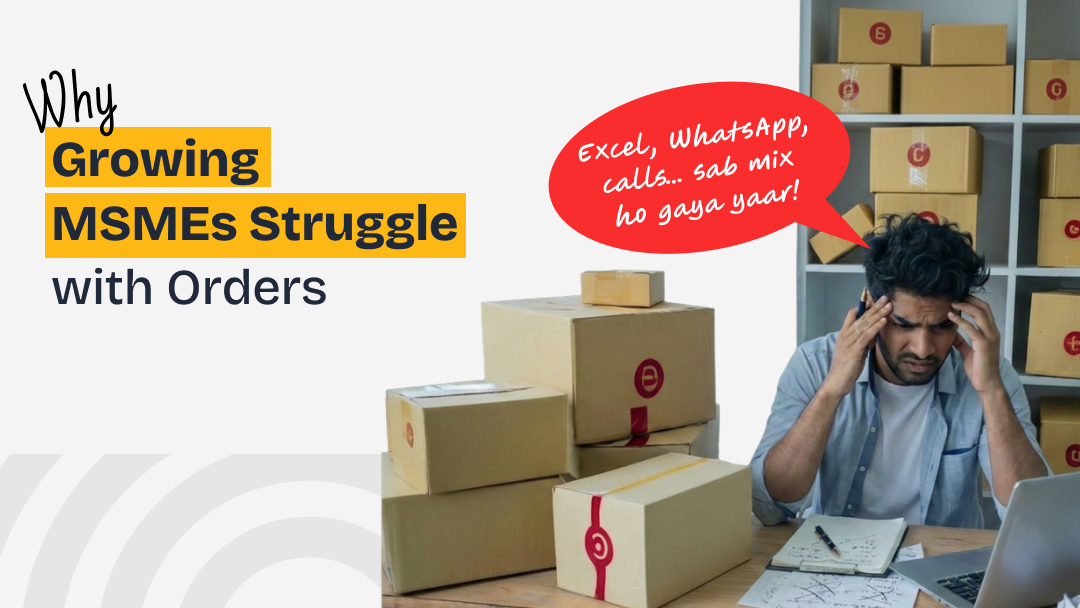
Why Growing MSMEs Struggle With Orders Even When Sales Are Strong
And How Structured Order Booking Creates Operational Stability
There is a particular kind of operational problem that tends to surface not when a business is failing, but when it is doing well. Sales are increasing. New customers are coming in. Order volumes are climbing. And yet, somewhere in the middle of all that apparent progress, the day-to-day has started to feel unstable. Decisions are slower. Mistakes are more frequent. The founding team is stretched thin, and nobody quite has a clean answer for where any given order stands at any given moment.
This pattern shows up consistently in growing Indian MSMEs, and it deserves a more careful examination than it usually receives. The instinct is to assume that operational friction comes from weak sales or poor team discipline. In practice, the more common scenario is the reverse: strain intensifies precisely because order volumes are rising faster than the underlying system can manage them.
What follows is an attempt to diagnose why this happens, and what it actually takes to build an operational base that holds up as order booking increases.
The Structural Gap That Order Management Software Is Built to Close
To understand where the problem originates, it helps to map out how a typical order actually moves through a growing MSME.
- A typical order, traced from start to finish, moves something like this:
- A lead arrives through IndiaMART, a referral, or a direct call
- The customer places an order over the phone or through WhatsApp
- Someone consolidates the details manually, calculates the customer-specific price, and sends a quote
- The customer approves, the order is confirmed
- Stock availability is checked separately, usually by calling the warehouse or opening a spreadsheet
- If inventory is short, production or procurement is informed, often through another message or call. Dispatch is looped in, updates are relayed back to the customer through the same informal channels
- The delivery happens, and the accounting entry is recorded later, in a separate system, by a different person
Each of these steps is handled by people. Each requires coordination. And at no point in this process is there a single place where all of the relevant information sits together, visible to everyone who needs it.
This is the structural gap. It is not created by carelessness or lack of effort. It is created by the absence of an order management software layer that connects order booking to operational execution. Accounting systems record what happened. They do not manage the process through which orders are booked, confirmed, modified, and fulfilled. That part, in most MSMEs, is still held together by memory, messages, and manual coordination.
The gap is manageable at a small scale. At ten or fifteen customers, a founder can carry most of the relevant information in their head. But at sixty or eighty customers, with different pricing for each, frequent rate changes, and multiple delivery timelines running simultaneously, the informal approach reaches its limit.
Why the Gap Becomes Risky at Scale
Pricing complexity is where B2B order management software earns its place.
Indian B2B trade runs on negotiated pricing. Different customers receive different rates, based on order volume, payment terms, the history of the relationship, and sometimes factors as informal as a conversation from three months ago.
A growing MSME may be managing fifteen or twenty distinct customer-specific price points, alongside bulk pricing tiers, advance payment discounts, and temporary rate adjustments during supply fluctuations.
When this complexity is tracked manually, whether in spreadsheets, notebooks, or the salesperson’s memory, errors become inevitable.
The result is not just financial loss, though that is real. It is the erosion of the trust that makes B2B relationships work in the first place.
B2B order management software exists, in part, to remove this risk.
Inventory commitments need inventory and order management software behind them
When a customer calls and asks whether you can deliver 500 units by Thursday, the honest answer often requires checking.
When order booking and inventory visibility are not connected, overselling becomes a recurring problem.
Inventory and order management software addresses this by making stock levels visible at the moment of order confirmation.
Fulfillment planning improves when an order management platform structures the queue
When there is no centralized view of what orders are coming in and when they need to be dispatched, fulfillment planning defaults to urgency.
An order management platform creates a structured queue.
Accounting records transactions but does not ensure operational alignment
Accounting software records financial transactions.
What growing MSMEs need is a system that manages the operational lifecycle of an order from booking to delivery.
Why More Coordination Is Not a Substitute for Order Management Automation
The first response most businesses have when operational friction starts to build is to increase coordination.
Adding more communication on top of a fragmented system increases the coordination load.
Automated order processing software replaces coordination overhead with system-level clarity.
What the Best Order Management System Actually Changes in Practice
Order sent once
A customer places an order, and the record becomes immediately visible to the full team.
Pricing applies automatically
Customer-specific rates, bulk tiers, and discounts are embedded in the system.
Inventory is visible before committing
Before an order is confirmed, the system reflects current stock levels.
Status updates flow through the system
When an order moves through stages, customers and teams see the status.
Accounting entries reflect validated operational data
The order management tool and accounting system work together.
This is what the best order management system actually delivers in practice.
A Strong Case on Where Manual Systems Stop Working
Spreadsheets and accounting platforms are not inadequate tools. They perform their intended functions well within certain conditions.
The difficulty is that as order volumes grow, neither condition holds.
All-in-one business management software attempts consolidation, but the key question is whether the operational workflow is genuinely connected.
How to Evaluate an Order Management System for MSME Reality
For MSMEs evaluating order management software, the relevant questions are practical.
- Does it handle customer-specific pricing without manual overrides?
- Does order booking connect directly to inventory visibility?
- Can the full order lifecycle be tracked in one environment?
- Does accounting system integration work without duplicate entry?
- Can the team use it without extended training?
Where and Why Biizline Fits Within This Framework
Biizline is a private shared B2B order management environment used jointly by suppliers and their customers.
The system formalizes what emerges from relationships without disrupting them.
- Customer-specific pricing applied automatically
- Real-time stock visibility
- Order status tracking
- Private workspace
- Accounting system integration
See how other MSME owners use it →
Operational Alignment as a Condition for Sustainable Growth
Growing MSMEs struggle because order booking, fulfillment, and financial records operate as separate processes.
Accounting software records what happened. Spreadsheets track what someone wrote down.
When operational lifecycle management is structured properly, the day-to-day becomes quieter.
Growth requires structure at some point, because without it the cost of managing orders absorbs the margin that growth was supposed to create.