
B2B Order Management Software: Why Sales and Operations Keep Falling Out of Sync
You booked the order, but operations didn’t know about it, or if they did, the quantity was wrong, or the price agreed on the call never made it to the invoice, and now accounts is asking questions, dispatch is confused, and the customer is calling for the third time.
This isn’t a people problem but a structural one, and it follows a very predictable pattern as MSMEs grow beyond the scale at which manual coordination can hold things together. If you’re still figuring out the basics of how B2B order management should work, this complete guide to B2B order management for MSMEs covers the foundation before we get into the sales and operations breakdown here.”
Where B2B Order Management Actually Breaks Down
Most MSME orders flow roughly the same pattern, which looks like this:
- Customer calls or messages with a requirement
- Sales confirms verbally, notes it in WhatsApp or Excel
- Someone checks stock separately, usually by calling the warehouse
- Operations finds out about the order later, sometimes much later
- Dispatch plans based on whatever information reached them
- Accounts reconstructs the agreed price from old messages when it’s time to invoice
Each of these steps runs on a different channel, handled by a different person using a different tool, with no single point where everything is visible at once.
When you have 10 customers, you can hold this together with memory and effort, but at 50 or 100 customers, the same approach starts breaking down daily.
What are the Real Operational Order Management Problems?
1. Orders get missed or recorded wrong
An order comes in via WhatsApp voice note, someone listens and writes it down, but gets the quantity wrong, forgets one item, or the note gets buried under 40 other messages. By the time the error surfaces, the customer is already waiting on a delivery that was never properly recorded.
This isn’t carelessness on anyone’s part, but rather what inevitably happens when order placement has no structured format and every channel introduces its own room for error.
2. Pricing errors that cost real money
Customer A gets a special rate because they pay in advance, Customer B gets a bulk discount above 200 units, and Customer C is an old client with a negotiated price from six months ago that was agreed over a phone call and never formally recorded anywhere.
All of this pricing logic lives in someone’s head or scattered across old chat threads, so when a new team member handles the order or the usual person is unavailable, the wrong price goes out. At the same time, sometimes the customer catches it, more often it goes unnoticed until it shows up as a margin leak at the end of the month.
3. Operations is always working blind
Sales commits to a delivery date without knowing the current stock position, operations finds out about a large order two days before it’s due, and production is running on a plan that was made last week, before any of these new orders came in.
Everyone is working hard, but they are working off different information at different times, which is why commitments get missed, customers get let down, and the post-mortem always ends with the same conclusion: a communication breakdown that no amount of individual effort could have prevented.
4. The founder becomes the switchboard
In most growing MSMEs, there is one person who holds everything together, knowing which supplier is reliable for urgent deliveries, which customer always needs extra time on their orders, and exactly where the current dispatch plan stands at any given point.
When this person is unavailable, decisions wait, orders sit, and things slow down or stop entirely, which is not sustainable past a certain scale, and while most founders are aware of this, they rarely know what to replace it with.
5. No record, no accountability
When an order is modified, it is rarely clear who approved the change, and when a price is adjusted or a delivery delayed, there is often no record of what the customer was told or when the decision was made.
When everything runs through calls and messages, there is no log to refer back to, disputes become a matter of he-said-she-said with no resolution, and trust erodes quietly until the relationship is already strained before either side fully realizes it.
Why Disconnected Tools or Systems Make Order Management Worse?
The first instinct when coordination starts breaking down is to add more software, so a CRM gets added for sales, a separate inventory tool for the warehouse, an accounting platform for finance, and perhaps a project management app to track pending tasks.
The problem is that none of these tools talk to each other, so sales logs the order in the CRM, operations tracks stock in a separate system, and accounts works in yet another tool entirely, which means someone still has to manually move information between all of them, data gets entered two or three times, errors creep in at every handoff, and the original visibility problem continues unchanged.
More tools, in this case, create more reconciliation work rather than less, because the underlying problem was never a lack of software but a lack of connection between the parts.
What is actually missing is not another tool but a connected flow where an order placed at one end automatically reaches everyone who needs to act on it, without anyone having to manually pass the information along.
What Good B2B Order Management Software Should Actually Do
The fix is not complicated, but it does require a fundamental shift in how orders are captured and shared across the business.
Orders need one entry point
When a customer places an order, it should go into one system rather than travelling through WhatsApp, then Excel, then a verbal update to operations, so that from the moment it is placed, everyone who needs visibility, including sales, operations, dispatch, and accounts, gets it automatically without any follow-up calls required.
Pricing needs to be locked in at the time of order
Customer-specific rates, bulk pricing tiers, and advance payment discounts should all be set once in the system and applied automatically whenever a matching order comes in, rather than being recalled from memory or calculated manually each time.
Stock and orders need to be connected
Before confirming a delivery date, you need to know whether the stock is actually available, which means inventory and order management need to work together.
Order status needs to be visible without anyone asking
At every stage of the order, whether confirmed, processing, dispatched, or delivered, the customer should not need to call for an update.
Every change needs to be logged
Every order modification, price change, and delivery date update should have a record showing who made the change, when, and what it was.
These five things, a single order entry point, locked-in pricing, connected inventory, visible status, and a change log, are not advanced features but the baseline of what any serious B2B order management system should handle, and you can see exactly how Biizline handles each of them on the features page.
Signs Your Business Has Outgrown Manual Order Management
If most of the following signs sound familiar, the problem is structural rather than operational.
New team members take weeks to get up to speed because everything is undocumented, and you’re hesitant to take on more customers because the backend already feels stretched.
When one key person is out, things slow down noticeably.
Most MSME founders hit this wall somewhere between 30 and 80 customers.
Switching to a structured order management system comes with measurable benefits that compound quickly once the chaos is removed.
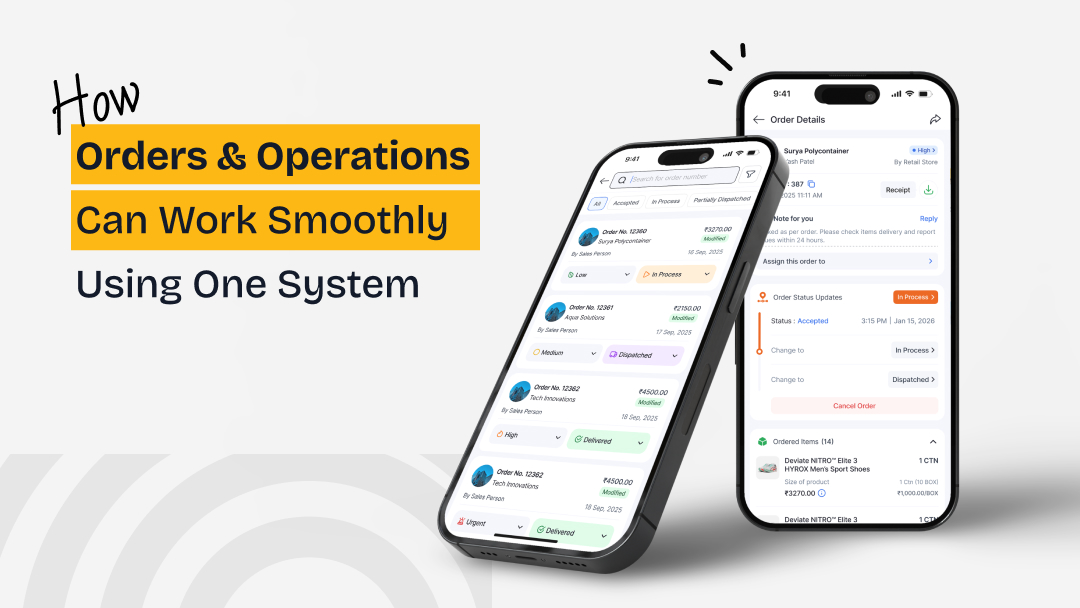
How B2B Order Management Software Connects Sales and Operations
To make this concrete, here is how the same order flow looks when it runs through a properly connected B2B order management system rather than across scattered channels and tools:
- Customer places an order through the system in a structured format.
- Sales sees it immediately.
- Operations sees it immediately.
- Pricing applies automatically.
- Status updates as the order moves.
- If anything changes, it’s logged.
The founder is no longer the switchboard through whom all information must pass.
How Biizline Fits in as a B2B Order Management System
Biizline is built specifically for this gap as a private B2B order management system.
Because Indian B2B trade runs on relationship-driven sales, negotiated pricing, and multi-channel communication, Biizline gives the existing workflow a proper structure so that orders are captured clearly, pricing is applied consistently, and everyone stays informed without constant back-and-forth.
If your business has grown to the point where manual coordination is visibly costing you time, margin, and customer trust, that’s exactly the stage Biizline is built for.
See how other MSME owners are using it →
The Bottom Line
Sales and operations fall out of sync because orders move through too many channels with no single source of truth.
The fix is not hiring more people to manage the growing chaos but giving the order itself a proper home in one system.
That shift—from orders scattered across channels to orders flowing through a single connected system—is what turns growth from something exhausting into something the business can actually manage and build on.