
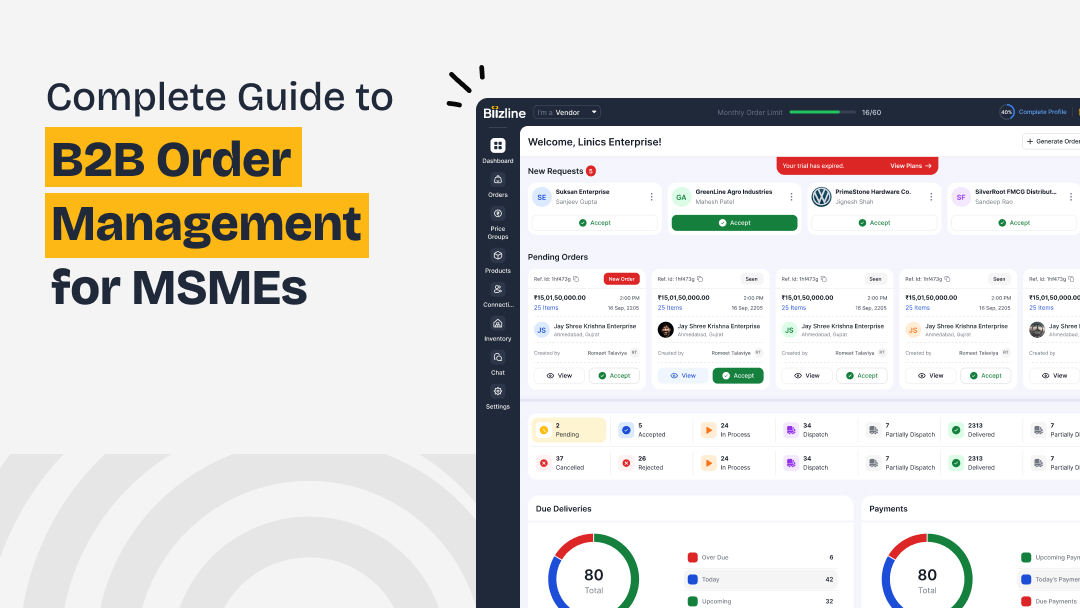
Complete Guide to B2B Order Management for MSMEs
There is a moment most MSME owners and suppliers recognize but rarely talk about. Often, your days start with explaining to a client where their order is held up or sharing new pricing details of a product with another client. You’ve hired 3-5 extra people for order management, and even their plates and hands are full.
It’s 12 PM, and you still haven’t done any real work. Just clarified, coordinated, and cross-checked. This is not what you signed up for. You wanted to build something. Instead, you spend half your day managing chaos that comes with growth.
Why Order Management Became a Problem
Nobody decides to manage orders badly. It happens gradually. When a company starts, it has maybe 3 to 5 customers. Orders come through calls; you write them on paper, confirm them on another call, deliver, and invoice. Simple.
Then the company grows. 10 customers become 20 and then 50. Suddenly, customers are in different cities. Some order in bulk to get discounted rates. Some paid an advance and expected better rates. Some were old clients with special pricing.
Orders started coming through WhatsApp because it was faster. Or email, because some customers are formal. Or, voice notes because people are busy. As a business owner/supplier, you adapt to keep growing.
But somewhere in that growth, the system stopped being simple. Orders were scattered across platforms, pricing became contextual, and delivery timelines depended on supplier schedules, transport availability, and customer urgency.
The informal approach that worked for 5 customers could not handle fifty. You start spending more time managing orders than managing the business. Growth and scaling the business gets sidelined. This is where most MSMEs are today. They grow faster than their systems can keep up. The cost shows up in missed orders, pricing disputes, endless follow-ups, and a constant feeling of being behind.
The solution is structure. Enough structure to make orders clear, prices consistent, and customers, informed. That is what B2B order management software should do: it should bring order to the chaos.
How are B2B Orders Managed These Days?
Walk into any MSME and ask how orders get managed. You will hear the same story.
Leads come from IndiaMART, TradeIndia, and referrals. This part works.
Then comes the order
Customer calls needing 500 units. You note it. They messaged on WhatsApp with a revised list. Now 450 units with two additional items. You update. They send a voice note clarifying quantities. You listen, update again. You consolidate everything, calculate pricing based on their history and current rates, and send a quote. They approve, and you confirm.
Order gets processed
Customer calls to check status. You check with your team and update them. Two days later, they call again. You check, update. Order is ready. You arrange dispatch, call with tracking details. They confirm receipt and follow up on delivery.
Finally, invoicing
You pull details together. What was ordered, what was delivered, and what price was agreed upon. You cross-reference messages, check notes, and create the invoice.
This is the dark side of the wholesale order management system in India.
It works, but takes a great deal of time and creates constant friction. At no point is there a single source of truth. Everything is scattered. As an owner, you are the system. When you are unavailable, things slow down. When you make a mistake, there is no record to fall back on. When you manage fifty or a hundred customers like this, cracks start to show.
What a B2B Order Management System Should Do
Most b2b order management software misses the problem because it is built for companies with structured processes, fixed pricing, and dedicated operations teams. Not how Indian MSMEs work. For India, you need something that understands relationship-driven sales, negotiated pricing, and multi-channel communication.
A proper wholesale order management system for MSMEs needs to solve specific problems.
1. Order clarity from the start
When the customer places an order, both supplier and client see the same thing. What was ordered, how much, at what price, and when expected. No complications, just organized order management that eliminates confusion.
2. Real-time inventory visibility
Before confirming the order, you need to know if you have stock. You cannot accept orders and then scramble to fulfill them. The system should show stock levels in real time, so you can commit accurately.
3. Instant rate updates
When a product’s price changes, every customer should be notified immediately. Not through a group message that they might miss but through a system where they log in to see the updated price. This leaves no room for ambiguity or outdated quotes.
4. Customer-specific pricing built in
You should be able to set different rates for different customers, offer bulk discounts, use advance payment pricing, and set long-term client rates. The system should be able to handle logic. You set rules once, so it applies automatically without anymanual calculation..
5. Supplier coordination
For multiple suppliers, track which products come from which suppliers and at what cost. Know the landed cost before quoting a price.
6. Transparent order status
The customer can checks status of the order without calling once it is placed. The system shows: Confirmed, Processing, Dispatched, Delivered, etc. At every stage, they can see where order is. Cuts follow-up calls by half, and saves a lot of time and arguments.
7. Complete accountability
The system should be fully transparent about who placed the order, when, and who confirmed the order. It should be able to indicate the price, allow modifications, and log approvals automatically. If a dispute arises, you can pull the complete record in seconds.
8. Full order history
See the complete order history for any customer. What they ordered last month. Average order size, prices, reorder details, etc., to enable you to make smarter decisions on credit, pricing, and inventory.
If a system does not address these pain points, it is not built for MSMEs. It will create more problems than it solves. That’s where Biizline, the B2B order management system comes in.
Why Biizline is better than Traditional Order Management and How it works?
Most MSMEs are stuck in the traditional model because they do not know there is a better way. Biizline was built specifically for Indian MSMEs. Not as a generic tool but as a system designed around how you actually work.
As we discussed before, the traditional method works well at a small scale but breaks as you grow. Biizline is built to help you move into that growth phase. Biizline helps when you have too many customers to manage manually, but are not ready for enterprise complexity. When you need structure without losing flexibility, that makes relationships work.
Why Biizline Is Built Differently
Most b2b order management software is designed for Western markets or large corporations. It assumes fixed pricing, formal processes, and dedicated teams. This is not the reality for Indian MSMEs.
Indian B2B operates differently. Relationships matter more than transactions. Pricing is negotiated, not fixed. Communication is multi-channel and informal. Orders come through calls and WhatsApp. Customers expect flexibility, not rigid processes.
Biizline was built specifically for this reality. Works for traders sourcing from multiple suppliers. Distributors dealing with hundreds of SKUs and dozens of price points. Manufacturers are coordinating raw material availability with order commitments.
Variable pricing is not an afterthought. Built in. Set customer-specific rates, bulk pricing tiers, advance payment discounts, and seasonal offers. The system remembers all of it. When an order comes in, pricing applies automatically. No manual calculation or mistakes.
For multiple suppliers, Biizline tracks which products come from where and at what cost. You know margins before quoting. You know delivery timelines before committing, so you don’t have to guess.
The system is private. Not a marketplace where competitors see your pricing or customers. It works as a shared workspace between you and your customers. They place orders, you process them, and you update their status. Everything is transparent between you two, private from everyone else.
It also maintains and respects how the business relationships work. You still talk to customers. Still negotiate. Still build trust. Biizline does not replace that; it just makes sure that when an order is placed, it is recorded properly. When pricing is agreed, it is locked in. When status changes, everyone knows.
See how other MSME owners use it
The focus is not on digitization for optics, but on clarity and simplicity. When orders are clear, fewer mistakes happen. Transparent pricing builds trust. Visible status = fewer follow-ups. Business runs more smoothly and you can get more time and get more work done.
Order Management is about structure, not software
Software is just a tool. What matters is structure.
Biizline does this for Indian MSMEs. A b2b online ordering system built around how you actually operate. Relationship-driven sales. Negotiated pricing. Multi-channel communication. Variable costs. Does not try to change how you work. Just brings order to it.
Because the goal is not managing more chaos. The goal is to stop the firefighting so you can build the business you set out to build. Fewer mistakes. Better trust. Faster decisions. More time to focus on what matters. Maybe you get to stop spending mornings on the phone explaining where orders are.